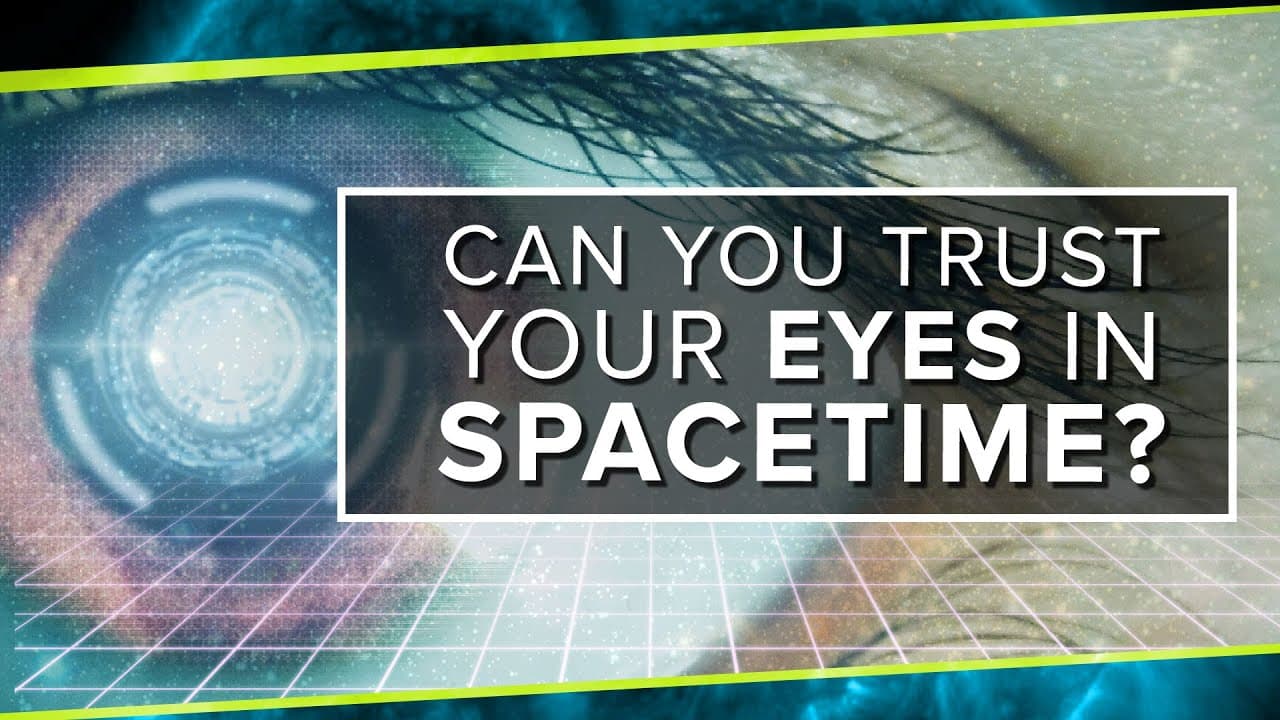
Can You Trust Your Eyes in Spacetime?
TL;DR
Explores flat spacetime geometry and its implications for relativity.
Transcript
We've talked before about flat spacetime here. But before we can graduate to the curves version and general relativity, we need a stronger foundation in spacetime geometry. So today, on "Space Time," it's spacetime. To begin, here's a heads up. Today's episode will reference information from three of our earlier episodes. To avoid getting lost, you... Read More
Key Insights
- Flat spacetime is crucial to understanding curved spacetime and general relativity, requiring a solid grasp of spacetime geometry.
- Spacetime diagrams are essential tools for visualizing physical events, using a unique method of representing time and space.
- World lines represent the entire history of an object, showing its path through spacetime, and can vary based on the observer's frame.
- Parallel lines remain parallel in spacetime diagrams, maintaining their visual parallelism across different frames of reference.
- Inertial observers have geodesic world lines, while non-inertial observers do not, allowing for geometric distinction in spacetime.
- 4-velocity vectors represent an object's movement through spacetime, maintaining a constant length equal to the negative square of light speed.
- Spacetime intervals, not Euclidean distances, are preserved in spacetime diagrams, challenging visual intuition.
- Understanding flat spacetime geometry sets the stage for exploring curved spacetime in future discussions.
Install to Summarize YouTube Videos and Get Transcripts
Explore YouTube Video Summarizer or Get YouTube Transcript Extractor
Questions & Answers
Q: What is the purpose of using spacetime diagrams?
Spacetime diagrams are used to visualize physical events in a gravity-free world, representing them in a two-dimensional space with time and space axes. They help in understanding complex concepts like world lines, parallel transport, and the geometry of flat spacetime, which are crucial for grasping the basics of relativity.
Q: How do world lines function in spacetime diagrams?
World lines in spacetime diagrams represent the entire history of an object through spacetime. They show the path an object takes and vary depending on the observer's frame of reference. Inertial observers have straight, geodesic world lines, while non-inertial observers have non-geodesic paths, reflecting their dynamic behavior.
Q: What distinguishes inertial and non-inertial observers in spacetime?
In spacetime, inertial observers have geodesic world lines, indicating they are not subject to external forces and maintain a constant velocity. In contrast, non-inertial observers have non-geodesic world lines, reflecting changes in velocity or direction due to external forces. This geometric distinction is crucial for understanding motion in spacetime.
Q: Why are spacetime intervals important in spacetime diagrams?
Spacetime intervals are preserved in spacetime diagrams, unlike Euclidean distances, which can change based on the observer's frame of reference. This preservation is essential for maintaining the consistency of physical laws across different frames, challenging our visual intuitions and providing a more accurate representation of spacetime geometry.
Q: How do 4-velocity vectors relate to motion in spacetime?
4-velocity vectors represent an object's movement through spacetime, combining both spatial and temporal components. They maintain a constant length equal to the negative square of the speed of light, providing a frame-invariant measure of an object's state of motion. This concept is fundamental for understanding relativistic motion and dynamics.
Q: What role do parallel lines play in spacetime diagrams?
Parallel lines in spacetime diagrams remain visually parallel across different frames of reference, maintaining their relative orientation. This consistency helps in understanding the geometric properties of spacetime, as parallelism is preserved even though visual lengths and angles may change, providing insights into the structure of flat spacetime.
Q: How does the episode prepare viewers for understanding curved spacetime?
By exploring flat spacetime geometry, the episode lays the groundwork for understanding more complex concepts in curved spacetime and general relativity. It introduces key ideas like world lines, parallel transport, and 4-velocity vectors, which are essential for grasping the geometric nature of spacetime and the effects of gravity on it.
Q: What challenges do spacetime diagrams present to visual intuition?
Spacetime diagrams challenge visual intuition by preserving spacetime intervals rather than Euclidean distances, which can mislead our perception of lengths and angles. This discrepancy requires viewers to adjust their understanding of geometry, emphasizing the importance of spacetime intervals in accurately representing physical events and relationships.
Summary & Key Takeaways
-
The episode delves into flat spacetime geometry, a foundational concept for understanding general relativity. It explains how spacetime diagrams are used to represent physical events, emphasizing the importance of grasping these concepts before tackling curved spacetime.
-
World lines in spacetime diagrams illustrate the history of objects, with inertial observers having geodesic paths. The episode highlights how parallel lines remain consistent across frames of reference, a key insight for understanding spacetime geometry.
-
Spacetime intervals, rather than Euclidean distances, are preserved in spacetime diagrams, challenging our visual intuitions. The episode introduces 4-velocity vectors, which represent an object's movement through spacetime, maintaining a constant length related to the speed of light.
Read in Other Languages (beta)
Share This Summary 📚
Summarize YouTube Videos and Get Video Transcripts with 1-Click
Try YouTube Summary with ChatGPT & Claude or YouTube Transcript Generator
Explore More Summaries from PBS Space Time 📚
Summarize YouTube Videos and Get Video Transcripts with 1-Click
Try YouTube Summary with ChatGPT & Claude or YouTube Transcript Generator