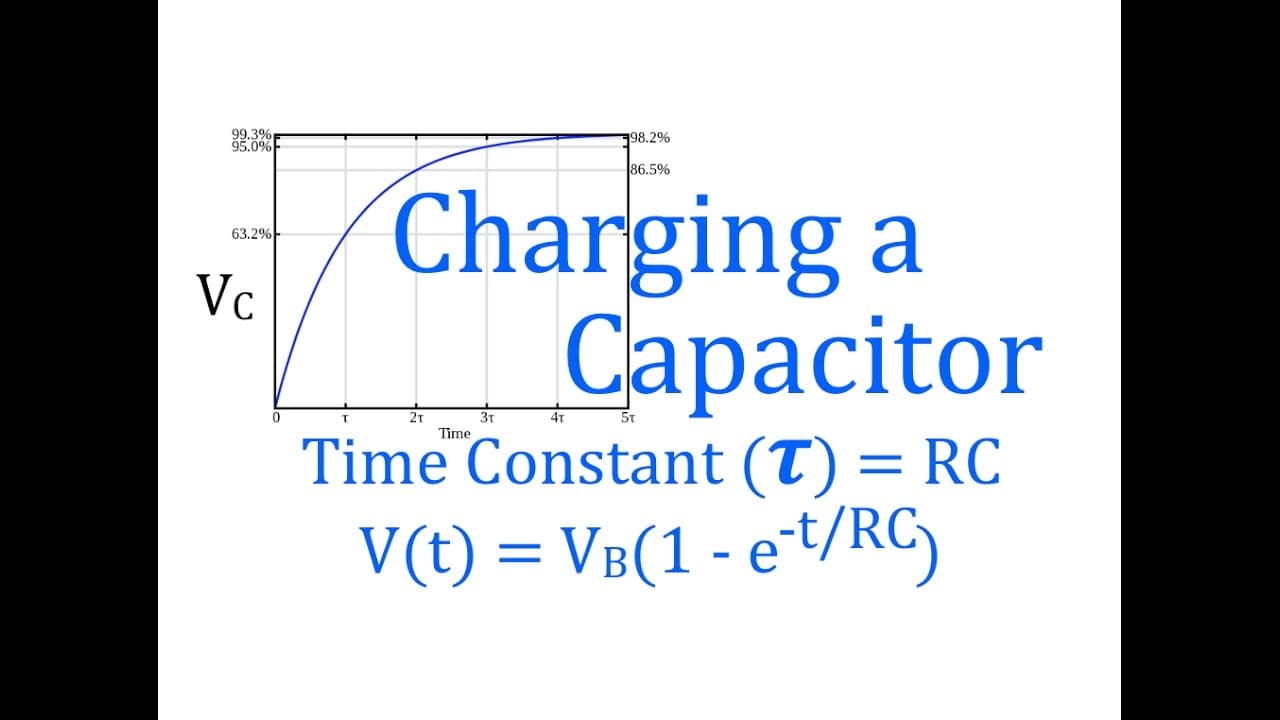
RC Circuits (4 of 8) Charging a Capacitor, Time Constant, Voltage, Current, An Explanation
TL;DR
Learn how voltage and current in RC circuits change with time using time constants and exponential equations.
Transcript
okay in today's video as you can see I'm going to go over an explanation for charging a capacitor in a simple RC circuit and what I want to do this video is go over three things how we calculate the voltage across the capacitor with respect to time how we calculate the current through the circuit with respect to time also to give you a good concept... Read More
Key Insights
- ⌛ Time constant (τ) equals R times C in an RC circuit.
- ⚡ Voltage across a capacitor follows an exponential curve during charging.
- 🈂️ Current through the circuit decreases exponentially as the capacitor charges.
- 😑 Voltage and current are expressed as percentages of their maximum values in time constants.
- ⌛ Different resistor and capacitor combinations result in varying time constants.
- ⌛ Capacitor charging reaches 63.2%, 86.5%, 95%, and 99.3% of max values after 1, 2, 3, and 5 time constants.
- ⌛ Understanding time constants helps predict capacitor charging behavior.
Install to Summarize YouTube Videos and Get Transcripts
Explore YouTube Video Summarizer or Get YouTube Transcript Extractor
Questions & Answers
Q: How is the voltage across a capacitor calculated over time in an RC circuit?
The voltage across a capacitor is calculated using the equation V(t) = Vb * (1 - e^(-t/RC)), where Vb is the battery voltage, V(t) is the voltage at time t, R is resistance, C is capacitance, and e is a mathematical constant.
Q: What does the time constant (τ) signify in an RC circuit?
The time constant, τ = R * C, indicates how quickly a capacitor charges in an RC circuit. It determines the time it takes for the capacitor voltage to reach approximately 63.2% of the battery voltage and governs the rate of change of both voltage and current.
Q: How does the current through an RC circuit change over time during capacitor charging?
The current through the circuit decreases exponentially over time during capacitor charging, following the equation I(t) = I0 * e^(-t/RC). Initially, the current is at its maximum value and gradually decreases towards zero as the capacitor charges.
Q: What happens to the voltage and current in an RC circuit after five time constants?
After five time constants, the capacitor is considered fully charged, with the voltage across it being 99.3% and the current through the circuit being 0.7% of their maximum values, respectively.
Summary & Key Takeaways
-
Explanation of charging a capacitor in an RC circuit.
-
Calculation of voltage and current over time.
-
Understanding of time constants and exponential growth in capacitor charging.
Read in Other Languages (beta)
Share This Summary 📚
Summarize YouTube Videos and Get Video Transcripts with 1-Click
Try YouTube Summary with ChatGPT & Claude or YouTube Transcript Generator
Explore More Summaries from Step by Step Science 📚


Summarize YouTube Videos and Get Video Transcripts with 1-Click
Try YouTube Summary with ChatGPT & Claude or YouTube Transcript Generator