How to Solve Two-Dimensional Motion Problems in Physics
TL;DR
To solve two-dimensional motion problems, start by determining the time of flight using vertical motion equations. Then, calculate the horizontal range by multiplying the horizontal velocity by the time. Finally, use the Pythagorean theorem to find the final speed and the arctan function for the final velocity direction.
Transcript
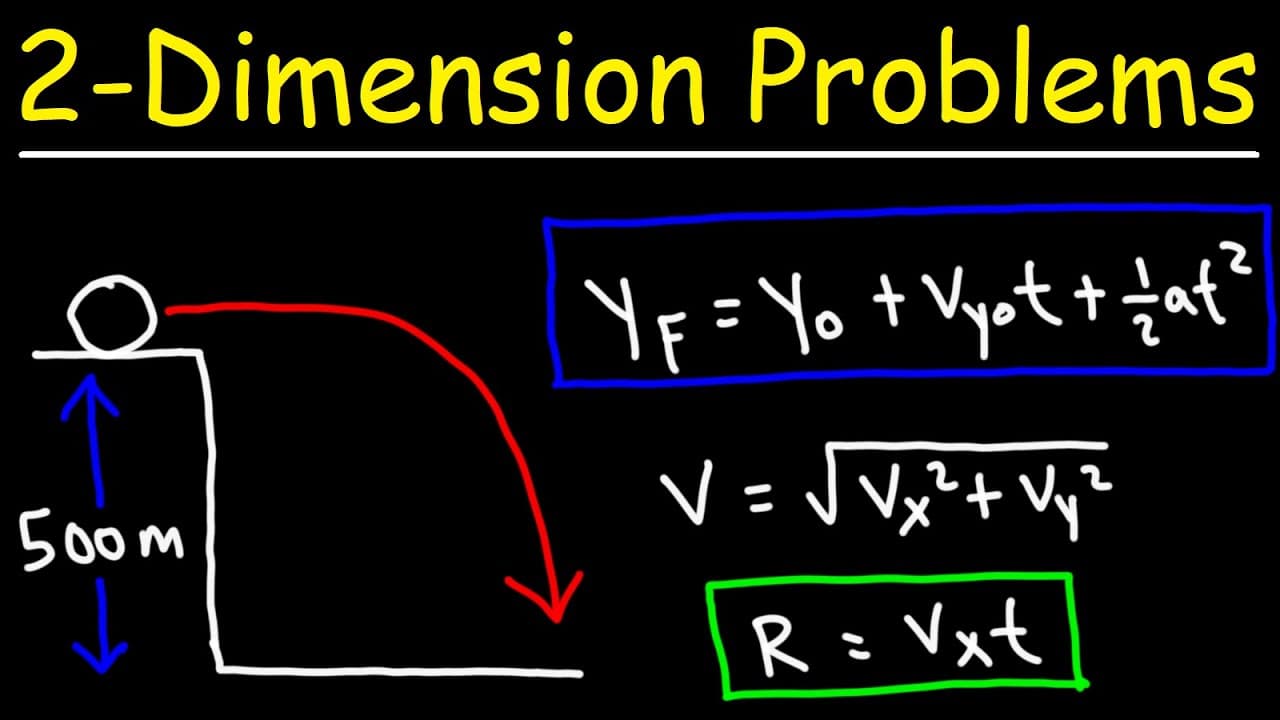
in this video we're going to work on a two-dimensional motion problem with multiple parts so let's go ahead and begin A ball rolls horizontally off a 500 meter Cliff at a speed of 5 meters per second well let's begin with a picture so let's say this is the cliff and here is the ball and it's going to roll off the cliff and then it's going to hit th... Read More
Key Insights
- 🚥 Two-dimensional motion problems involve both horizontal and vertical components.
- 🅰️ Kinematic equations can be utilized to solve these types of problems.
- 🚦 The time of flight can be calculated using the equation for vertical motion.
- 🚥 The range or horizontal displacement is determined by multiplying the horizontal velocity by the time of flight.
- 🐎 The final speed is the magnitude of the final velocity and can be found using the Pythagorean theorem.
- ❓ The final velocity includes both magnitude and direction, which can be calculated using the arctan function.
- 🥶 Understanding the concepts of projectile motion and free fall physics is essential for solving these types of problems.
Install to Summarize YouTube Videos and Get Transcripts
Explore YouTube Video Summarizer or Get YouTube Transcript Extractor
Questions & Answers
Q: How is the time it takes for the ball to hit the ground calculated?
The time is found by using the equation y_final = y_initial + v_y_initial * t + 1/2 * a * t^2, where y_final is 0 (ground level), y_initial is 500 meters (height of the cliff), v_y_initial is 0 (no vertical velocity initially), and a is -9.8 m/s^2 (acceleration due to gravity). Solving for t gives a time of 10.1 seconds.
Q: How is the range of the projectile calculated?
The range is equal to the horizontal velocity (v_x) multiplied by the time of flight (t). In this case, the range is 5 m/s * 10.1 s = 50.5 meters.
Q: What is the final speed of the ball just before it hits the ground?
The final speed is determined by finding the magnitude of the final velocity, which is calculated using the Pythagorean theorem. The horizontal velocity (v_x) is 5 m/s, and the vertical velocity (v_y) is -98.98 m/s. With these values, the final speed is found to be 99.1 m/s.
Q: How is the final velocity of the ball just before it hits the ground determined?
The final velocity is the combination of the final speed and the direction or angle. To find the angle, the arctan function is used with the absolute values of v_y and v_x. The reference angle is then subtracted from 360 degrees to get the angle counterclockwise from the positive x-axis. In this case, the final velocity is 99.1 m/s at an angle of 272.9 degrees.
Summary & Key Takeaways
-
A ball is rolled horizontally off a 500-meter cliff at a speed of 5 m/s.
-
The time it takes for the ball to hit the ground is calculated using kinematic equations.
-
The range of the projectile, or the horizontal displacement, is found by multiplying the horizontal velocity by the time of flight.
-
The final speed and final velocity of the ball just before hitting the ground are determined using the Pythagorean theorem and the arctan function.
Read in Other Languages (beta)
Share This Summary 📚
Summarize YouTube Videos and Get Video Transcripts with 1-Click
Try YouTube Summary with ChatGPT & Claude or YouTube Transcript Generator
Explore More Summaries from The Organic Chemistry Tutor 📚


Summarize YouTube Videos and Get Video Transcripts with 1-Click
Try YouTube Summary with ChatGPT & Claude or YouTube Transcript Generator