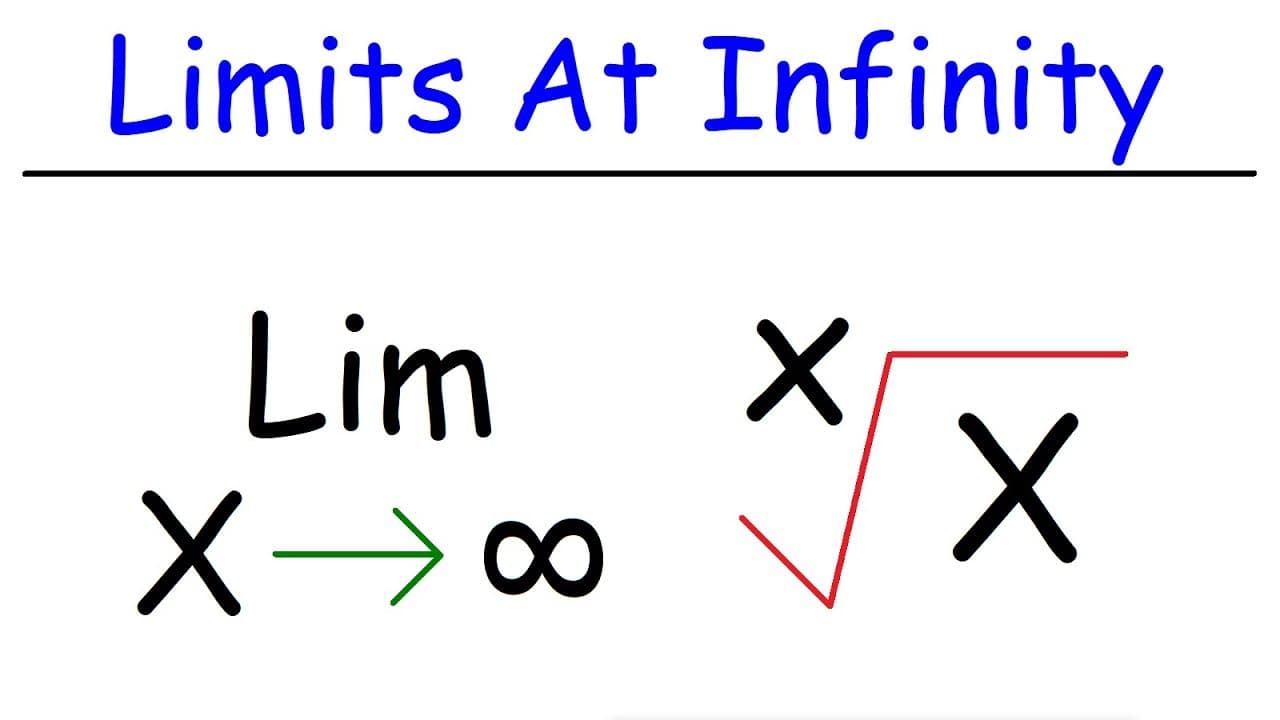
What Is the Limit of the X Root of X as X Approaches Infinity?
TL;DR
The limit of the x root of x as x approaches infinity is one. This is determined by transforming the expression using logarithms and applying L'Hopital's rule when faced with indeterminate forms. Ultimately, as x increases, the expression converges to one.
Transcript
consider this problem what is the limit as x goes to infinity of the x root of x feel free to try this problem so what would you recommend is our first step here what's the first thing we need to do in order to solve this problem what i recommend doing is setting the original expression equal to y so we have y is equal to the limit as x goes to inf... Read More
Key Insights
- 🌆 Setting the original expression as y and using logarithms simplifies the analysis of the limit problem.
- 📁 L'Hopital's rule is used when direct substitution does not yield a determinate result for the limit.
- 😑 Conversion of logarithmic expressions to exponential form is a useful technique in problem-solving.
Install to Summarize YouTube Videos and Get Transcripts
Explore YouTube Video Summarizer or Get YouTube Transcript Extractor
Questions & Answers
Q: How does changing the radical into a fractional exponent help in solving the problem?
Changing the radical into a fractional exponent allows us to rewrite the expression as x raised to the 1 over x. This makes it easier to apply logarithms and simplifies the analysis of the limit.
Q: Why do we use logarithms in this problem?
Logarithms help bring the exponent down so that we can use L'Hopital's rule. By taking the natural log of both sides, we can simplify the expression and apply the rule to evaluate the limit.
Q: What is L'Hopital's rule, and why is it used?
L'Hopital's rule states that for an indeterminate form, such as infinity over infinity or zero over zero, the limit can be evaluated by taking the derivative of the numerator and denominator separately. It is used here because direct substitution of infinity over infinity did not yield a determinate result.
Q: How do we convert a logarithmic expression into an exponential expression?
In general, if log base a of b is equal to c, then a raised to the power of c is equal to b. In this case, since the base of a natural log is always e, we can say that e to the 0 power is equal to y, which simplifies to y = 1.
Summary & Key Takeaways
-
The video discusses solving the limit of the x root of x as x approaches infinity.
-
The first step is to set the original expression equal to y and change the radical into a fractional exponent.
-
Using logarithms and L'Hopital's rule, the limit is evaluated as zero, confirming that the answer is one.
Read in Other Languages (beta)
Share This Summary 📚
Summarize YouTube Videos and Get Video Transcripts with 1-Click
Try YouTube Summary with ChatGPT & Claude or YouTube Transcript Generator
Explore More Summaries from The Organic Chemistry Tutor 📚





Summarize YouTube Videos and Get Video Transcripts with 1-Click
Try YouTube Summary with ChatGPT & Claude or YouTube Transcript Generator