What Number Comes Next? - Numberphile
TL;DR
Exploring quirky number sequences and patterns, from mathematical topology to Roman numerals, including eban numbers and emirps.
Transcript
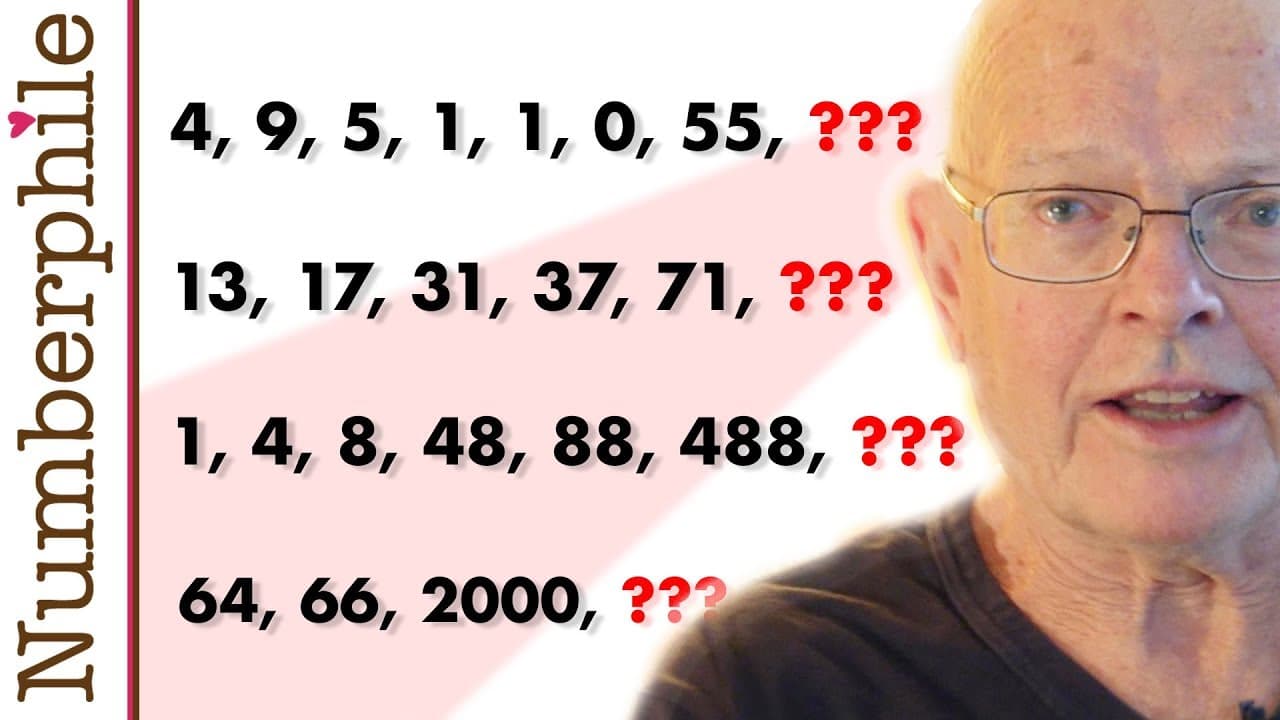
What's the next term in the following sequence? It goes 1, 4, 8, 48, 88, 488 - what's the next term? Which actually is very easy, and why? That's not so obvious. Well, it's a little strange. 4, 8, 48, 88, 488, and obviously the next one is going to be 888, and then 4888. The right way to look at this is to stare at these numbers. Look at this numbe... Read More
Key Insights
- #️⃣ Number sequences can be defined by unique criteria like the number of holes in each digit, leading to creative patterns.
- 💨 Different ways of drawing or representing numbers can alter the sequences, showcasing the impact of visual cues in mathematics.
- ⚾ Base 10-specific sequences can change drastically based on how numbers are written, proving the significance of notation.
- 🧩 Roman numeral interpretations can offer unexpected results when analyzed in a particular manner, adding depth to numerical puzzles.
- 🥹 Multiples of numbers or straightforward mathematical progressions can still hold intrigue and deception when approached from new perspectives.
- #️⃣ Exploring patterns like eban numbers and emirps reveals the playful and enigmatic nature of number theory.
- #️⃣ Sequences like multiples of 6 or hidden patterns in Roman numerals can challenge traditional perceptions of number sequences.
Install to Summarize YouTube Videos and Get Transcripts
Explore YouTube Video Summarizer or Get YouTube Transcript Extractor
Questions & Answers
Q: How do the hole counts in numbers define the sequence discussed in the video?
The smallest number with n holes is the basis of the sequence, showcasing a unique way to generate the next terms by counting the holes in each digit.
Q: How does the way numbers are drawn affect the sequences shown in the video?
Drawing numbers differently or in non-standard ways can lead to alternate sequences, revealing the influence of topology on number patterns.
Q: What are eban numbers, and what sets them apart from regular even numbers?
Eban numbers are even numbers without the letter "E", making them a unique subset of even numbers with a distinct criterion for inclusion.
Q: Explain the concept behind emirps and why they are named as such.
Emirps are prime numbers that remain prime when read backward, introducing a fascinating concept of primes with a twist in their reversed form.
Summary & Key Takeaways
-
The video delves into quirky number sequences, exploring the secrets behind patterns like smallest numbers with specific hole counts.
-
It discusses how the way numbers are drawn can alter the sequence, revealing base 10-specific sequences based on unique definitions.
-
The content covers various sequences like multiples of 6, Roman numeral patterns, eban numbers, and emirps with intriguing twists.
Read in Other Languages (beta)
Share This Summary 📚
Summarize YouTube Videos and Get Video Transcripts with 1-Click
Try YouTube Summary with ChatGPT & Claude or YouTube Transcript Generator
Explore More Summaries from Numberphile 📚




Summarize YouTube Videos and Get Video Transcripts with 1-Click
Try YouTube Summary with ChatGPT & Claude or YouTube Transcript Generator