Lecture 19
TL;DR
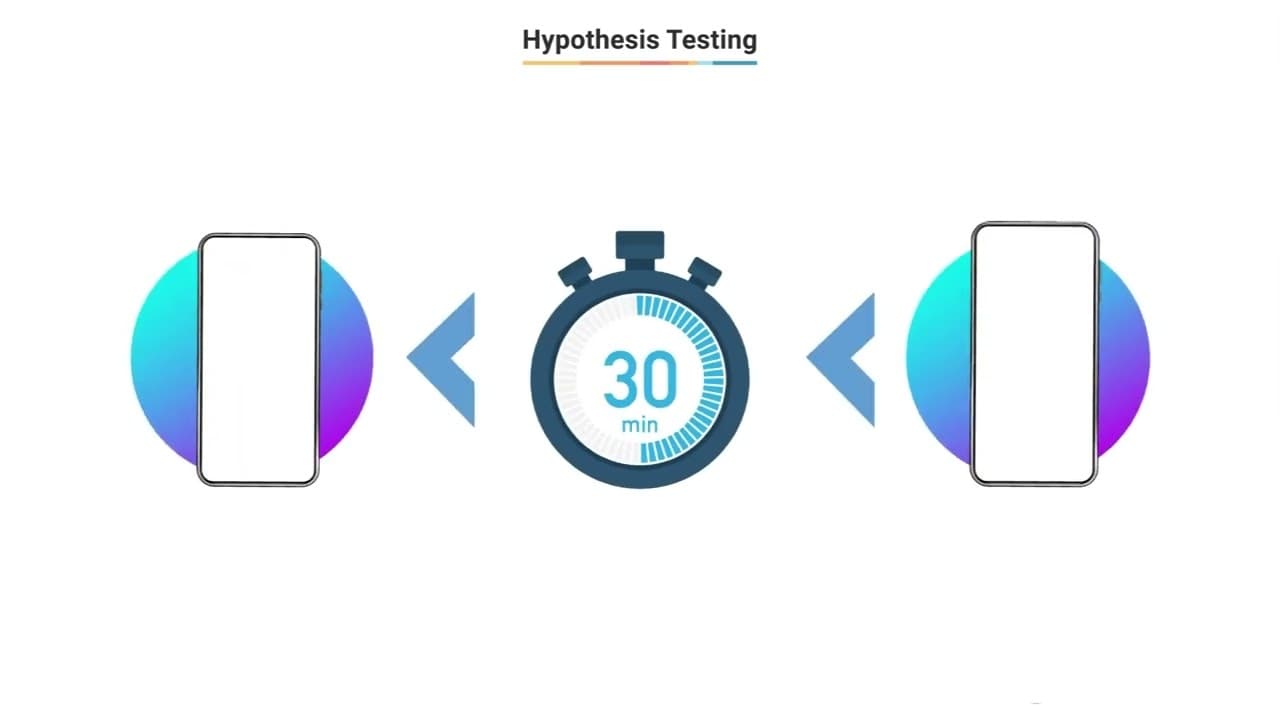
Explains hypothesis testing using a phone charging example.
Transcript
thank you in this video we'll learn about hypothesis testing consider a hypothetical scenario where you have joined the mobile phone manufacturer brand a as a business analyst now the company has come up with a new model called Max and the popular sentiment among the company's Engineers is that it requires 30 minutes of charging to ... Read More
Key Insights
- Hypothesis testing is used to determine the statistical validity of claims, such as a phone charging in 30 minutes.
- The null hypothesis represents the status quo, while the alternative hypothesis opposes it, challenging the initial assumption.
- Confidence intervals help determine if sample data supports or rejects the null hypothesis, influencing business decisions.
- A two-tailed test checks for deviations on both sides of a distribution, while one-tailed tests focus on one side.
- Critical Value and p-value methods both assess hypothesis tests, with p-value being more intuitive and widely used.
- Hypothesis testing allows businesses to make data-driven decisions, like evaluating campaign effectiveness or product claims.
- The null hypothesis always includes an equality sign, ensuring mutually exclusive and exhaustive events with the alternative.
- Rejection of the null hypothesis doesn't confirm the alternative; it simply shows insufficient evidence to support the null.
Install to Summarize YouTube Videos and Get Transcripts
Explore YouTube Video Summarizer or Get YouTube Transcript Extractor
Questions & Answers
Q: What is the purpose of hypothesis testing?
Hypothesis testing is used to determine the statistical credibility of claims or assumptions. It allows businesses to make data-driven decisions by verifying claims with statistical rigor. By testing hypotheses, organizations can avoid relying solely on beliefs or assumptions, ensuring that decisions are backed by evidence.
Q: How are null and alternative hypotheses defined?
The null hypothesis represents the default assumption or status quo, typically including an equality sign. It is the hypothesis that researchers aim to test against. The alternative hypothesis opposes the null, challenging the initial assumption. It is mutually exclusive and collectively exhaustive, ensuring that one must be true.
Q: What is the difference between a two-tailed and a one-tailed test?
A two-tailed test assesses deviations on both sides of a distribution, checking if the sample mean significantly differs from the hypothesized mean in either direction. A one-tailed test focuses on one side, either left or right, to determine if the sample mean is significantly greater or lesser than the hypothesized mean.
Q: How is the p-value method used in hypothesis testing?
The p-value method simplifies hypothesis testing by calculating the probability of observing the sample data if the null hypothesis is true. A lower p-value indicates a higher chance of the null hypothesis being false. If the p-value is less than the significance level, the null hypothesis is rejected, supporting the alternative hypothesis.
Q: Why is the null hypothesis always written with an equality sign?
The null hypothesis includes an equality sign to ensure that it is mutually exclusive and collectively exhaustive with the alternative hypothesis. This means that at least one of these hypotheses must be true at any given time, covering the entire sample space and ensuring that they are perfect opposites of each other.
Q: What role does confidence level play in hypothesis testing?
The confidence level indicates the degree of certainty in the results of a hypothesis test. A higher confidence level means a narrower confidence interval, providing more precise estimates. It influences the critical values used to determine the rejection region, affecting whether the null hypothesis is accepted or rejected.
Q: How does hypothesis testing help in business decision-making?
Hypothesis testing aids businesses in making data-driven decisions by verifying claims such as product features or campaign effectiveness. By testing assumptions with statistical rigor, organizations can avoid relying on hunches, ensuring that decisions are backed by evidence, reducing risks, and improving overall decision quality.
Q: What are the steps involved in the critical value method?
The critical value method involves five steps: framing the null and alternative hypotheses, deciding the confidence level, determining the critical Z score, computing the sample Z score, and reaching a decision. The sample Z score is compared to the critical value to decide whether to reject the null hypothesis.
Summary & Key Takeaways
-
Hypothesis testing is a statistical method to verify claims, such as the charging time of a phone model. It involves formulating null and alternative hypotheses, collecting sample data, and using statistical measures to accept or reject the null hypothesis. Businesses use this approach to make informed decisions.
-
The null hypothesis is the default assumption, while the alternative hypothesis challenges it. Hypothesis testing uses confidence intervals and Z scores to determine if sample data supports or rejects the null hypothesis. The p-value method simplifies this process, providing an intuitive probability measure for hypothesis testing.
-
Hypothesis testing aids in evaluating business claims, such as campaign effectiveness or product features. By testing assumptions with statistical rigor, businesses can avoid relying on hunches and make data-driven decisions. The process ensures that claims are tested thoroughly before being accepted or rejected.
Read in Other Languages (beta)
Share This Summary 📚
Summarize YouTube Videos and Get Video Transcripts with 1-Click
Try YouTube Summary with ChatGPT & Claude or YouTube Transcript Generator
Explore More Summaries from IIT KANPUR-NPTEL 📚




Summarize YouTube Videos and Get Video Transcripts with 1-Click
Try YouTube Summary with ChatGPT & Claude or YouTube Transcript Generator