Products
Features
YouTube Video Summarizer
Summarize YouTube videos
Web & PDF Highlighter
Highlight web pages & PDFs
Chat with PDF
Ask any PDF questions with AI
Ask AI Clone
Chat with your highlights & memories
Audio Transcriber
Transcribe audio files to text
Glasp Reader
Read and highlight articles
Kindle Highlight Export
Export your Kindle highlights
Idea Hatch
Hatch ideas from your highlights
Integrations
Obsidian Plugin
Notion Integration
Pocket Integration
Instapaper Integration
Medium Integration
Readwise Integration
Snipd Integration
Hypothesis Integration
Apps & Extensions
Chrome Extension
Safari Extension
Edge Add-ons
Firefox Add-ons
iOS App
Android App
Discover
Discover
Ideas
Discover new ideas and insights
Articles
Curated articles and insights
Books
Book recommendations by great minds
Posts
Essays and notes from readers
Quotes
Inspiring quotes collection
Videos
Curated videos and summaries
Explore Glasp
Glasp Newsletter
Weekly insights and updates
Glasp Talk
Interview series with great minds
Glasp Blog
Latest news and articles
Glasp Use Cases
Learn how others use Glasp
Build & Support
Glasp API
Access Glasp's API for developers
MCP Connector
Connect Glasp to Claude & ChatGPT
Community
Glasp Reddit Community
Students
Student discount and benefits
FAQs
Frequently Asked Questions
AboutPricing
DashboardLog inSign up

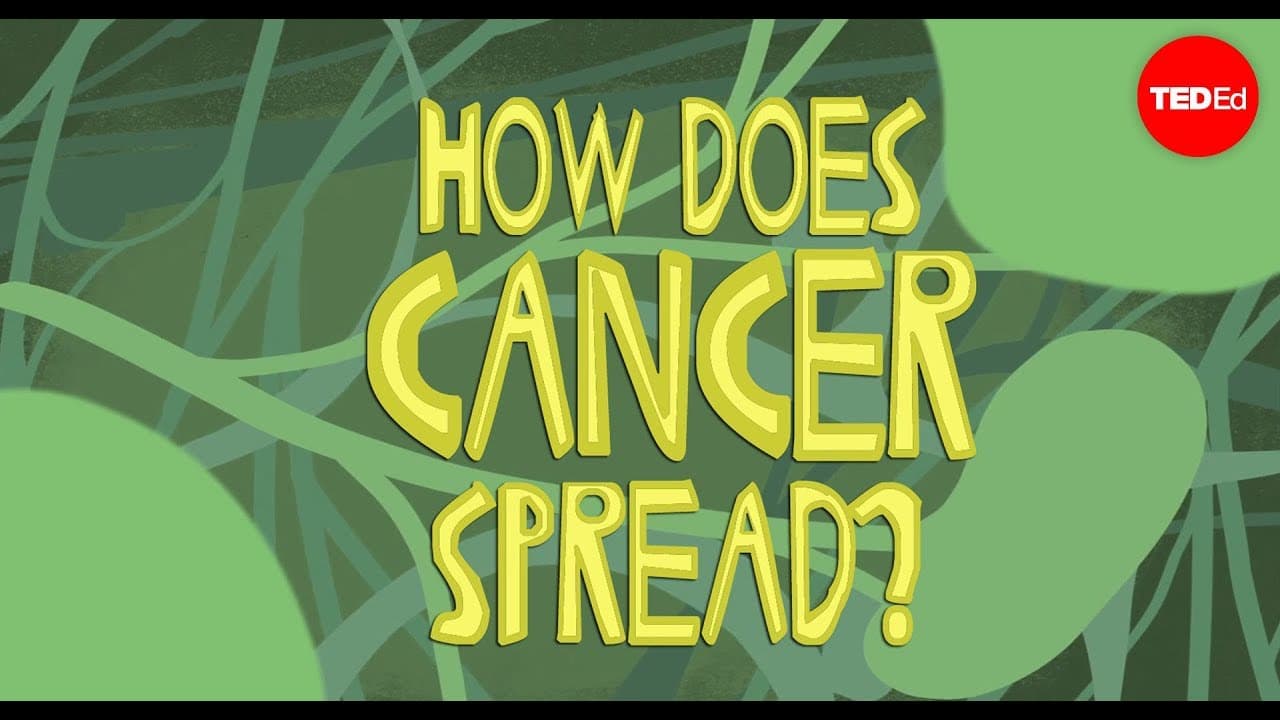
How does cancer spread through the body? - Ivan Seah Yu Jun
2.0M views
•
November 20, 2014
by
TED-Ed
YouTube video player
How does cancer spread through the body? - Ivan Seah Yu Jun

TL;DR

Cancer spreads through metastasis using three common routes: transcoelomic, lymphatic, and hematogenous spread.

Transcript

The onset of cancer usually begins as a solitary tumor in a specific area of the body. If the tumor is not removed, cancer has the ability to spread to nearby organs, as well as places far away from the origin, such as the brain. So how does cancer move to new areas, and why are some organs more likely to get infected than others? The process of c... Read More

Key Insights

  • 🥳 Metastasis involves cancer cells moving from primary tumors to other parts of the body via transcoelomic, lymphatic, or hematogenous spread.
  • 🧑‍🏭 Different cancers have preferred sites of metastasis due to vascular and microenvironmental factors.
  • 🌱 The seed and soil theory and vascular/lymphatic channels influence where cancer spreads in the body.
  • ♋ Understanding metastasis mechanisms is crucial for developing effective treatments against advanced cancers.

Install to Summarize YouTube Videos and Get Transcripts

Explore YouTube Video Summarizer or Get YouTube Transcript Extractor

Questions & Answers

Q: What is metastasis in cancer?

Metastasis in cancer refers to the process where cancer cells from a primary tumor spread to other parts of the body, forming secondary tumors. It is a complex process involving invasion, movement, and proliferation of cancerous cells.

Q: How do cancer cells spread through transcoelomic spread?

Transcoelomic spread occurs when cancer cells penetrate the lining of cavities in the body, such as the peritoneum, allowing them to move and grow in nearby tissues like the liver.

Q: Why do certain cancers have specific sites of metastasis?

Different cancers tend to metastasize to specific organs due to factors like blood flow patterns and microenvironments within those organs that are conducive to cancer cell growth.

Q: How do theories like the seed and soil theory explain metastasis?

The seed and soil theory proposes that cancer cells thrive in specific environments, only growing in areas with similar characteristics, while the vascular/lymphatic theory suggests that metastatic sites are determined by blood and lymph flow.

Summary & Key Takeaways

  • Cancer metastasis starts with cancer cells invading nearby tissues, spreading through the body via transcoelomic, lymphatic, or blood vessels.

  • Specific cancers have preferred sites of metastasis, like prostate cancer to bone or colon cancer to liver.

  • Theories like the seed and soil theory and vascular/lymphatic channels influence metastasis locations.


Read in Other Languages (beta)

English

Share This Summary 📚

Summarize YouTube Videos and Get Video Transcripts with 1-Click

Download browser extensions on:

Try YouTube Summary with ChatGPT & Claude or YouTube Transcript Generator

Explore More Summaries from TED-Ed 📚
Can you solve the bridge riddle? - Alex Gendler thumbnail
Can you solve the bridge riddle? - Alex Gendler
TED-Ed
The tale of the doctor who defied Death - Iseult Gillespie thumbnail
The tale of the doctor who defied Death - Iseult Gillespie
TED-Ed
What would happen if you didn’t drink water? - Mia Nacamulli thumbnail
What would happen if you didn’t drink water? - Mia Nacamulli
TED-Ed
Why do cats act so weird? - Tony Buffington thumbnail
Why do cats act so weird? - Tony Buffington
TED-Ed
Which is stronger: Glue or tape? - Elizabeth Cox thumbnail
Which is stronger: Glue or tape? - Elizabeth Cox
TED-Ed
Debunking the myths of OCD - Natascha M. Santos thumbnail
Debunking the myths of OCD - Natascha M. Santos
TED-Ed

Summarize YouTube Videos and Get Video Transcripts with 1-Click

Download browser extensions on:

Try YouTube Summary with ChatGPT & Claude or YouTube Transcript Generator

Apps & Extensions

  • Chrome Extension
  • Safari Extension
  • Edge Add-ons
  • Firefox Add-ons
  • iOS App
  • Android App

Key Features

  • YouTube Video Summarizer
  • Web & PDF Summarizer
  • Web & PDF Highlighter
  • Chat with PDF
  • Ask AI Clone
  • Audio Transcriber
  • Glasp Reader
  • Kindle Highlight Export
  • Idea Hatch

Integrations

  • Obsidian Plugin
  • Notion Integration
  • Pocket Integration
  • Instapaper Integration
  • Medium Integration
  • Readwise Integration
  • Snipd Integration
  • Hypothesis Integration

More Features

  • APIs
  • MCP Connector
  • Blog & Post
  • Embed Links
  • Image Highlight
  • Personality Test
  • Quote Shots

Company

  • About us
  • Blog
  • Community
  • FAQs
  • Job Board
  • Newsletter
  • Pricing
Terms

•

Privacy

•

Guidelines

© 2026 Glasp Inc. All rights reserved.