How Does Gravity Affect Light?
TL;DR
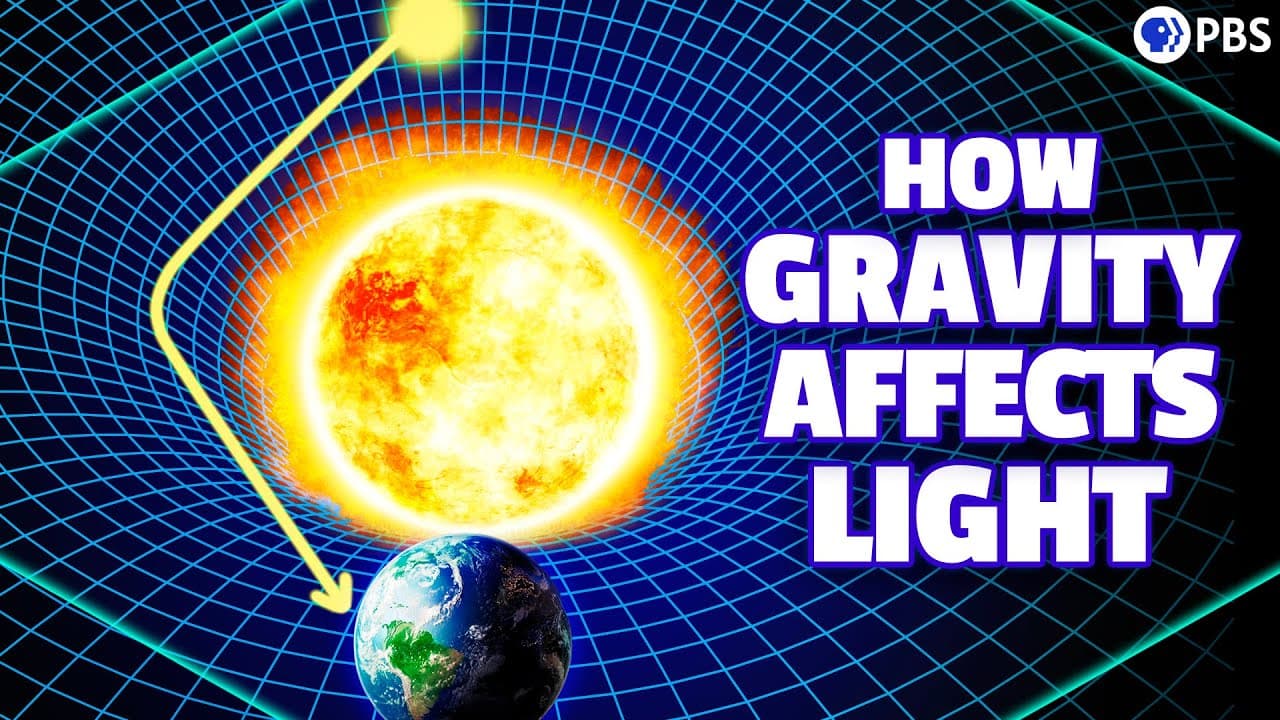
Gravity bends light, explained through relativity and historical theories.
Transcript
We know that gravity exerts its pull on light, and we have an explanation for why. Actually, we have multiple explanations that all predict the same thing. And at first glance, these explanations seem to describe completely different causes. So what is the true connection between light and gravity, or is truth, in fact, entirely relative? Gravity b... Read More
Key Insights
- Gravity affects light by bending its path, a phenomenon predicted by Einstein's general theory of relativity and historically by John Michell and Henry Cavendish.
- Michell and Cavendish's early predictions about light and gravity, despite incorrect assumptions, were validated by later scientific discoveries.
- Einstein's equivalence principle suggests that no experiment can distinguish between the effects of acceleration and gravity, which helps explain gravitational redshift.
- Gravitational redshift occurs when light is stretched as it moves out of a gravitational field, leading to a decrease in frequency and energy.
- At a black hole's event horizon, gravitational time dilation is so strong that light's frequency is reduced to zero, preventing escape.
- Einstein's calculations on light deflection by gravity, based on the equivalence principle, were confirmed by Arthur Eddington's solar eclipse observations.
- Huygens’ wave theory, which treats light as a wave, helps explain phenomena like diffraction and refraction, and can be adapted to model gravitational effects on light.
- Einstein's approach to light and gravity demonstrates the relativity of observations, where local measurements of light speed remain constant, but can appear altered from a distance.
Install to Summarize YouTube Videos and Get Transcripts
Explore YouTube Video Summarizer or Get YouTube Transcript Extractor
Questions & Answers
Q: How does gravity affect the path of light?
Gravity bends the path of light, a phenomenon predicted by Einstein's general theory of relativity. This bending occurs because gravity warps the fabric of spacetime, causing light to follow a curved path. Historical figures like John Michell and Henry Cavendish predicted similar effects, although their assumptions were based on Newtonian physics and were incorrect.
Q: What is gravitational redshift and how does it occur?
Gravitational redshift occurs when light is stretched as it moves out of a gravitational field, resulting in a decrease in frequency and energy. This phenomenon is explained by the equivalence principle, which suggests that light emerging from a gravitational field experiences a shift in wavelength due to the slowing of time within the field.
Q: Why was Arthur Eddington's observation during a solar eclipse significant?
Arthur Eddington's observation during a solar eclipse was significant because it confirmed Einstein's prediction of light deflection by gravity. Eddington measured the slight offset in the apparent positions of stars around the sun, caused by their light rays bending in the sun's gravitational field, providing empirical evidence for general relativity.
Q: How does Huygens’ wave theory relate to gravitational effects on light?
Huygens’ wave theory treats light as a wave composed of point-like oscillations, which can be used to explain phenomena like diffraction and refraction. Einstein adapted this theory to model gravitational effects on light, suggesting that light can be refracted by gravitational fields, with the speed of light appearing to change from a distance due to time dilation and space stretching.
Q: What role does the equivalence principle play in understanding light and gravity?
The equivalence principle is crucial in understanding light and gravity, as it posits that no experiment can distinguish between acceleration and gravitational effects. This principle explains gravitational redshift and the bending of light, suggesting that observers in different frames of reference perceive the effects of gravity and acceleration similarly.
Q: How does gravitational time dilation affect light at a black hole's event horizon?
Gravitational time dilation at a black hole's event horizon is so strong that it stops clocks and reduces the frequency of photons trying to escape to zero. This means light is redshifted to an extent that its wavelength becomes infinite, preventing any light from escaping the gravitational pull of the black hole.
Q: What assumptions did Michell and Cavendish make about light and gravity?
Michell and Cavendish assumed that light could be slowed down by gravity and that it experienced a gravitational force like any massive object. They based their calculations on Newtonian gravity, believing light behaves like a particle. Despite these incorrect assumptions, their predictions about light deflection were later validated by general relativity.
Q: Why is the speed of light considered relative in Einstein's theory?
In Einstein's theory, the speed of light is considered relative because while everyone measures the same local speed of light, it can appear to change when viewed from a distance. This is due to the slowing of time and stretching of space within gravitational fields, which affects the apparent speed of light without altering its local measurement.
Summary & Key Takeaways
-
Gravity influences light by bending its path, a concept supported by Einstein's general relativity and historical predictions by Michell and Cavendish. Despite their incorrect assumptions, their predictions were validated by later scientific advancements, demonstrating the complex relationship between gravity and light.
-
The equivalence principle posits that gravitational effects are indistinguishable from acceleration, explaining gravitational redshift, where light's frequency decreases as it exits a gravitational field. This principle also accounts for the bending of light, confirmed by Eddington's observations during a solar eclipse.
-
Einstein's use of Huygens' wave theory, which treats light as a wave, explains phenomena like diffraction and refraction, and offers a model for gravitational effects on light. This approach underscores the relativity of observations, maintaining constant local light speed despite apparent changes from a distance.
Read in Other Languages (beta)
Share This Summary 📚
Summarize YouTube Videos and Get Video Transcripts with 1-Click
Try YouTube Summary with ChatGPT & Claude or YouTube Transcript Generator
Explore More Summaries from PBS Space Time 📚
Summarize YouTube Videos and Get Video Transcripts with 1-Click
Try YouTube Summary with ChatGPT & Claude or YouTube Transcript Generator