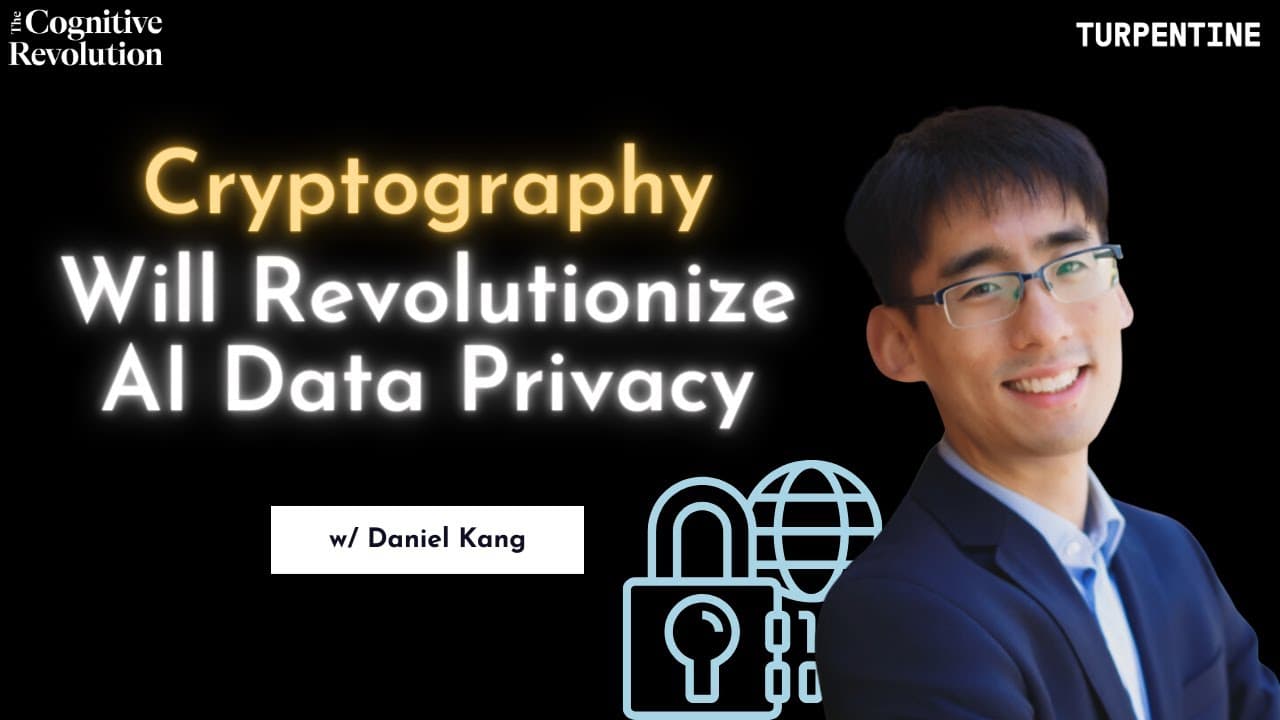
Cryptography Will Revolutionize AI Data Privacy with Daniel Kang
TL;DR
Cryptography can ensure AI data privacy without compromising authenticity.
Transcript
so if I want to somehow prove that I'm human today the way that I need to do that is to essentially reveal a lot of information about myself because AI generation methods are becoming so powerful maybe we don't want this so for example you have Services which take pictures of your face to verify that you're a real human being but the way this works... Read More
Key Insights
- Zero knowledge cryptographic proofs can verify AI model execution without revealing sensitive inputs, ensuring both privacy and authenticity.
- These proofs are critical for verifying that AI models, like those used in medical diagnostics, have not been tampered with.
- Cryptographic hashes are used for commitments, allowing parties to prove that a specific model was run without revealing the model details.
- The process involves transforming computations into polynomials over finite fields, making it computationally intensive but secure.
- Current computational costs for these proofs are high, but ongoing research aims to reduce these costs significantly.
- Attested cameras can authenticate images at the moment of capture, providing a solution to the problem of AI-generated deep fakes.
- The integration of cryptography in AI could lead to seamless, secure interactions in daily life, much like HTTPS for web traffic today.
- Potential regulation could mandate hardware authentication for devices, enhancing data privacy and security across industries.
Install to Summarize YouTube Videos and Get Transcripts
Explore YouTube Video Summarizer or Get YouTube Transcript Extractor
Questions & Answers
Q: What problem does cryptography solve in AI?
Cryptography addresses the fundamental trade-off between privacy and authenticity in AI applications. By using zero knowledge proofs, it's possible to verify that an AI model was executed correctly without revealing the sensitive data inputs or model details. This ensures that privacy is maintained while still proving authenticity, which is crucial in applications like verifying medical AI services or proving human identity without revealing personal information.
Q: How do zero knowledge proofs work in AI?
Zero knowledge proofs in AI work by representing the model's computations as polynomials over finite fields. This allows the proving system to ensure that a specific model was run correctly without revealing the model's weights or the input data. The process involves cryptographic hashes for commitments and exhaustive lookup tables for nonlinearities, ensuring that the model's execution is both private and authentic.
Q: What are the computational costs of using cryptographic proofs in AI?
The computational costs of using cryptographic proofs in AI are currently quite high, with the process being approximately 10,000 times more expensive than a standard model inference. This is due to the complex arithmetic and cryptographic operations involved. However, ongoing research aims to reduce these costs significantly, potentially bringing them down by 10 to 100 times, making the technology more feasible for widespread use.
Q: How can attested cameras help combat AI-generated deep fakes?
Attested cameras can combat AI-generated deep fakes by authenticating images at the moment of capture. These cameras use cryptographic techniques to sign the data they capture, ensuring that the image is genuine and can be traced back to its physical source. This provides a reliable way to verify the authenticity of images, which is essential in an era where AI-generated content can easily be mistaken for real.
Q: What potential impact could cryptography have on daily life?
Cryptography in AI could significantly impact daily life by providing seamless, secure interactions similar to HTTPS for web traffic. It could enable secure verification of identity and data without compromising privacy, facilitate trusted AI model execution, and protect against misinformation through authenticated media. As costs decrease and regulation encourages adoption, cryptographic techniques could become a ubiquitous part of digital interactions.
Q: Could regulation mandate the use of cryptographic techniques in devices?
Yes, regulation could potentially mandate the use of cryptographic techniques in devices to enhance data privacy and security. For instance, requiring attested cameras in smartphones could ensure that all captured media is authenticated, providing a defense against deep fakes and misinformation. Such regulation would likely depend on the feasibility of integrating these technologies without significantly increasing device costs.
Q: What challenges exist in implementing cryptographic proofs in AI?
Challenges in implementing cryptographic proofs in AI include the high computational costs and the need for both parties to agree on specific models and outcomes. The technology requires significant computational resources, which can be a barrier to widespread adoption. Additionally, there is a need for consensus on the models and data used, which can be complex in situations involving multiple stakeholders or varying privacy requirements.
Q: How does quantization affect cryptographic proofs in AI?
Quantization affects cryptographic proofs in AI by enabling the efficient representation of model computations as polynomials. By reducing the precision of model weights and inputs, quantization allows for the creation of exact lookup tables for nonlinearities, facilitating the arithmetic operations needed for cryptographic proofs. This process is crucial for reducing the computational burden of proofs, making them more feasible for practical use while maintaining accuracy.
Summary & Key Takeaways
-
Daniel Kang discusses how zero knowledge proofs can ensure AI model execution without revealing sensitive data, balancing privacy and authenticity. This technology is crucial for verifying models in high-stakes applications like medical diagnostics.
-
The conversation covers the technical aspects of cryptographic proofs, including the use of polynomials and finite fields. Despite current high computational costs, efforts are underway to make these proofs more efficient.
-
Kang also highlights the potential for attested cameras to authenticate images, addressing the threat of AI-generated deep fakes. Future regulation may require such authentication to enhance security and privacy.
Read in Other Languages (beta)
Share This Summary 📚
Summarize YouTube Videos and Get Video Transcripts with 1-Click
Try YouTube Summary with ChatGPT & Claude or YouTube Transcript Generator
Explore More Summaries from Cognitive Revolution "How AI Changes Everything" 📚




Summarize YouTube Videos and Get Video Transcripts with 1-Click
Try YouTube Summary with ChatGPT & Claude or YouTube Transcript Generator