L16.5 Example: The LMS Estimate
TL;DR
Bayesian estimation involves finding the posterior distribution of a random variable given a conditional distribution, and in this example, the posterior distribution of the unknown variable Theta is a uniform distribution.
Transcript
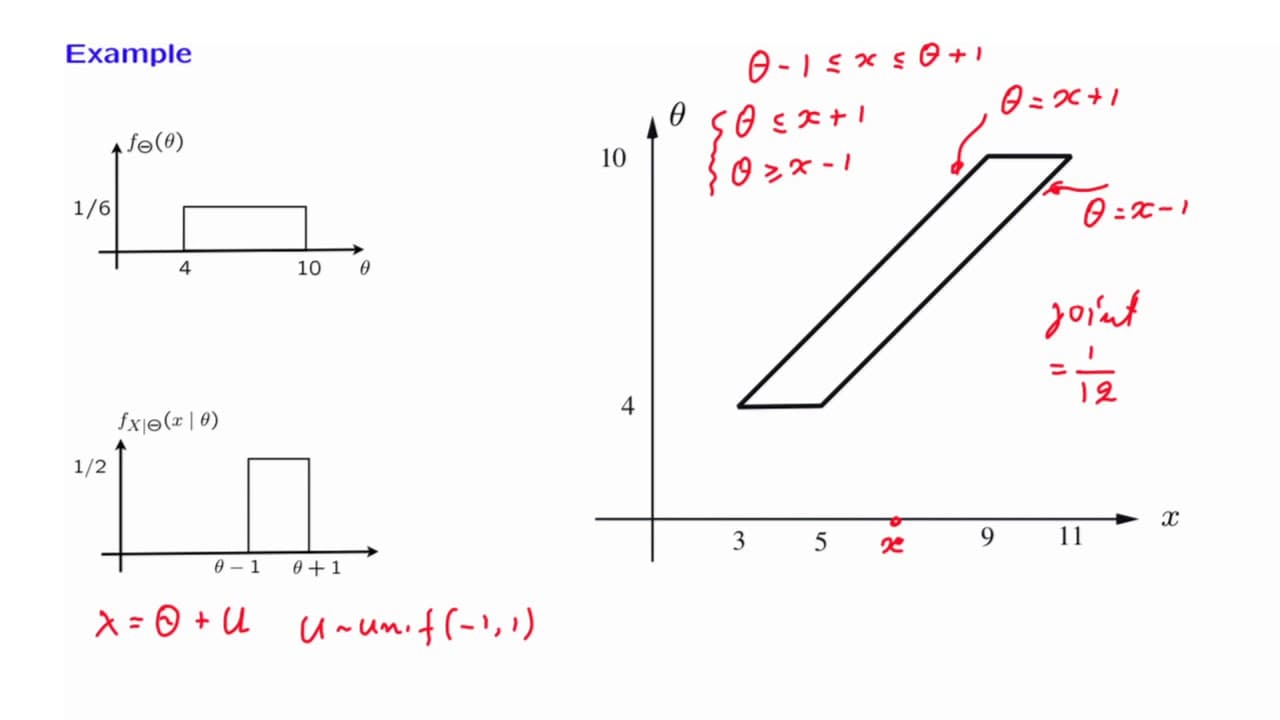
Let us now go through an example. Suppose that we have an unknown random variable Theta that has a uniform distribution between 4 and 10. We observe some other random variable X that's related to Theta according to the following model. This is the conditional distribution of X given Theta. For any given value of theta, X is going to take values bet... Read More
Key Insights
- 💁 Bayesian estimation involves finding the posterior distribution based on the conditional distribution and prior information.
- ✖️ The joint distribution is obtained by multiplying the constant prior and conditional distributions.
- 🧡 The posterior distribution, in this example, is a uniform distribution on the range corresponding to the observed value of X.
- 🥋 The conditional expectation of Theta is the midpoint of the uniform distribution given the observed value of X.
- ❓ The estimator function in Bayesian estimation is determined by the conditional expectation of Theta for different values of X.
- 💁 The resulting estimator function forms a curve that represents the conditional expectation of Theta based on different values of X.
- 💁 The information obtained from the observed data is used to estimate the unknown variable Theta.
Install to Summarize YouTube Videos and Get Transcripts
Explore YouTube Video Summarizer or Get YouTube Transcript Extractor
Questions & Answers
Q: What is the first step in Bayesian estimation?
The first step in Bayesian estimation is finding the posterior distribution of the random variable given the conditional distribution.
Q: What constraints are there on the possible values of X and Theta in the example?
In the example, Theta must be less than or equal to X+1 and larger than or equal to X-1. Additionally, Theta is between 4 and 10.
Q: What is the shape of the joint PDF in the given example?
The joint PDF is constant over the set of possible X and Theta values, forming a shape between two lines representing Theta = X+1 and Theta = X-1.
Q: What is the posterior distribution of Theta in the example?
The posterior distribution of Theta, given a specific value of X, is a uniform distribution on the range corresponding to the observed X value.
Summary & Key Takeaways
-
The example involves an unknown random variable Theta with a uniform distribution between 4 and 10, and a related variable X with a conditional distribution that is uniform between Theta-1 and Theta+1.
-
The joint distribution of X and Theta is constant over a specific range, resulting in a uniform joint PDF.
-
The posterior distribution of Theta, given a specific value of X, is also a uniform distribution on the range corresponding to the observed X value.
Read in Other Languages (beta)
Share This Summary 📚
Summarize YouTube Videos and Get Video Transcripts with 1-Click
Try YouTube Summary with ChatGPT & Claude or YouTube Transcript Generator
Explore More Summaries from MIT OpenCourseWare 📚


Summarize YouTube Videos and Get Video Transcripts with 1-Click
Try YouTube Summary with ChatGPT & Claude or YouTube Transcript Generator