Products
Features
YouTube Video Summarizer
Summarize YouTube videos
Web & PDF Highlighter
Highlight web pages & PDFs
Chat with PDF
Ask any PDF questions with AI
Ask AI Clone
Chat with your highlights & memories
Audio Transcriber
Transcribe audio files to text
Glasp Reader
Read and highlight articles
Kindle Highlight Export
Export your Kindle highlights
Idea Hatch
Hatch ideas from your highlights
Integrations
Obsidian Plugin
Notion Integration
Pocket Integration
Instapaper Integration
Medium Integration
Readwise Integration
Snipd Integration
Hypothesis Integration
Apps & Extensions
Chrome Extension
Safari Extension
Edge Add-ons
Firefox Add-ons
iOS App
Android App
Discover
Discover
Ideas
Discover new ideas and insights
Articles
Curated articles and insights
Books
Book recommendations by great minds
Posts
Essays and notes from readers
Quotes
Inspiring quotes collection
Videos
Curated videos and summaries
Explore Glasp
Glasp Newsletter
Weekly insights and updates
Glasp Talk
Interview series with great minds
Glasp Blog
Latest news and articles
Glasp Use Cases
Learn how others use Glasp
Build & Support
Glasp API
Access Glasp's API for developers
MCP Connector
Connect Glasp to Claude & ChatGPT
Community
Glasp Reddit Community
Students
Student discount and benefits
FAQs
Frequently Asked Questions
AboutPricing
DashboardLog inSign up

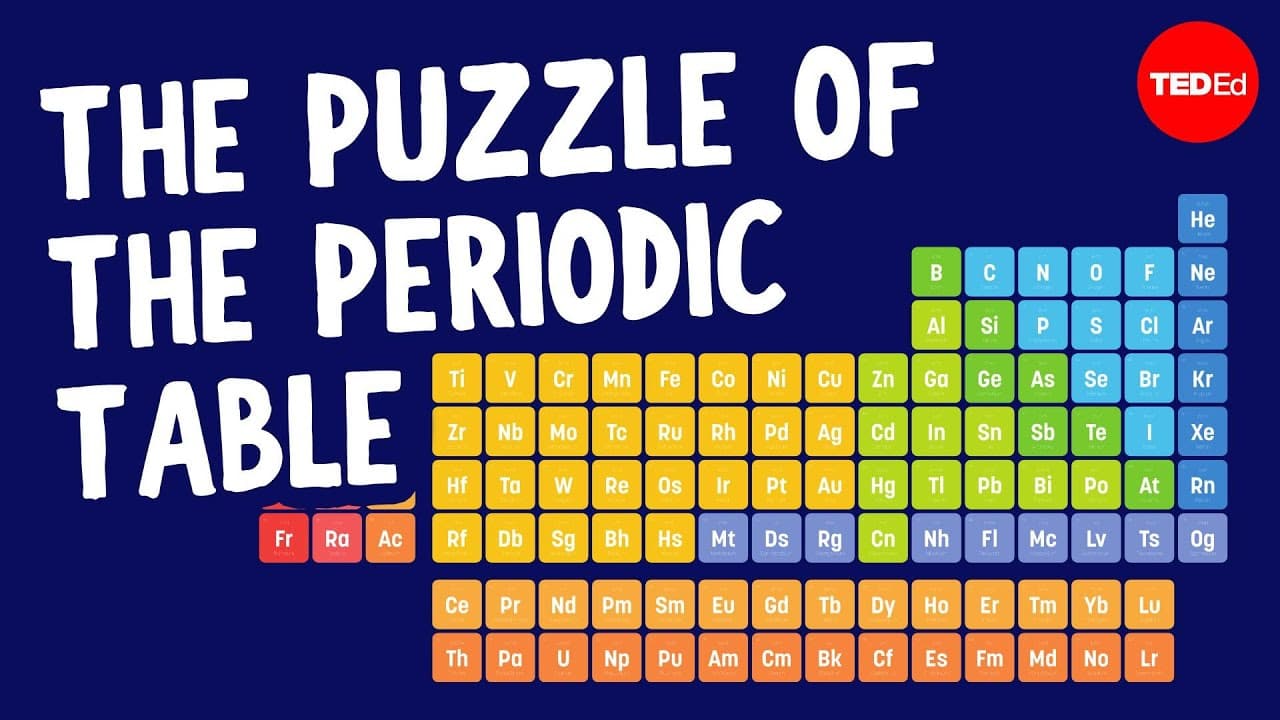
Solving the puzzle of the periodic table - Eric Rosado
1.1M views
•
December 12, 2012
by
TED-Ed
YouTube video player
Solving the puzzle of the periodic table - Eric Rosado

TL;DR

Discover how exploding stars created elements, leading to the development of the periodic table.

Transcript

Transcriber: Andrea McDonough Reviewer: Bedirhan Cinar Our Earth is a collection of puzzle pieces that make up the universe. In the vast darkness of space, the universe is lit by stars, which could one day become a supernova and create all the puzzle pieces that we know today as the elements. All elements were formed and released into space by expl... Read More

Key Insights

  • 🤩 Elements on Earth were created by exploding stars in space.
  • ❓ Ancient civilizations identified certain elements without understanding their significance.
  • 🖐️ Chemists like Hennig Brand and Dmitri Mendeleev played crucial roles in discovering and organizing elements.
  • 🚰 The periodic table revolutionized scientific understanding of the elements.
  • 👪 Some elements are less reactive and easier to identify, while others have similar properties in reactive families.
  • 🍳 Antoine Lavoisier defined an element as a substance that cannot be broken down chemically.
  • 🤑 Dmitri Mendeleev's periodic table successfully organized known elements and predicted undiscovered ones.

Install to Summarize YouTube Videos and Get Transcripts

Explore YouTube Video Summarizer or Get YouTube Transcript Extractor

Questions & Answers

Q: How did exploding stars create the elements found on Earth?

Exploding stars release elements into space through supernovae, which eventually formed planets like Earth with various elements.

Q: Why were certain elements like gold, silver, and copper easily identified by ancient civilizations?

Gold, silver, and copper are less reactive, making them stand out and easier to spot compared to other elements that react more readily with their surroundings.

Q: Who is considered the father of modern chemistry and how did he define an element?

Antoine Lavoisier is the father of modern chemistry, defining an element as a substance that cannot be broken down by existing chemical means.

Q: How did Dmitri Mendeleev contribute to the development of the periodic table?

Mendeleev created the periodic table by arranging known elements based on atomic weight and properties, even predicting elements not yet discovered.

Summary & Key Takeaways

  • Exploding stars produce elements released into space, leading to human discovery of elements.

  • Ancient civilizations identified elements like gold, copper, and silver without understanding their significance.

  • Scientists like Hennig Brand and Dmitri Mendeleev played key roles in developing the periodic table.


Read in Other Languages (beta)

English

Share This Summary 📚

Summarize YouTube Videos and Get Video Transcripts with 1-Click

Download browser extensions on:

Try YouTube Summary with ChatGPT & Claude or YouTube Transcript Generator

Explore More Summaries from TED-Ed 📚
Why do people join cults? - Janja Lalich thumbnail
Why do people join cults? - Janja Lalich
TED-Ed
How does the Rorschach inkblot test work? - Damion Searls thumbnail
How does the Rorschach inkblot test work? - Damion Searls
TED-Ed
Can you solve the locker riddle? - Lisa Winer thumbnail
Can you solve the locker riddle? - Lisa Winer
TED-Ed
Does time exist? - Andrew Zimmerman Jones thumbnail
Does time exist? - Andrew Zimmerman Jones
TED-Ed
How did Hitler rise to power? - Alex Gendler and Anthony Hazard thumbnail
How did Hitler rise to power? - Alex Gendler and Anthony Hazard
TED-Ed
The myth of Hercules: 12 labors in 8-bits - Alex Gendler thumbnail
The myth of Hercules: 12 labors in 8-bits - Alex Gendler
TED-Ed

Summarize YouTube Videos and Get Video Transcripts with 1-Click

Download browser extensions on:

Try YouTube Summary with ChatGPT & Claude or YouTube Transcript Generator

Apps & Extensions

  • Chrome Extension
  • Safari Extension
  • Edge Add-ons
  • Firefox Add-ons
  • iOS App
  • Android App

Key Features

  • YouTube Video Summarizer
  • Web & PDF Summarizer
  • Web & PDF Highlighter
  • Chat with PDF
  • Ask AI Clone
  • Audio Transcriber
  • Glasp Reader
  • Kindle Highlight Export
  • Idea Hatch

Integrations

  • Obsidian Plugin
  • Notion Integration
  • Pocket Integration
  • Instapaper Integration
  • Medium Integration
  • Readwise Integration
  • Snipd Integration
  • Hypothesis Integration

More Features

  • APIs
  • MCP Connector
  • Blog & Post
  • Embed Links
  • Image Highlight
  • Personality Test
  • Quote Shots

Company

  • About us
  • Blog
  • Community
  • FAQs
  • Job Board
  • Newsletter
  • Pricing
Terms

•

Privacy

•

Guidelines

© 2026 Glasp Inc. All rights reserved.