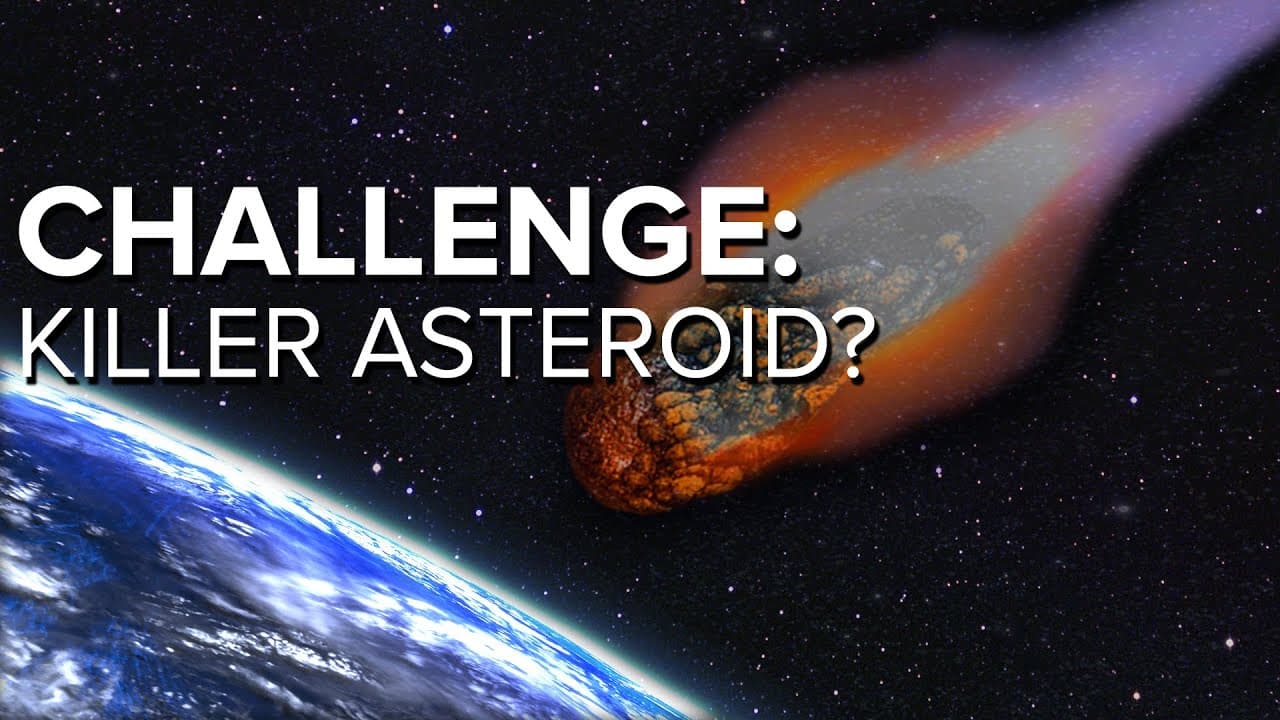
Challenge: Can you save Earth from a Killer Asteroid? | Space Time | PBS Digital Studios
TL;DR
Calculate spacecraft mass to deflect asteroid Apophis.
Transcript
Today, we're doing a challenge question instead of a regular episode. This question is going to draw on two episodes-- our interstellar travel episode from a few weeks ago and next week's episode on killer asteroids. We're going to use some rocket science to save the planet. Here's the situation. The near-Earth asteroid, Apophis, is set to buzz by ... Read More
Key Insights
- The challenge involves calculating the necessary spacecraft mass to deflect the asteroid Apophis, which could collide with Earth in 2036.
- Apophis is a 325-meter-diameter asteroid weighing 30 billion kilograms, traveling at 30 kilometers per second.
- A gravitational tractor method is proposed, where a spacecraft hovers in front of Apophis to alter its trajectory over seven years.
- The spacecraft must intercept Apophis during its 2029 pass and increase its speed enough to miss Earth by 25,000 kilometers in 2036.
- A state-of-the-art post-fusion rocket engine with exhaust velocities of 500 kilometers per second is assumed to be available.
- Newton's law of universal gravitation and the rocket equation are essential for solving the challenge.
- Participants are encouraged to submit their solutions by November 20, with a chance to win PBS Digital Studios t-shirts.
- The challenge emphasizes individual problem-solving, discouraging the sharing of answers online.
Install to Summarize YouTube Videos and Get Transcripts
Explore YouTube Video Summarizer or Get YouTube Transcript Extractor
Questions & Answers
Q: What is the main objective of the challenge?
The main objective of the challenge is to calculate the mass of a spacecraft needed to deflect the asteroid Apophis, preventing it from colliding with Earth in 2036. The spacecraft will act as a gravitational tractor, altering the asteroid's trajectory over a seven-year period.
Q: What are the characteristics of the asteroid Apophis?
Apophis is a near-Earth asteroid with a diameter of 325 meters and a mass of approximately 30 billion kilograms. It travels at a speed of 30 kilometers per second and poses a potential threat to Earth if its trajectory is altered by external factors.
Q: How does the gravitational tractor method work?
The gravitational tractor method involves launching a spacecraft to hover in front of the asteroid Apophis. The mutual gravitational attraction between the spacecraft and the asteroid will gradually alter the asteroid's speed and trajectory, ensuring it misses Earth by a safe distance.
Q: What assumptions are made in the challenge?
The challenge assumes the availability of a state-of-the-art post-fusion rocket engine with exhaust velocities of 500 kilometers per second. It also assumes a constant use of propellant over the seven-year period and requires calculations based on Newtonian physics and the rocket equation.
Q: What is the significance of the 2029 pass of Apophis?
The 2029 pass of Apophis is significant because it provides an opportunity to launch the spacecraft to intercept the asteroid. By positioning the spacecraft as a gravitational tractor during this pass, it allows for a seven-year period to alter the asteroid's trajectory before the potential impact in 2036.
Q: What physics concepts are essential for solving the challenge?
Newton's law of universal gravitation and basic mechanics and kinematics are essential for solving the challenge. Additionally, the Tsiolkovsky rocket equation, which relates velocity change to propellant exhaust velocity and mass ratio, is crucial for calculating the necessary spacecraft mass.
Q: What are the submission guidelines for the challenge?
Participants must submit their solutions via email to PBS Space Time by November 20, using the subject line 'Spacetime Killer Asteroid Challenge.' Solutions should not be discussed or posted online to allow everyone a fair chance to solve the problem independently.
Q: What rewards are offered for correct solutions?
Five random correct answers will be selected to receive PBS Digital Studios t-shirts. The challenge encourages individual problem-solving and creativity, with the solution to be revealed in a future episode of PBS Space Time.
Summary & Key Takeaways
-
The challenge presented by PBS Space Time involves using rocket science to prevent an asteroid, Apophis, from colliding with Earth in 2036. Participants must calculate the mass of a spacecraft needed to act as a gravitational tractor, altering the asteroid's trajectory over seven years.
-
Apophis, a large asteroid, poses a hypothetical threat to Earth. The proposed solution involves launching a spacecraft with a fusion rocket engine to intercept Apophis in 2029, using gravitational attraction to adjust its path, ensuring it misses Earth by 2036.
-
Participants are tasked with using Newtonian physics and the rocket equation to determine the spacecraft's mass. The challenge encourages individual effort, with solutions submitted via email for a chance to win prizes. No calculus is needed, and hints are provided on social media.
Read in Other Languages (beta)
Share This Summary 📚
Summarize YouTube Videos and Get Video Transcripts with 1-Click
Try YouTube Summary with ChatGPT & Claude or YouTube Transcript Generator
Explore More Summaries from PBS Space Time 📚



Summarize YouTube Videos and Get Video Transcripts with 1-Click
Try YouTube Summary with ChatGPT & Claude or YouTube Transcript Generator