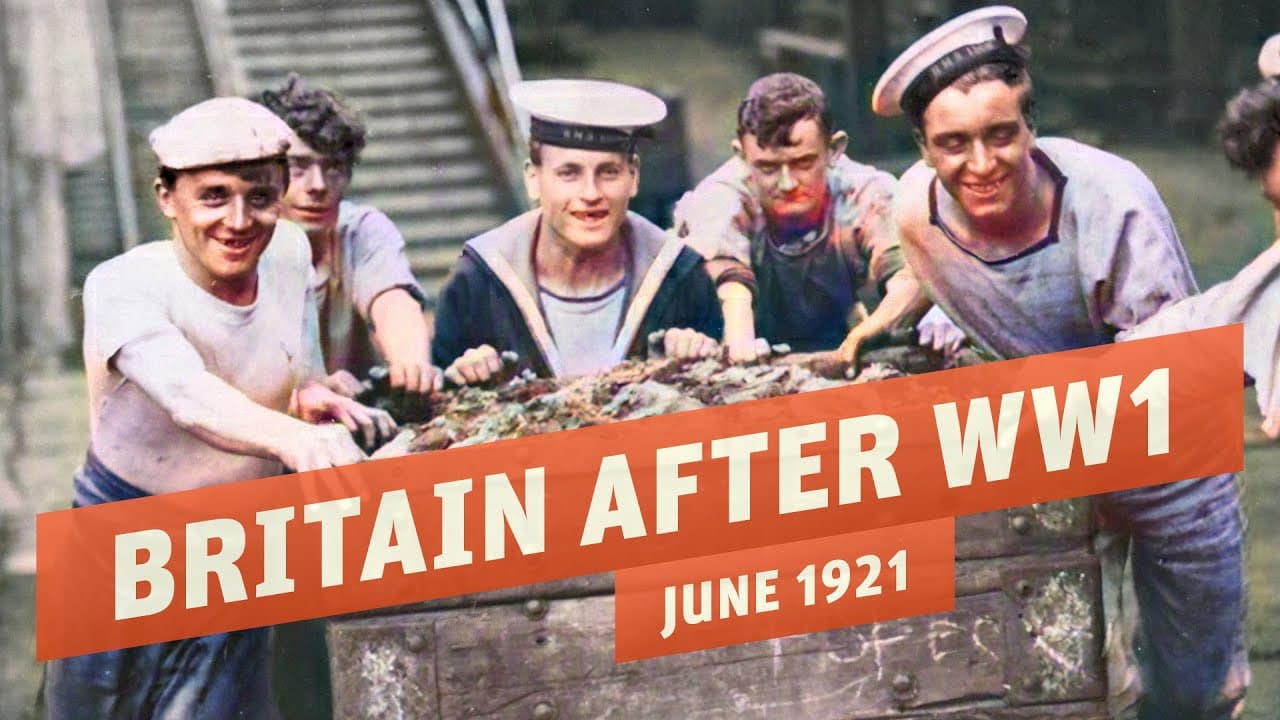
British Economy after WW1 - Fear of The Bolshevik Brit I THE GREAT WAR 1921
TL;DR
Post-WWI Britain saw intense labour strikes and fear of revolution.
Transcript
British society emerged from the Great War profoundly changed, and this was especially true of the working class. The requirements of the wartime economy meant that miners, shipbuilders, and railwaymen had more responsibility and influence than ever before. Unions were able to improve their positions during the war, but once Russian revolution brok... Read More
Key Insights
- The British working class gained significant influence during WWI, leading to increased union power post-war.
- Labour unions doubled their membership from 4 million in 1913 to 8 million in 1919, forming powerful alliances.
- The Labour Party, while containing socialist elements, generally sought reform through parliamentary means rather than revolution.
- Fear of a Bolshevik-style revolution gripped Britain, though actual revolutionary intent among workers was minimal.
- The 1919 Glasgow strike highlighted tensions between workers and the government, resulting in military intervention.
- Post-war Britain faced economic challenges, including high national debt and inflation, impacting labour relations.
- The Emergency Powers Act of 1920 allowed the government to respond strongly to industrial unrest.
- The failure of the 1921 miners' strike marked a turning point, weakening labour's influence in subsequent years.
Install to Summarize YouTube Videos and Get Transcripts
Explore YouTube Video Summarizer or Get YouTube Transcript Extractor
Questions & Answers
Q: What were the main challenges faced by the British economy after WWI?
The British economy faced several challenges post-WWI, including a significant loss of human capital due to wartime casualties, with 715,000 men killed and twice as many wounded. Additionally, the war destroyed 10% of domestic assets and 24% of overseas assets, leading to rising national debt and inflation. The global export market saw Britain being displaced by the US and Japan, further straining the economy.
Q: How did the Labour Party's stance on socialism affect its political strategy?
The Labour Party, while containing socialist thinkers and leaders, generally aimed for reform rather than revolution. This approach involved pushing for improvements in workers' lives through parliamentary means, avoiding affiliation with more radical groups like the Communist Party. The party promoted international worker solidarity but remained cautious of revolutionary movements, focusing on democratic processes to achieve social change.
Q: What role did the Emergency Powers Act play in post-war Britain?
The Emergency Powers Act, introduced in late 1920, allowed the British government to respond strongly to industrial unrest. It was a tool to prevent potential revolutions, drawing comparisons to wartime restrictions. The act reflected the government's fear of a Bolshevik-style uprising, enabling them to impose measures to control strikes and maintain order amid rising political and social tensions.
Q: What was the significance of the 1919 Glasgow strike?
The 1919 Glasgow strike was significant as it highlighted the tension between left-wing unions and the government. Workers demanded a reduction in the workweek to create jobs for demobilized soldiers. The strike led to violence, known as the 'Battle of George Square,' and prompted the government to deploy troops and tanks to maintain order. It underscored the government's fear of revolution and the growing power of labour movements.
Q: How did the fear of Bolshevism influence British politics?
The fear of Bolshevism significantly influenced British politics, as the government and intelligence community were concerned about a potential workers' revolution. This fear led to heightened tensions and measures like the Emergency Powers Act to control industrial unrest. Although the Labour Party and many unions did not seek revolution, socialist ideas gained traction, leading to increased political polarization and government efforts to maintain the status quo.
Q: What impact did the post-war economic boom and bust have on British labour?
The brief post-war economic boom was followed by a bust, significantly impacting British labour. The government's return to pre-war financial practices, such as reinstating the gold standard, led to a decrease in the value of the Pound, necessitating cuts in prices and wages. This resulted in decreased productivity and rising unemployment, prompting unions to demand nationalization of industries and leading to significant labour unrest, including the failed 1921 miners' strike.
Q: How did the 'Triple Alliance' influence British labour movements?
The 'Triple Alliance,' consisting of the Miners’ Federation, the National Union of Railwaymen, and the National Transport Workers' Federation, was a powerful force in British labour movements. It represented a significant consolidation of union power, allowing for coordinated strikes and demands. However, the alliance's failure during the 1921 miners' strike, known as Black Friday, marked a turning point, weakening labour's influence and highlighting the challenges of maintaining solidarity among diverse unions.
Q: What were the consequences of the 1921 miners' strike for British labour?
The 1921 miners' strike had significant consequences for British labour. The failure of the strike, due to a lack of support from other unions and the public, marked a decline in labour's influence. It exposed the fragility of the 'Triple Alliance' and led to a shift in government policy, which aimed to divide unions and align union leaders with industry owners. This defeat set a precedent, as British labour movements struggled to regain their previous strength in subsequent years.
Summary & Key Takeaways
-
Post-WWI Britain experienced profound changes in its labour landscape, with unions gaining power due to wartime economic shifts. The Labour Party, though socialist-leaning, pursued reform through democratic means. Fear of Bolshevism influenced government actions, leading to significant political and social tensions.
-
The British economy struggled post-war, with high national debt and inflation. Unions, empowered by wartime gains, pushed for reforms, leading to significant strikes. The government, fearing revolution, enacted the Emergency Powers Act to control industrial unrest, reflecting societal divisions.
-
The 1919 Glasgow strike was a pivotal moment, showcasing the government's fear of revolution and willingness to use military force. Despite the Labour Party's moderate stance, socialist ideas gained traction among workers, though actual revolutionary intent was limited, shaping the political climate.
Read in Other Languages (beta)
Share This Summary 📚
Summarize YouTube Videos and Get Video Transcripts with 1-Click
Try YouTube Summary with ChatGPT & Claude or YouTube Transcript Generator
Explore More Summaries from The Great War 📚

Summarize YouTube Videos and Get Video Transcripts with 1-Click
Try YouTube Summary with ChatGPT & Claude or YouTube Transcript Generator