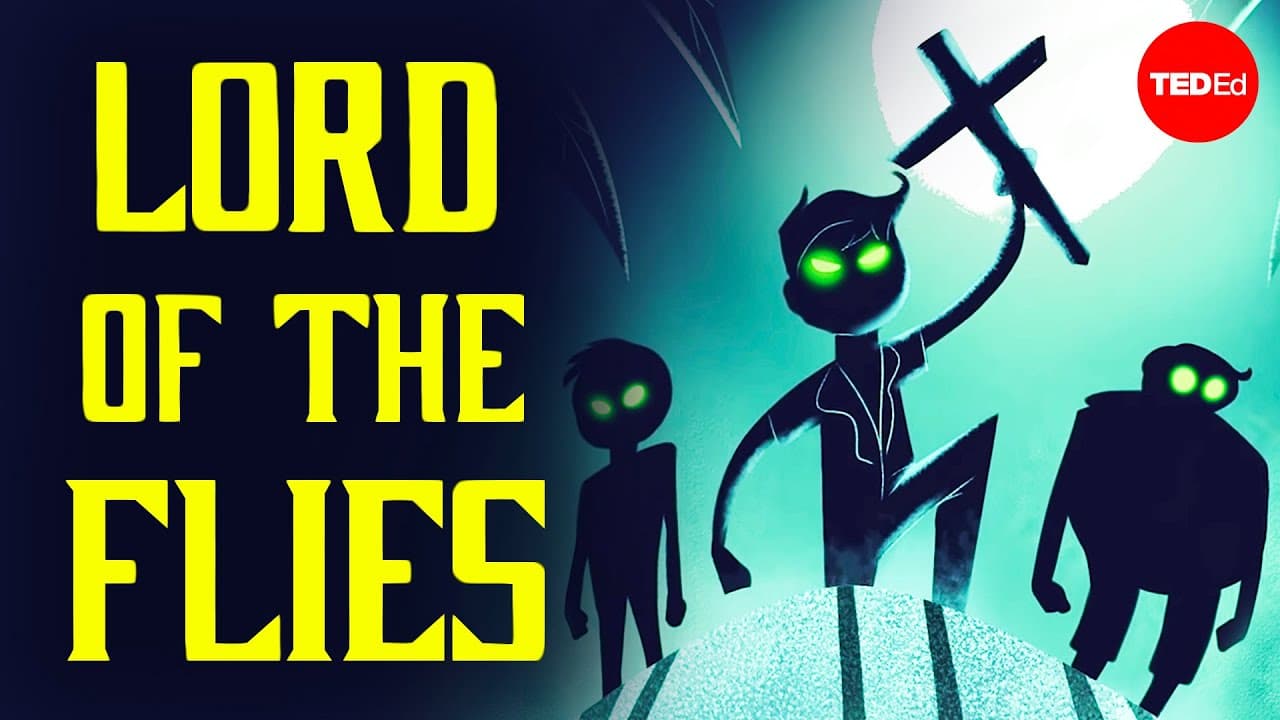
Why should you read “Lord of the Flies” by William Golding? - Jill Dash
TL;DR
Golding's novel challenges human nature on a deserted island with tragic consequences.
Transcript
William Golding was losing his faith in humanity. Serving aboard a British destroyer in World War II, the philosophy teacher turned Royal Navy lieutenant was constantly confronted by the atrocities of his fellow man. And when he returned to England to find Cold War superpowers threatening one another with nuclear annihilation, he was forced to... Read More
Key Insights
- ❓ Golding's experiences during World War II and the Cold War heavily influenced the bleak themes in "Lord of the Flies."
- 🏝️ The novel subverts traditional island adventure tropes by revealing the darker side of human nature.
- 😀 "Lord of the Flies" examines the fragility of civilization and societal constructs when faced with primal instincts.
- 🇬🇧 Golding satirizes colonialist narratives by portraying British schoolboys as savage caricatures in the novel.
- 🧑 The absence of adult authority in the story highlights the vulnerability of societal structures to individual darkness.
- 🏛️ The universal themes of morality and society in the novel make it a timeless classic that challenges readers' perceptions.
- 💦 Golding's work serves as a cautionary tale about the inherent darkness within humanity and the fragility of societal norms.
Install to Summarize YouTube Videos and Get Transcripts
Explore YouTube Video Summarizer or Get YouTube Transcript Extractor
Questions & Answers
Q: How does Golding use the setting and character names from "Coral Island" to subvert the island adventure genre?
Golding's appropriation of Ballantyne's "Coral Island" elements allows him to critique colonialism, innocence, and morality by contrasting with the darker nature of his characters in "Lord of the Flies."
Q: What role does the absence of adult authority play in the descent into chaos among the boys?
The lack of adult supervision in the novel highlights how quickly social order disintegrates when primal urges and power dynamics take precedence, leading to the boys' savagery and loss of civilization.
Q: In what way does Golding explore the themes of violence, morality, and society through the boys' behaviors on the island?
Golding portrays the boys' journey as a microcosm of society, showcasing how unchecked aggression, primal instincts, and power struggles ultimately lead to the breakdown of civilization and morality.
Q: How does the novel challenge readers' perceptions of human nature and societal norms?
"Lord of the Flies" forces readers to confront the darker aspects of human nature, challenging idealistic views of society and civilization by illustrating how easily individuals can succumb to savagery without societal structures.
Summary & Key Takeaways
-
William Golding's "Lord of the Flies" critiques humanity's dark nature through boys stranded on an island.
-
The novel satirizes colonialist narratives and explores themes of morality, civility, and society.
-
Golding's work questions the inherent goodness of humanity when stripped of societal norms.
Read in Other Languages (beta)
Share This Summary 📚
Summarize YouTube Videos and Get Video Transcripts with 1-Click
Try YouTube Summary with ChatGPT & Claude or YouTube Transcript Generator
Explore More Summaries from TED-Ed 📚

Summarize YouTube Videos and Get Video Transcripts with 1-Click
Try YouTube Summary with ChatGPT & Claude or YouTube Transcript Generator