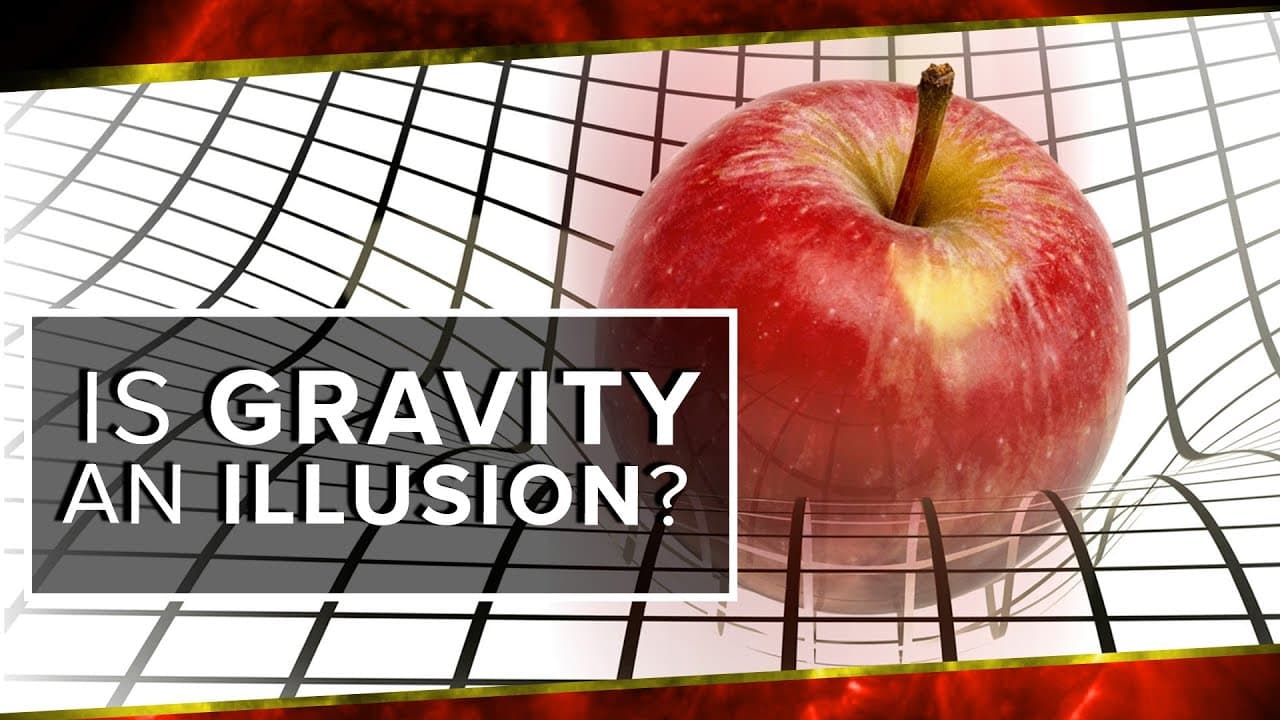
Is Gravity An Illusion?
TL;DR
Einstein's view of gravity challenges Newton's traditional understanding.
Transcript
[MUSIC PLAYING] Isaac Newton said that an apple falls because a gravitational force accelerates it toward the ground, but what if it's really the ground accelerating up to meet the apple? [THEME MUSIC] Suppose I drop an apple. According to Isaac Newton, the ground can be considered at rest, Earth applies a gravitational force to the apple, and that... Read More
Key Insights
- Isaac Newton described gravity as a force pulling objects down, while Einstein proposed that objects are stationary and the ground accelerates upward.
- Frames of reference are crucial in physics to measure motion, highlighting that only relative motion can be observed.
- Inertial frames are non-accelerating frames where Newton's second law applies, showing that acceleration is relative.
- Accelerated frames mimic gravitational fields, suggesting gravity might be an illusion caused by acceleration.
- Einstein's equivalence principle posits that freefall is indistinguishable from zero gravity, challenging traditional views of gravity.
- Curved spacetime in general relativity allows for inertial frames to accelerate relative to each other, explaining gravitational phenomena.
- General relativity, which views gravity as a result of spacetime curvature, has been experimentally validated over Newtonian gravity.
- The discussion of exoplanets and the James Webb Space Telescope emphasizes the importance of scientific exploration beyond our solar system.
Install to Summarize YouTube Videos and Get Transcripts
Explore YouTube Video Summarizer or Get YouTube Transcript Extractor
Questions & Answers
Q: How does Einstein's view of gravity differ from Newton's?
Einstein proposed that gravity is not a force pulling objects downward, as Newton suggested, but rather an effect of the ground accelerating upwards. This view is based on the concept of frames of reference and the equivalence principle, which states that freefall is indistinguishable from zero gravity, leading to the theory of general relativity.
Q: What is the significance of frames of reference in physics?
Frames of reference are crucial for measuring motion, as they provide a relative point of view. In physics, only relative motion can be observed, and inertial frames, which do not accelerate, are essential for applying Newton's second law. Understanding frames of reference helps clarify how acceleration and gravity are perceived.
Q: What is the equivalence principle introduced by Einstein?
Einstein's equivalence principle posits that freefall is indistinguishable from being in a state of zero gravity. This principle challenges the traditional view of gravity as a force, suggesting instead that gravity is an illusion caused by acceleration. It is a foundational concept in Einstein's theory of general relativity.
Q: How does general relativity explain gravitational phenomena?
General relativity explains gravity as the curvature of spacetime caused by mass. Unlike Newton's theory, which views gravity as a force, general relativity describes how objects follow curved paths in spacetime. This model accounts for various gravitational phenomena and has been validated through experimental evidence.
Q: What role do accelerated frames play in understanding gravity?
Accelerated frames mimic gravitational fields, suggesting that gravity might be an illusion caused by acceleration. In these frames, objects appear to experience a gravitational pull in the opposite direction of the acceleration. This concept supports Einstein's view that gravity is not a fundamental force but a result of spacetime curvature.
Q: What challenges did Einstein face in developing his theory of gravity?
Einstein faced challenges in reconciling his ideas with the established Newtonian physics, particularly the concept of inertial frames and acceleration. He had to consider the implications of curved spacetime, which allows inertial frames to accelerate relative to each other, ultimately leading to the development of general relativity.
Q: How does the James Webb Space Telescope contribute to our understanding of exoplanets?
The James Webb Space Telescope, primarily an infrared telescope, will enhance our understanding of exoplanets by observing them in infrared light. It aims to study super-Earths near red dwarfs, although Earth analogs around Sun-like stars may remain elusive due to observation limitations. Its findings will advance knowledge of planetary systems and atmospheric conditions.
Q: Why is the study of exoplanets important in astronomy?
The study of exoplanets is crucial for understanding planetary system formation, the effects of different star types on planetary atmospheres, and the potential for life beyond our solar system. Exoplanet research provides insights into the diversity of planetary systems and serves as a laboratory for studying processes that cannot be observed within our own solar system.
Summary & Key Takeaways
-
Einstein's perspective on gravity suggests that what we perceive as gravitational force is actually the ground accelerating upwards. This challenges the traditional Newtonian view and introduces the concept of frames of reference to understand motion and acceleration.
-
Inertial frames are key to understanding true acceleration, and Einstein's equivalence principle suggests that freefall is equivalent to zero gravity. This principle laid the groundwork for general relativity, which describes gravity as the curvature of spacetime.
-
General relativity has provided new insights into gravitational phenomena, surpassing Newton's theories. The exploration of exoplanets with advanced telescopes like the James Webb Space Telescope highlights the ongoing quest to understand planetary systems and their potential for life.
Read in Other Languages (beta)
Share This Summary 📚
Summarize YouTube Videos and Get Video Transcripts with 1-Click
Try YouTube Summary with ChatGPT & Claude or YouTube Transcript Generator
Explore More Summaries from PBS Space Time 📚
Summarize YouTube Videos and Get Video Transcripts with 1-Click
Try YouTube Summary with ChatGPT & Claude or YouTube Transcript Generator