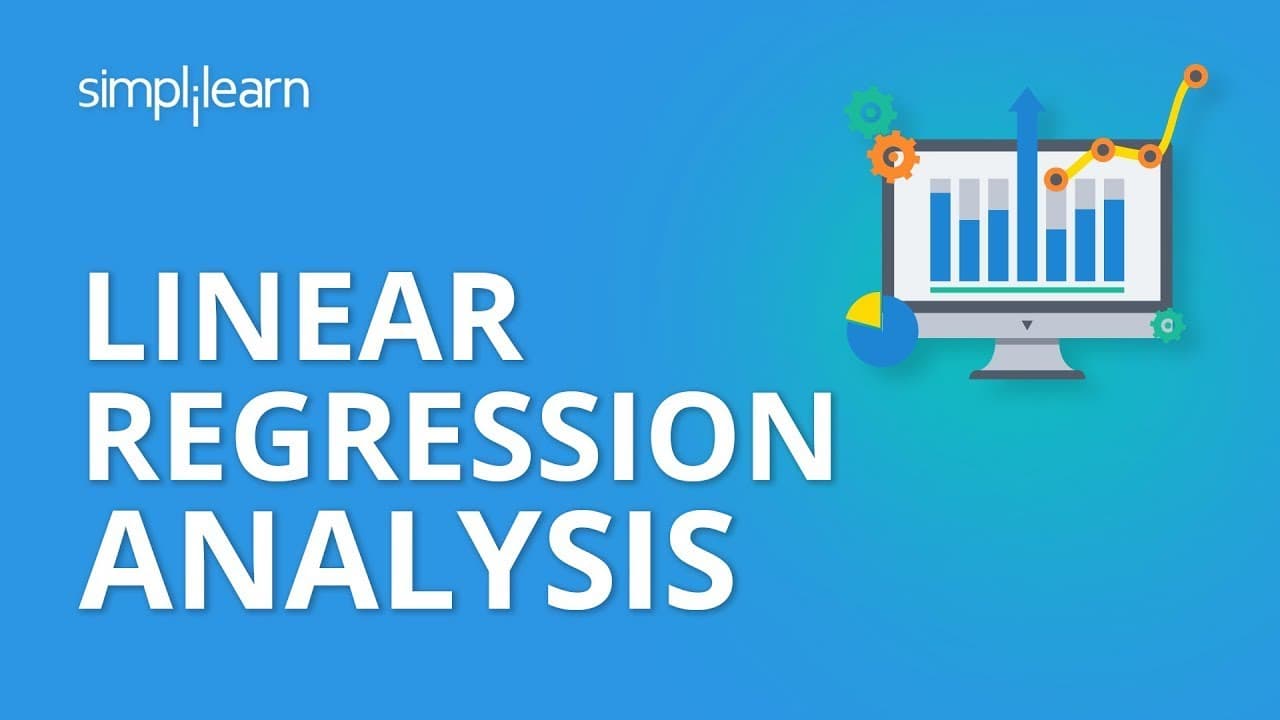
Linear Regression Analysis | Linear Regression in Python | Machine Learning Algorithms | Simplilearn
TL;DR
Learn linear regression basics and profit prediction with Python.
Transcript
welcome to linear regression my name is richard kirschner i'm with simply learn let's look at an example of a common use for linear regression profit estimation of a company if i was going to invest in a company i would like to know how much money i could expect to make so we'll take a look at a venture capitalist firm and t... Read More
Key Insights
- Linear regression is used to predict company profits based on expenses, focusing on R&D expenditure.
- Machine learning algorithms are categorized into supervised, unsupervised, and reinforcement learning.
- Supervised learning involves using known data to train models for prediction, with linear regression as a key example.
- Applications of linear regression include predicting economic growth, product pricing, housing sales, and sports scores.
- Simple linear regression involves one independent and one dependent variable, while multiple linear regression involves several predictors.
- The regression line is determined by minimizing the sum of squared errors between predicted and actual values.
- Python libraries like NumPy, Pandas, and Matplotlib are essential for implementing linear regression models.
- Evaluating model accuracy involves calculating the R-squared value, indicating the goodness of fit.
Install to Summarize YouTube Videos and Get Transcripts
Explore YouTube Video Summarizer or Get YouTube Transcript Extractor
Questions & Answers
Q: What is the primary use of linear regression in the video?
Linear regression is primarily used to predict the profit of companies based on their expenses, particularly focusing on research and development (R&D) expenditure. The video demonstrates how to use linear regression to make these predictions using Python, providing a practical application of the statistical model.
Q: How does the video categorize machine learning algorithms?
The video categorizes machine learning algorithms into three main types: supervised, unsupervised, and reinforcement learning. It focuses on supervised learning, where the model is trained using labeled data, and highlights linear regression as a key example of a supervised learning algorithm.
Q: What are some real-world applications of linear regression mentioned?
Real-world applications of linear regression mentioned in the video include predicting economic growth, estimating future product prices, forecasting housing sales, and predicting sports scores. These examples illustrate the versatility of linear regression in various fields, from economics to sports analytics.
Q: What is the difference between simple and multiple linear regression?
Simple linear regression involves predicting a dependent variable using a single independent variable, while multiple linear regression uses several independent variables to predict the outcome. The video explains this distinction and demonstrates how multiple factors can be integrated into a linear regression model for more accurate predictions.
Q: How is the regression line determined in linear regression?
The regression line in linear regression is determined by minimizing the sum of squared errors between the predicted values and the actual values. This process involves calculating the best-fit line that represents the relationship between the independent and dependent variables, ensuring the highest possible accuracy in predictions.
Q: Which Python libraries are essential for implementing linear regression?
Essential Python libraries for implementing linear regression include NumPy for numerical computations, Pandas for data manipulation and analysis, and Matplotlib for data visualization. These libraries provide the necessary tools to preprocess data, build regression models, and visualize results effectively.
Q: How is model accuracy evaluated in the video?
Model accuracy in the video is evaluated using the R-squared value, which measures the proportion of variance in the dependent variable that is predictable from the independent variables. A higher R-squared value indicates a better fit of the model to the data, signifying more accurate predictions.
Q: What steps are involved in creating a linear regression model in Python?
Creating a linear regression model in Python involves importing necessary libraries, preprocessing data, splitting data into training and testing sets, fitting the regression model to the training data, and evaluating the model's accuracy using metrics like the R-squared value. The video walks through these steps, demonstrating the process with code examples.
Summary & Key Takeaways
-
The video introduces linear regression, a statistical model for predicting relationships between variables. It focuses on using R&D expenses to estimate company profits, illustrating the process with Python code.
-
Key concepts in machine learning are covered, including supervised learning and linear regression applications. The distinction between simple and multiple linear regression is explained, with emphasis on the importance of accurate predictions.
-
The tutorial demonstrates the implementation of linear regression in Python, using libraries like NumPy and Pandas. It highlights the process of splitting data into training and testing sets, and evaluates model accuracy using the R-squared value.
Read in Other Languages (beta)
Share This Summary 📚
Summarize YouTube Videos and Get Video Transcripts with 1-Click
Try YouTube Summary with ChatGPT & Claude or YouTube Transcript Generator
Explore More Summaries from Simplilearn 📚



Summarize YouTube Videos and Get Video Transcripts with 1-Click
Try YouTube Summary with ChatGPT & Claude or YouTube Transcript Generator