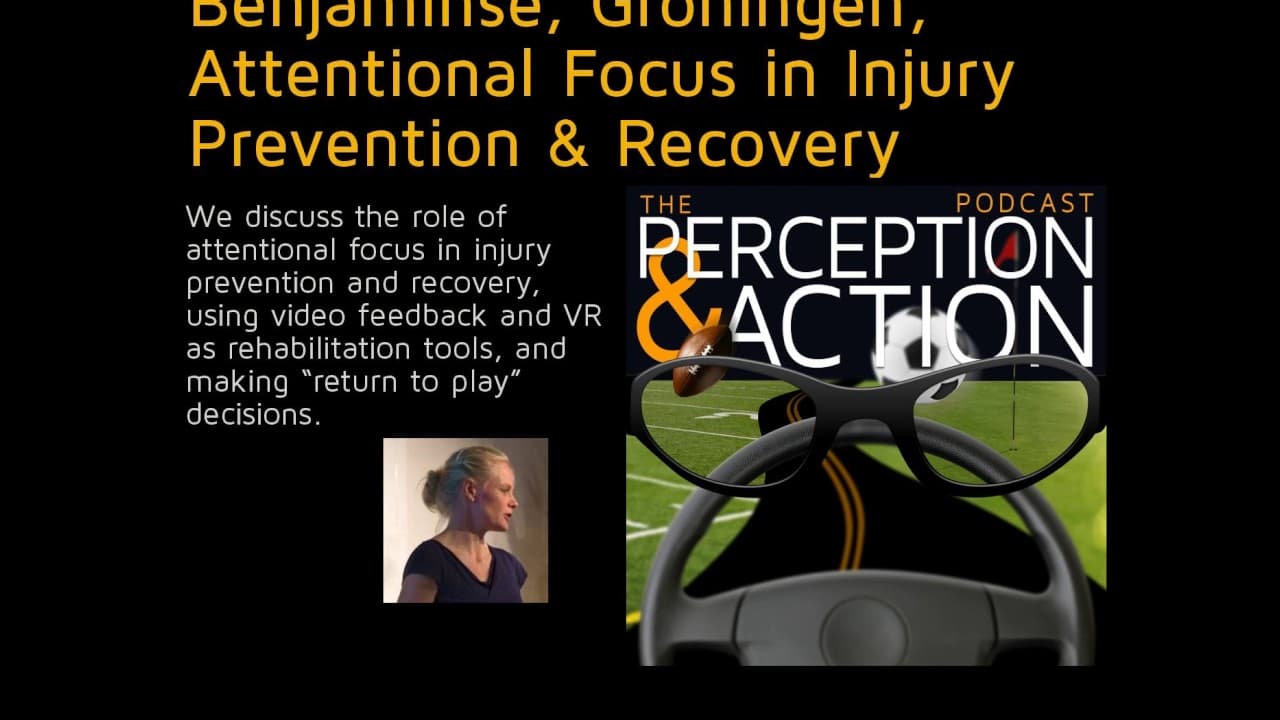
70 – Interview with Anne Benjaminse, Groningen, Attentional Focus in Injury Prevention & Recovery
TL;DR
Interview on using attentional focus for injury prevention and recovery.
Transcript
this is Rob Gray from ASU and perception action.com today on the perception and action podcast my interview with Anna Benjamin from the Department for human movement Sciences at the University of groan in the Netherlands hi everyone welcome to the perception and action podcast where I discuss how psychological research can be applied to improving p... Read More
Key Insights
- Anna Benjaminse emphasizes using an external focus of attention to enhance movement automaticity, which aids in injury prevention and skill transfer to real sports environments.
- Traditional internal focus instructions, like directing athletes to flex specific body parts, may hinder automaticity and awareness of external risks, potentially increasing injury risk.
- Video feedback and virtual reality are effective tools in rehabilitation, offering athletes visual examples to mimic expert movements without explicit body-focused instructions.
- The Drop Vertical Jump Test and Landing Error Scoring System help identify athletes' strengths and weaknesses, guiding targeted interventions rather than predicting injuries outright.
- Recovery from injury should prioritize external focus to avoid the increased conscious control that can result from internal focus, promoting more natural movement patterns.
- Return to play decisions should be individualized, considering psychological readiness and movement quality, not just physical benchmarks or time-based criteria.
- Future research aims to combine motor learning insights with real-time biomechanical measurements on the field, enhancing injury prevention and rehabilitation strategies.
- Collaborating with coaches and trainers is crucial for integrating safe movement techniques into regular training, ensuring athletes can transfer learned skills to real sports scenarios.
Install to Summarize YouTube Videos and Get Transcripts
Explore YouTube Video Summarizer or Get YouTube Transcript Extractor
Questions & Answers
Q: What is the role of attentional focus in injury prevention?
Attentional focus plays a crucial role in injury prevention by promoting movement automaticity and environmental awareness. An external focus of attention, where athletes concentrate on the effects of their movements rather than the movements themselves, can help in acquiring safer movement patterns. This approach reduces the likelihood of injury by facilitating more natural and automatic responses during sports activities.
Q: How does video feedback aid in rehabilitation?
Video feedback aids rehabilitation by providing visual examples of expert movements for athletes to imitate. This approach allows athletes to see and understand the desired movement patterns without focusing on specific body parts. By using techniques like overlaying expert models with athletes' performances, video feedback helps athletes explore and discover effective movement strategies, enhancing their rehabilitation process.
Q: What are the challenges in predicting sports injuries?
Predicting sports injuries is challenging due to the complex interplay of factors influencing injury risk. Tests like the Drop Vertical Jump Test can highlight an athlete's strengths and weaknesses, but they do not predict injuries outright. Instead, these tests provide insights into an athlete's current status, helping coaches and trainers target specific areas for improvement to reduce injury risk.
Q: Why is an individualized approach important in return to play decisions?
An individualized approach is vital in return to play decisions because each athlete's recovery journey and readiness vary. Factors such as psychological readiness, movement quality, and physical benchmarks must be considered. A multifactorial approach ensures that athletes are truly prepared to return to sports, reducing the risk of re-injury and ensuring a safe and effective transition back to play.
Q: How can virtual reality be used in sports rehabilitation?
Virtual reality (VR) can be used in sports rehabilitation by immersing athletes in simulated environments that require attention to external stimuli. This approach encourages athletes to focus less on their body movements and more on environmental interactions, promoting more natural movement patterns. VR can help athletes practice and refine skills in a controlled yet realistic setting, aiding in their recovery process.
Q: What future research directions does Anna Benjaminse suggest?
Anna Benjaminse suggests future research should focus on understanding motor learning processes, particularly the role of self-controlled feedback. Additionally, measuring biomechanical loads in real sports settings is crucial, as this provides insights into athletes' movement patterns in actual conditions. Collaborating with coaches to integrate these findings into regular training is also a key future direction.
Q: What is the significance of movement quality in injury recovery?
Movement quality is significant in injury recovery as it ensures athletes are not only physically ready to return to sports but also capable of performing movements safely and effectively. High-quality movement reduces the risk of re-injury by preventing compensatory patterns that can arise from inadequate recovery. Assessing movement quality alongside physical benchmarks provides a comprehensive view of an athlete's readiness.
Q: How does collaboration with coaches enhance injury prevention strategies?
Collaboration with coaches enhances injury prevention strategies by integrating research findings into practical training routines. Coaches can help implement safe movement techniques and attentional focus strategies during regular training sessions. This partnership ensures that athletes can transfer learned skills from controlled environments to real sports scenarios, improving overall injury prevention efforts.
Summary & Key Takeaways
-
Anna Benjaminse discusses the importance of attentional focus in injury prevention and recovery, advocating for an external focus to promote automaticity and environmental awareness. She highlights the use of video feedback and VR as effective rehabilitation tools.
-
Using tools like the Drop Vertical Jump Test, Anna aims to identify athletes' strengths and weaknesses, guiding targeted interventions. She emphasizes that injury prediction is challenging, focusing instead on current athlete status and movement quality.
-
In recovery, Anna stresses the need for external focus to avoid increased conscious control. Return to play should be individualized, considering psychological readiness and movement quality, with future research focusing on real-time field measurements and collaboration with coaches.
Read in Other Languages (beta)
Share This Summary 📚
Summarize YouTube Videos and Get Video Transcripts with 1-Click
Try YouTube Summary with ChatGPT & Claude or YouTube Transcript Generator
Explore More Summaries from Rob Gray 📚

Summarize YouTube Videos and Get Video Transcripts with 1-Click
Try YouTube Summary with ChatGPT & Claude or YouTube Transcript Generator