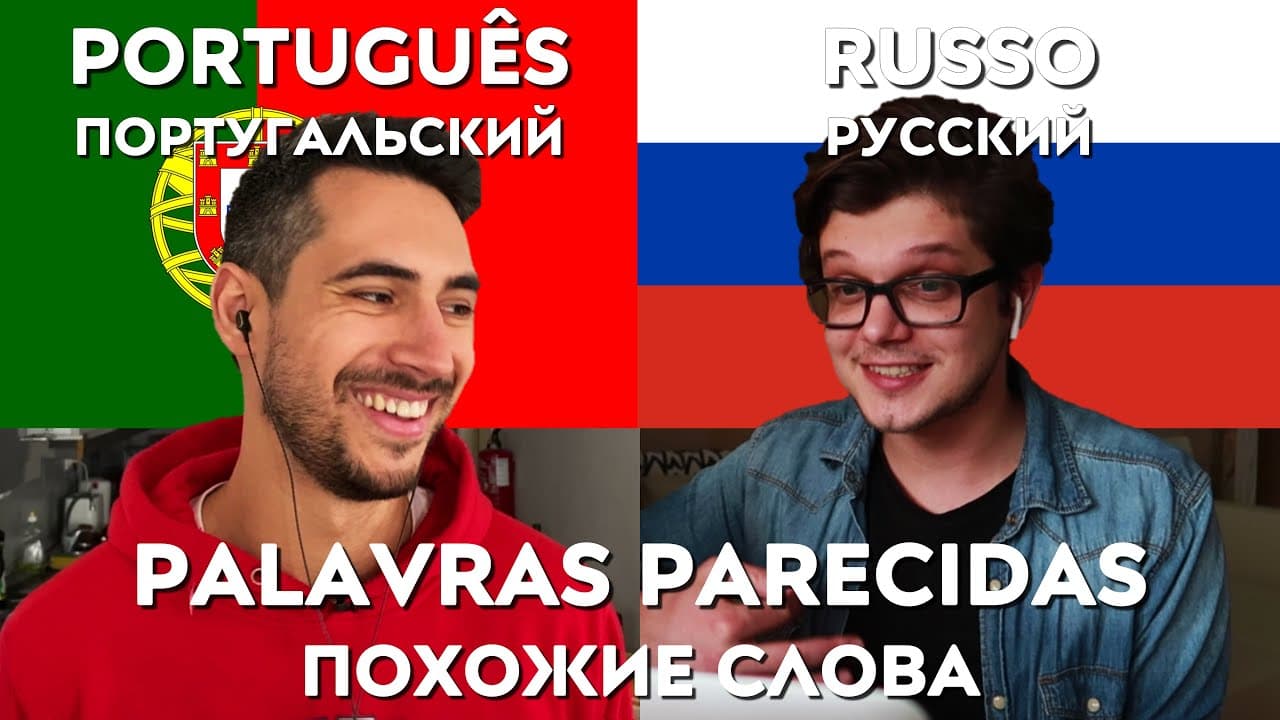
Palavras parecidas em português e russo
TL;DR
Exploring phonetic similarities between Portuguese and Russian words.
Transcript
Hello everyone and welcome back to Portuguese With Leo! Last week I did a collaboration with Pavel from the Dom Idiom channel, in which we explored the phonetic similarities between Portuguese and Russian, and during our conversation, Pavel told me the following: And there are even similar words. Although Russian is a Slavic language, many Russian ... Read More
Key Insights
- The collaboration between Leo and Pavel highlights phonetic similarities between Portuguese and Russian, focusing on words of Latin origin in Russian.
- Russian words ending in '-tsiya' have similar counterparts in Portuguese and English, such as 'aviatsiya' translating to 'aviation'.
- Some Portuguese words have historical roots and variations, like 'paletó' used in Brazilian Portuguese for 'jacket'.
- The Russian word 'banya' translates to 'sauna', while in Portuguese 'banha' colloquially means 'fat', demonstrating interesting false cognates.
- The word 'kvartira' in Russian means 'apartment', showing phonetic resemblance to Portuguese 'quartira' or 'quarto' (room).
- Russian 'pivo' means 'beer', similar to its use in Angolan Portuguese, though unfamiliar in European Portuguese.
- The conversation reveals how language learners often encounter unexpected challenges with similar-sounding words that have different meanings.
- Pavel's YouTube channel, Dom Idiom, offers content for Russians learning Portuguese, emphasizing cross-linguistic understanding.
Install to Summarize YouTube Videos and Get Transcripts
Explore YouTube Video Summarizer or Get YouTube Transcript Extractor
Questions & Answers
Q: What is the main focus of the collaboration between Leo and Pavel?
The collaboration between Leo and Pavel focuses on exploring the phonetic similarities between Portuguese and Russian words. They discuss how certain Russian words of Latin origin sound similar to their Portuguese counterparts, providing insights into language learning and the historical connections between the languages.
Q: How do Russian words ending in '-tsiya' relate to Portuguese and English?
Russian words ending in '-tsiya' often have counterparts in Portuguese and English that end in '-tion'. For example, 'aviatsiya' in Russian translates to 'aviation' in English and Portuguese, demonstrating a phonetic similarity across these languages due to their shared Latin roots.
Q: What is the significance of the word 'paletó' in Brazilian Portuguese?
In Brazilian Portuguese, 'paletó' is used to refer to a 'jacket'. This term is less common in European Portuguese, where 'sobretudo' is more frequently used. The discussion highlights how certain words have historical roots and variations across different Portuguese-speaking regions.
Q: What is an example of a false cognate between Russian and Portuguese?
A notable example of a false cognate is the Russian word 'banya', which means 'sauna', while in Portuguese, 'banha' colloquially refers to 'fat'. This highlights the challenges language learners face when encountering similar-sounding words with different meanings across languages.
Q: How does the word 'kvartira' demonstrate phonetic resemblance to Portuguese?
The Russian word 'kvartira', meaning 'apartment', shows phonetic resemblance to Portuguese 'quartira' or 'quarto', which means 'room'. This similarity underscores the shared linguistic roots and phonetic patterns between Russian and Portuguese, despite their distinct language families.
Q: What is the significance of the word 'pivo' in Russian and Angolan Portuguese?
In Russian, 'pivo' means 'beer', and this word is also used in Angolan Portuguese as 'piven'. However, it is unfamiliar in European Portuguese. This highlights regional variations in language use and the influence of cultural exchanges on language development.
Q: What challenges do language learners face with similar-sounding words?
Language learners often encounter challenges with similar-sounding words, known as false cognates, which have different meanings across languages. This can lead to misunderstandings and requires learners to pay close attention to context and pronunciation nuances to accurately grasp the intended meaning.
Q: What resources does Pavel offer for Russians learning Portuguese?
Pavel runs a YouTube channel, Dom Idiom, which offers resources for Russians learning Portuguese. His content includes videos in Russian explaining Portuguese language concepts, encouraging cross-cultural understanding and providing valuable insights into the language learning process for Russian speakers.
Summary & Key Takeaways
-
Leo and Pavel explore phonetic similarities between Portuguese and Russian, focusing on words of Latin origin in Russian. They discuss how certain words sound similar across languages, offering insights into language learning challenges.
-
The video highlights various words like 'aviatsiya' (aviation), 'revolyutsiya' (revolution), and 'kvartira' (apartment), demonstrating phonetic similarities and differences. The conversation provides a fun exploration of linguistic connections.
-
Pavel's expertise in Russian and Portuguese offers valuable insights into language learning. His channel, Dom Idiom, provides resources for Russians learning Portuguese, encouraging cross-cultural and linguistic understanding.
Read in Other Languages (beta)
Share This Summary 📚
Summarize YouTube Videos and Get Video Transcripts with 1-Click
Try YouTube Summary with ChatGPT & Claude or YouTube Transcript Generator
Explore More Summaries from Portuguese With Leo 📚


Summarize YouTube Videos and Get Video Transcripts with 1-Click
Try YouTube Summary with ChatGPT & Claude or YouTube Transcript Generator