L01.6 More Properties of Probabilities
TL;DR
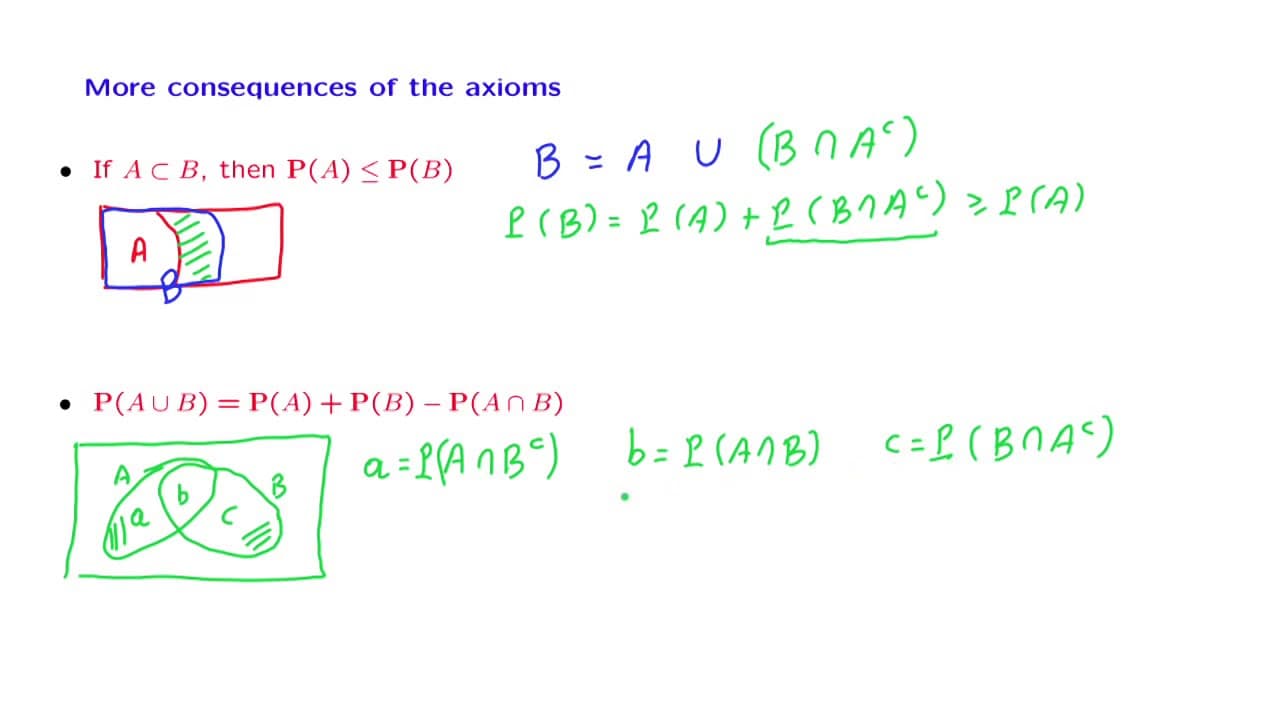
The video discusses two properties of probability laws - one showing that the probability of a larger set is greater than or equal to the probability of a smaller set, and another providing a formula for calculating the probability of the union of two sets.
Transcript
We will now continue and derive some additional properties of probability laws which are, again, consequences of the axioms that we have introduced. The first property is the following. If we have two sets and one set is smaller than the other-- so we have a picture as follows. We have our sample space. And we have a certain set, A. And then we hav... Read More
Key Insights
- 😫 The probability of a larger set is greater than or equal to the probability of a smaller set.
- 😫 The probability of the union of two sets can be calculated by adding the probabilities of three disjoint pieces.
- 🇪🇺 The union bound inequality states that the probability of the union of two sets is always less than or equal to the sum of their individual probabilities.
Install to Summarize YouTube Videos and Get Transcripts
Explore YouTube Video Summarizer or Get YouTube Transcript Extractor
Questions & Answers
Q: How can we prove that the probability of a larger set is greater than or equal to the probability of a smaller set?
By expressing the larger set as a union of two pieces - the smaller set itself and the elements of the larger set that do not belong to the smaller set. Using the additivity axiom, we can show that the probability of the larger set is at least as large as the probability of the smaller set.
Q: What is the formula for calculating the probability of the union of two sets?
The probability of the union of two sets can be found by adding the probabilities of three pieces - the part of the first set not in the second set, the intersection of the two sets, and the part of the second set not in the first set.
Q: What is the name of the inequality stating that the probability of the union of two sets is smaller than or equal to the sum of their individual probabilities?
It is called the union bound.
Q: How can we calculate the probability of the union of three sets?
By expressing the union of three sets as the union of three disjoint pieces - the first set, the part of the second set not in the first set, and the part of the third set not in either the first or second set. We can then use the additivity axiom to find the probability.
Summary & Key Takeaways
-
Property 1: If one set is larger than another, then the probability of the larger set is greater than or equal to the probability of the smaller set.
-
Property 2: The probability of the union of two sets can be calculated by adding the probabilities of three disjoint pieces - the part of the first set not in the second set, the intersection of the two sets, and the part of the second set not in the first set.
Read in Other Languages (beta)
Share This Summary 📚
Summarize YouTube Videos and Get Video Transcripts with 1-Click
Try YouTube Summary with ChatGPT & Claude or YouTube Transcript Generator
Explore More Summaries from MIT OpenCourseWare 📚
Summarize YouTube Videos and Get Video Transcripts with 1-Click
Try YouTube Summary with ChatGPT & Claude or YouTube Transcript Generator