How to Segment MRI Images Using K-Means Clustering
TL;DR
To segment MRI brain images effectively, use the k-means clustering algorithm, especially when hierarchical clustering fails due to large datasets. K-means works by assigning data points to clusters based on the nearest mean and iteratively updates these means until no further reassignments are needed. This method efficiently partitions image data into distinct regions.
Transcript
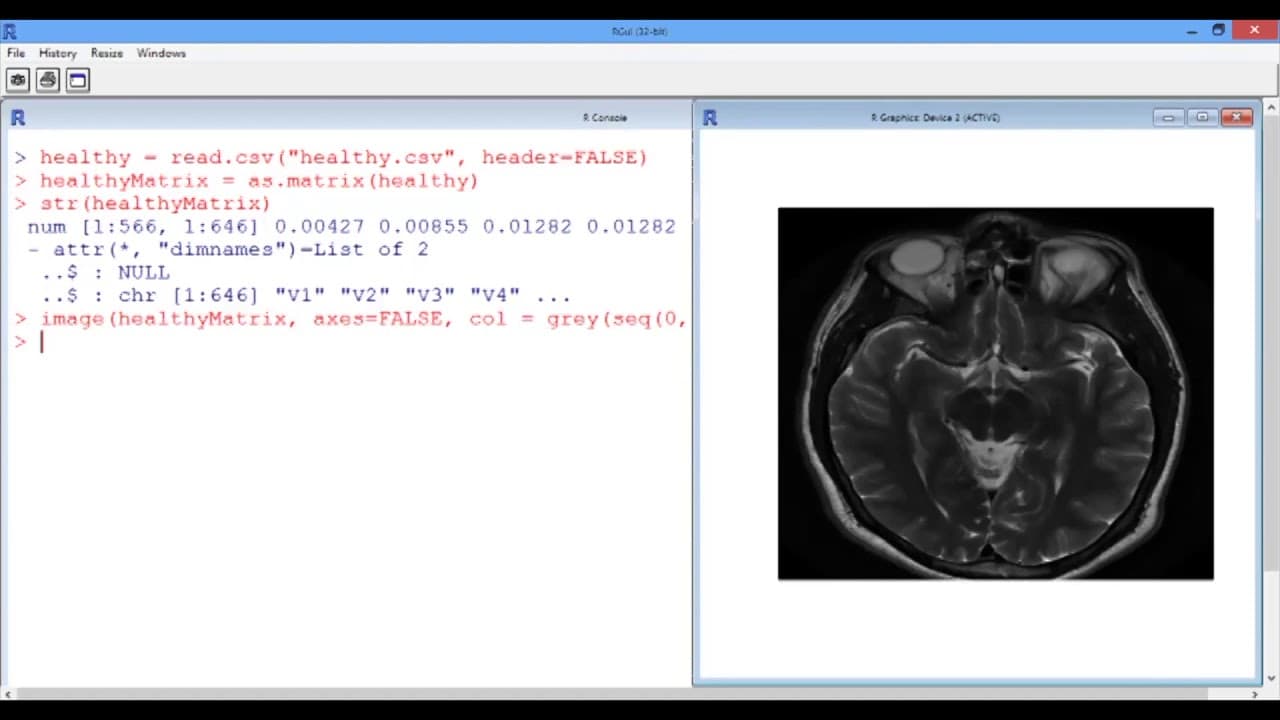
In this video we will try to segment an MRI brain image of a healthy patient using hierarchical clustering. Make sure that you are in the directory where you saved the healthy.csv file. We will be following the exact same steps we did in the previous video. First, read in the data, and call the data frame healthy. Use the read.csv function to read ... Read More
Key Insights
- 🌥️ Hierarchical clustering is not suitable for large datasets due to memory limitations.
- 😉 The k-means clustering algorithm can be used as an alternative for image segmentation.
- 👈 K-means clustering operates by assigning data points to the cluster with the nearest mean.
- #️⃣ It is important to specify the number of clusters when using k-means clustering.
- 😉 K-means clustering does not require calculating pairwise distances.
- ❓ The algorithm iteratively updates cluster means until no further reassignments are necessary.
- 👈 K-means clustering can partition data points based on similarity.
Install to Summarize YouTube Videos and Get Transcripts
Explore YouTube Video Summarizer or Get YouTube Transcript Extractor
Questions & Answers
Q: Why is hierarchical clustering not suitable for segmenting the MRI brain image?
Hierarchical clustering requires calculating pairwise distances, which results in a massive number of values to be stored in a matrix. The size of the matrix becomes too large for R to handle, leading to memory allocation errors.
Q: What is the purpose of the k-means clustering algorithm?
The k-means algorithm aims to partition data into k clusters, assigning each data point to the cluster with the nearest mean. It is a popular method for clustering data points based on similarity.
Q: How does the k-means clustering algorithm work?
The algorithm starts by randomly grouping data points into k clusters. It then computes the means (centroids) of each cluster. Data points are then reassigned to the cluster with the nearest mean. The process is repeated, constantly updating the cluster means, until no further reassignments are needed.
Q: How does k-means clustering differ from hierarchical clustering?
K-means clustering requires specifying the number of clusters in advance and assigns data points to the nearest mean. Hierarchical clustering creates a hierarchy of clusters without the need to specify the number of clusters in advance.
Q: Is k-means clustering suitable for high-resolution images?
K-means clustering can work with high-resolution images as it does not require calculating pairwise distances. However, it may not be as effective as hierarchical clustering in some cases.
Summary & Key Takeaways
-
The video begins by reading in the MRI brain image data and creating a matrix of intensity values.
-
The image is displayed using the R programming language, showing different substances in the brain.
-
Attempts to perform hierarchical clustering fail due to the large size of the dataset.
-
The k-means clustering algorithm is introduced as an alternative method for image segmentation.
Read in Other Languages (beta)
Share This Summary 📚
Summarize YouTube Videos and Get Video Transcripts with 1-Click
Try YouTube Summary with ChatGPT & Claude or YouTube Transcript Generator
Explore More Summaries from MIT OpenCourseWare 📚


Summarize YouTube Videos and Get Video Transcripts with 1-Click
Try YouTube Summary with ChatGPT & Claude or YouTube Transcript Generator