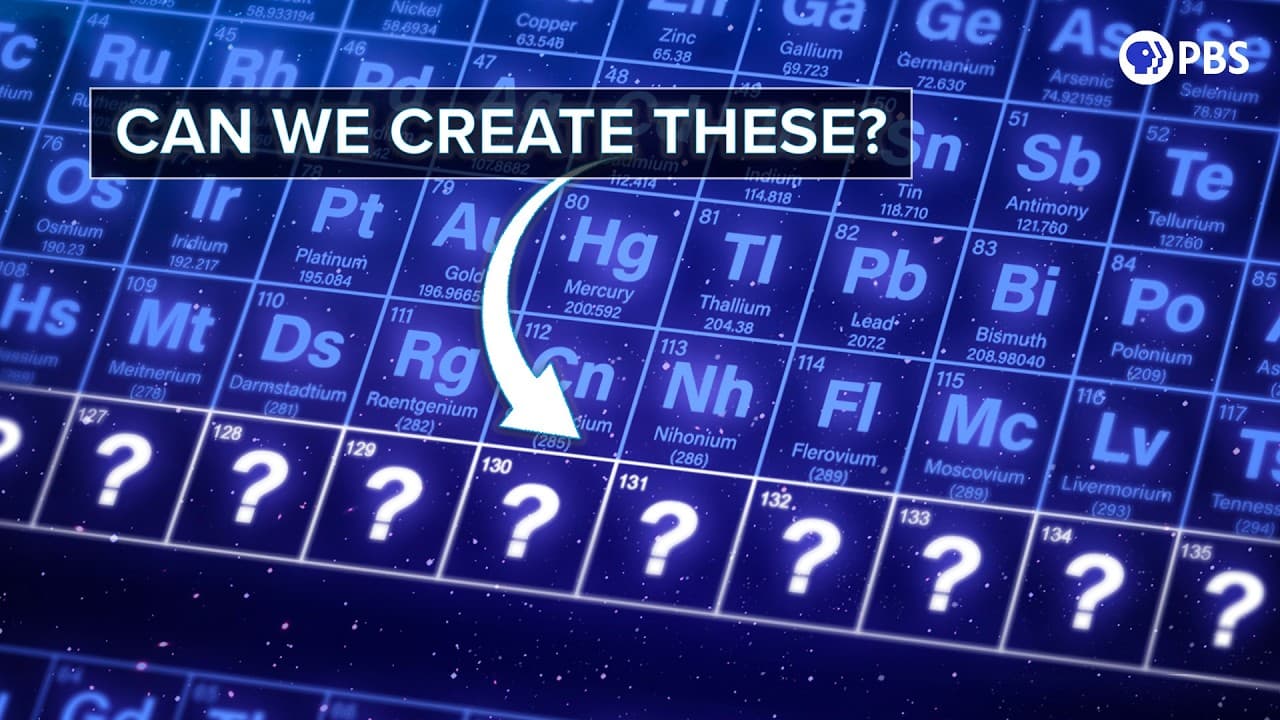
Can We Create New Elements Beyond the Periodic Table?
TL;DR
Exploring the potential for new elements beyond the periodic table.
Transcript
Thank you to Raycon for supporting PBS Scientists have been slowly extending the periodic table one element at a time, pushing to higher and higher masses, and have discovered some incredibly useful materials along the way. But the elements at the current end of the table are so unstable that they decay almost as soon as they’re created in our p... Read More
Key Insights
- The periodic table has been gradually extended by scientists, but the heaviest elements are highly unstable, decaying quickly after creation.
- The Island of Stability is a theoretical area in the periodic table where heavy elements might have unusual stability and properties.
- Current methods of creating new elements involve particle accelerators, but these struggle to produce stable super-heavy elements.
- Neutron star mergers, cosmic events where two neutron stars collide, might create elements from the Island of Stability.
- Neutron stars are essentially massive atomic nuclei, and their mergers release neutron-rich material that can form heavy elements.
- The r-process, or rapid neutron capture process, in neutron star mergers can create elements up to the end of the periodic table.
- Observations of stars formed after neutron star mergers provide evidence of heavy elements' creation, detected through their elemental signatures.
- Kilonovae, the afterglow of a neutron star merger, might reveal the presence of elements from the Island of Stability if observed quickly enough.
Install to Summarize YouTube Videos and Get Transcripts
Explore YouTube Video Summarizer or Get YouTube Transcript Extractor
Questions & Answers
Q: What is the Island of Stability?
The Island of Stability is a theoretical concept in nuclear physics suggesting a region in the periodic table where certain super-heavy elements might have increased stability. These elements could have longer half-lives compared to other heavy elements, potentially possessing unique and useful properties.
Q: How are new elements typically created in laboratories?
New elements are typically created in laboratories using particle accelerators. This involves colliding smaller atomic nuclei, such as calcium or titanium, with heavier target nuclei, like californium, to form super-heavy elements. However, these elements often have short half-lives due to their instability.
Q: What role do neutron star mergers play in element creation?
Neutron star mergers play a significant role in creating heavy elements. During these cosmic events, neutron-rich material is ejected, allowing rapid neutron capture (r-process) to occur, forming heavy elements. This process can potentially produce elements from the Island of Stability, extending the periodic table.
Q: Why are neutron stars described as massive atomic nuclei?
Neutron stars are described as massive atomic nuclei because they are incredibly dense, composed almost entirely of neutrons, similar to the core of an atomic nucleus. They are formed from the remnants of supernovae, where the core of a massive star collapses under gravity, creating a city-sized nucleus with immense density.
Q: What evidence supports the creation of heavy elements in neutron star mergers?
Evidence supporting the creation of heavy elements in neutron star mergers comes from observing stars formed after such events. These stars display unique elemental signatures, indicating the presence of heavy elements created during the merger. The decay products of these elements, such as ruthenium and palladium, can be detected in their spectra.
Q: How might kilonovae reveal the presence of Island of Stability elements?
Kilonovae, the afterglow of neutron star mergers, might reveal Island of Stability elements through their decay patterns. If heavy nuclei decay through this island, changes in the kilonova's brightness over time could reflect the half-lives of these elements. Quick observation after the merger is crucial to detect these transitions.
Q: What challenges exist in creating stable super-heavy elements in labs?
Creating stable super-heavy elements in labs is challenging due to their rapid decay and instability. Particle accelerators struggle to add enough neutrons to achieve the ideal neutron-to-proton ratio, often resulting in isotopes with short half-lives. Achieving stability requires reaching doubly-magic numbers or the Island of Stability.
Q: What are the potential applications of discovering new stable elements?
Discovering new stable elements could lead to significant advancements in materials science, nuclear physics, and technology. These elements might possess unique properties, such as enhanced stability or novel chemical behaviors, opening up possibilities for new materials, energy sources, and scientific insights into atomic structure and nuclear forces.
Summary & Key Takeaways
-
Scientists have been extending the periodic table by creating new, heavier elements, but these are often unstable and decay rapidly. The Island of Stability is a hypothesized region where certain heavy elements might be more stable, offering potential for new discoveries.
-
Neutron star mergers, cosmic events where two neutron stars collide, could create elements from the Island of Stability. These mergers release neutron-rich material that can form heavy elements through the r-process, potentially extending the periodic table.
-
Observations of stars formed after neutron star mergers provide evidence of heavy elements' creation, detected through their elemental signatures. Kilonovae, the afterglow of such mergers, might reveal the presence of Island of Stability elements if observed quickly enough.
Read in Other Languages (beta)
Share This Summary 📚
Summarize YouTube Videos and Get Video Transcripts with 1-Click
Try YouTube Summary with ChatGPT & Claude or YouTube Transcript Generator
Explore More Summaries from PBS Space Time 📚





Summarize YouTube Videos and Get Video Transcripts with 1-Click
Try YouTube Summary with ChatGPT & Claude or YouTube Transcript Generator