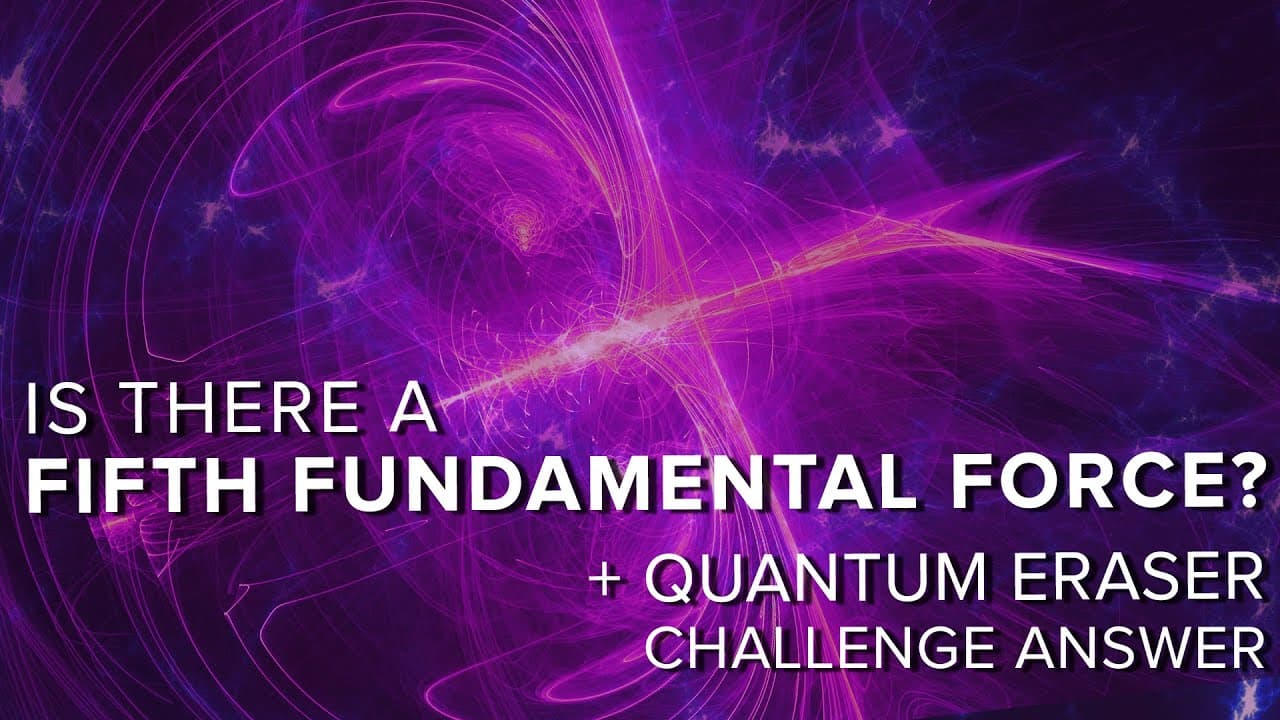
Is There a Fifth Fundamental Force? + Quantum Eraser Answer
TL;DR
Potential discovery of a fifth fundamental force in beryllium-8 decay.
Transcript
[MUSIC PLAYING] A few weeks ago, some very excitable science journalists were plastering the internet with headlines, like "Fifth Fundamental Force of Nature Discovered." What was that all about? Is there really a new force? Can I finally get my X-wing out of that swamp? Let me make it sound a little less hyped. There was something slightly weird a... Read More
Key Insights
- The discovery of a potential fifth fundamental force arises from anomalies in beryllium-8 atom decay, suggesting a new particle may exist.
- This new particle, with a mass energy equivalence of 17 MEV, could be a spin-1 gauge boson, indicating a new force.
- The anomaly in beryllium-8 decay is significant, with a 6.8 sigma excess, suggesting a high probability of new physics.
- The new particle could interact very weakly with regular matter, similar to dark matter, making it difficult to detect.
- The potential new force could mediate interactions between the dark sector and the visible universe, offering insights into dark matter.
- The delayed choice quantum eraser experiment demonstrates the complexity of quantum mechanics, with no data being sent back in time.
- The experiment reveals that photon interference patterns depend on the future measurement of entangled partners, but causality is not violated.
- Quantum mechanics remains mysterious, with no need for mystical interpretations to explain its phenomena.
Install to Summarize YouTube Videos and Get Transcripts
Explore YouTube Video Summarizer or Get YouTube Transcript Extractor
Questions & Answers
Q: What is the significance of the beryllium-8 decay anomaly?
The beryllium-8 decay anomaly is significant because it suggests the existence of a new particle, which may indicate a fifth fundamental force. This anomaly is characterized by a 6.8 sigma excess, a strong statistical indication that something unusual is happening, potentially extending the standard model of physics.
Q: Why is the potential new particle compared to dark matter?
The potential new particle is compared to dark matter because it may interact very weakly with regular matter, making it difficult to detect, much like dark matter. This characteristic suggests that the particle could mediate interactions between the dark sector and the visible universe, offering new insights into dark matter's nature.
Q: How does the delayed choice quantum eraser experiment work?
The delayed choice quantum eraser experiment involves photons passing through a double-slit setup, where interference patterns depend on future decisions about measuring entangled partners. Although the patterns seem influenced by future measurements, this experiment does not violate causality, demonstrating the non-intuitive nature of quantum mechanics.
Q: Why can't information be sent back in time using the quantum eraser experiment?
Information cannot be sent back in time using the quantum eraser experiment because the interference patterns are only observable after comparing results from different detectors. The distribution of photons appears as a single blurred pattern until additional data from entangled partners is available, ensuring information flow adheres to causality.
Q: What role do spin-1 gauge bosons play in fundamental forces?
Spin-1 gauge bosons play a crucial role in fundamental forces as they mediate interactions between particles. For example, electromagnetism and the strong and weak nuclear forces are communicated by these bosons. The discovery of a new spin-1 gauge boson would suggest a new fundamental force, expanding our understanding of particle physics.
Q: What is the standard method for discovering new particles?
The standard method for discovering new particles involves creating higher energy collisions, as seen in facilities like the Large Hadron Collider. This approach aims to produce new particles at higher energies, but some particles, like the potential new one, may exist at lower energies and interact weakly, making them harder to detect.
Q: How does the potential new force relate to the standard model?
The potential new force relates to the standard model as a mild extension, introducing a new particle that could be a spin-1 gauge boson. This addition would not radically alter the model but would provide new insights and expand our understanding of the fundamental forces governing the universe.
Q: What does the experiment reveal about consciousness in quantum mechanics?
The experiment reveals that consciousness is not required to explain quantum mechanics phenomena, such as the delayed choice quantum eraser. The results can be understood through decoherence and wave function interactions, without invoking mystical interpretations about consciousness affecting quantum events, maintaining a scientific perspective on quantum theory.
Summary & Key Takeaways
-
Recent experiments with beryllium-8 atoms suggest the existence of a new particle, possibly indicating a fifth fundamental force. This discovery could extend the standard model of physics and provide new insights into the universe's fundamental workings.
-
The anomaly in beryllium-8 decay shows a 6.8 sigma excess, a strong indication of something unusual occurring. The potential new particle may interact weakly with regular matter, similar to dark matter, and could be a spin-1 gauge boson.
-
The delayed choice quantum eraser experiment highlights the complexity of quantum mechanics, where photon interference patterns depend on future measurements. Despite the experiment's intricacies, it does not violate causality, maintaining the consistency of quantum theory.
Read in Other Languages (beta)
Share This Summary 📚
Summarize YouTube Videos and Get Video Transcripts with 1-Click
Try YouTube Summary with ChatGPT & Claude or YouTube Transcript Generator
Explore More Summaries from PBS Space Time 📚





Summarize YouTube Videos and Get Video Transcripts with 1-Click
Try YouTube Summary with ChatGPT & Claude or YouTube Transcript Generator