The Alchemy of Neutron Star Collisions
TL;DR
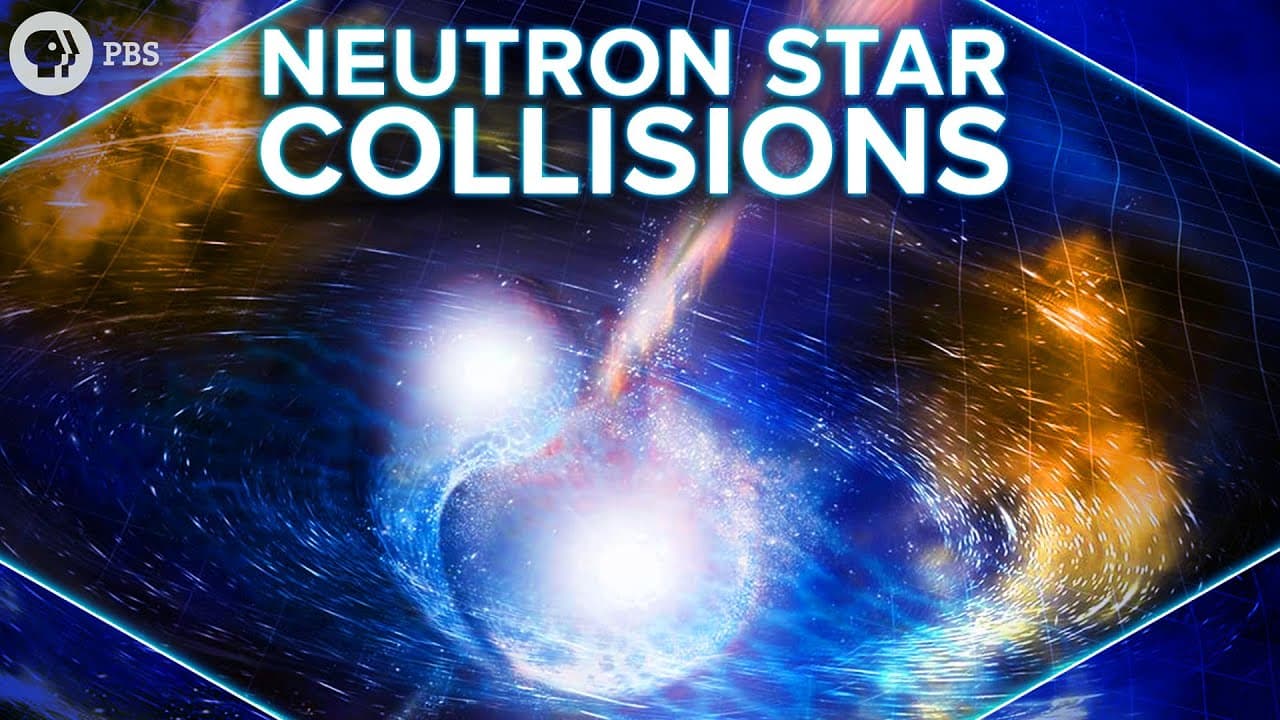
Neutron star collisions are key to Earth's heavy elements.
Transcript
Carl Sagan's famous words: "We are star stuff", refers to a mind-blowing idea that most atomic nuclei in our bodies were created in the nuclear furnaces and explosive deaths of stars that lived in the ancient universe in recent years it's become clear that the truth is even more mind-blowing many of Earth's heavy elements including most precious me... Read More
Key Insights
- Carl Sagan's concept of 'star stuff' is expanded to include neutron star collisions as a source of Earth's heavy elements.
- Traditional understanding of element formation in supernovae is challenged by new findings about neutron star collisions.
- Neutron star collisions are now considered the primary source of heavy elements, surpassing supernovae in their contribution.
- The r-process in neutron star collisions is responsible for creating neutron-rich isotopes of heavy elements.
- Gravitational wave observatories like LIGO and Virgo have detected neutron star mergers, confirming their role in element creation.
- The study of isotopic decay in meteorites provides evidence for neutron star mergers occurring before the solar system's formation.
- Neutron star mergers are rare events but have a significant impact on the abundance of heavy elements in the galaxy.
- The discovery of r-process elements in neutron star collision sites supports the theory of their origin in such cosmic events.
Install to Summarize YouTube Videos and Get Transcripts
Explore YouTube Video Summarizer or Get YouTube Transcript Extractor
Questions & Answers
Q: What is the significance of neutron star collisions in element formation?
Neutron star collisions are significant because they are now considered the primary source of Earth's heavy elements, including precious metals and radioactive isotopes. These collisions offer conditions for the rapid neutron capture process, or r-process, which creates neutron-rich isotopes of heavy elements, surpassing supernovae in their contribution.
Q: How do gravitational wave observatories contribute to our understanding of neutron star collisions?
Gravitational wave observatories like LIGO and Virgo have detected the space-time ripples from neutron star mergers, providing direct evidence of these cosmic events. These observations confirm the role of neutron star collisions in producing heavy elements and allow scientists to study the conditions and outcomes of such mergers in detail.
Q: What is the r-process, and why is it important?
The r-process, or rapid neutron capture process, is crucial for creating heavy elements in the universe. It occurs when neutrons are captured faster than nuclei can decay, allowing the formation of very heavy nuclei. This process is significant in neutron star collisions, producing neutron-rich isotopes of heavy elements essential for various cosmic and terrestrial phenomena.
Q: How do scientists trace the origins of Earth's heavy elements?
Scientists trace the origins of Earth's heavy elements by analyzing isotopic decay in ancient meteorites. These meteorites contain radioactive r-process isotopes formed in neutron star mergers. By studying the decay products and their ratios, scientists can determine the timing and location of the mergers, providing insights into the cosmic events that contributed to Earth's elemental makeup.
Q: Why are neutron star mergers considered rare events?
Neutron star mergers are considered rare because they result from the collision of two neutron stars, which requires specific conditions and timing. These events are infrequent on a galactic scale, occurring approximately every 20 million years. Despite their rarity, they have a significant impact on the abundance and distribution of heavy elements in the galaxy.
Q: What role do isotopic decay studies play in understanding neutron star mergers?
Isotopic decay studies play a crucial role in understanding neutron star mergers by providing a method to date these events. By examining the decay products of radioactive isotopes in meteorites, scientists can infer the time and distance of the mergers. This information helps reconstruct the history of heavy element formation in the early solar system and the galaxy.
Q: How does the r-process differ in neutron star collisions compared to supernovae?
In neutron star collisions, the r-process is more efficient at producing heavy elements due to the extreme density and neutron-rich environment. Unlike supernovae, where conditions may not always favor the r-process, neutron star mergers provide optimal conditions for rapid neutron capture, resulting in a greater abundance of neutron-rich isotopes and heavy elements.
Q: What evidence supports the theory that neutron star collisions are a major source of heavy elements?
The evidence supporting neutron star collisions as a major source of heavy elements includes the detection of r-process elements in the aftermath of observed mergers, isotopic decay studies in meteorites, and theoretical models. These findings collectively indicate that neutron star collisions are more effective than supernovae in producing the heavy elements found on Earth and throughout the galaxy.
Summary & Key Takeaways
-
Carl Sagan's idea of 'star stuff' is expanded to include neutron star collisions as a source of Earth's heavy elements, challenging the traditional view that supernovae were the primary source.
-
Recent studies and observations from gravitational wave observatories have confirmed that neutron star collisions are a major source of heavy elements, surpassing the contributions from supernovae.
-
By analyzing isotopic decay in ancient meteorites, scientists have traced the origins of Earth's heavy elements to a neutron star merger that occurred before the solar system formed.
Read in Other Languages (beta)
Share This Summary 📚
Summarize YouTube Videos and Get Video Transcripts with 1-Click
Try YouTube Summary with ChatGPT & Claude or YouTube Transcript Generator
Explore More Summaries from PBS Space Time 📚


Summarize YouTube Videos and Get Video Transcripts with 1-Click
Try YouTube Summary with ChatGPT & Claude or YouTube Transcript Generator