How to Calculate pH of a Solution Without a Calculator
TL;DR
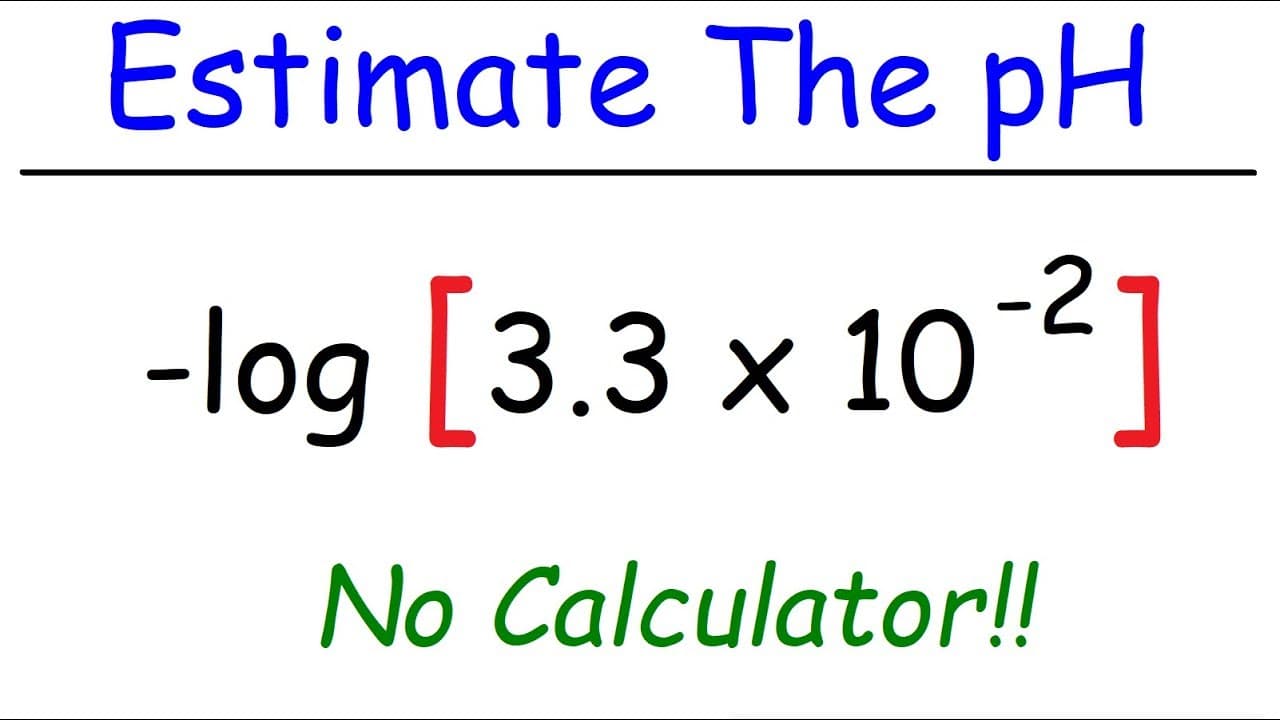
To calculate the pH of a solution without a calculator, use the formula pH = -log[H+], where [H+] is the concentration of hydrogen ions. Estimate by knowing logarithm values up to 9 and using the lower range of potential pH estimates, adjusting for the concentration's decimal part to refine your answer.
Transcript
in this video we're going to talk about how to calculate the ph of a solution be it an acid or base without the use of a calculator so let's start with this example what is the ph of a four times ten to minus three molar hydrochloric acid solution the formula that we need to use to calculate the ph of a solution is this one the ph is equal to negat... Read More
Key Insights
- 😥 pH can be calculated using the formula pH = -log[H+], with [H+] being the concentration of the acid or base.
- 😥 Estimating pH without a calculator involves using logarithm values up to 9 and subtracting the logarithm of the concentration from a fixed value.
- 😑 The pH of a strong acid solution is directly related to the concentration of the acid, as it fully dissociates into hydrogen ions.
- 😘 The estimation method involves choosing the lower range of two potential pH values based on the decimal part of the concentration.
- 🍂 Average values of logarithms can be used when the concentration falls between two whole numbers to approximate the pH.
- 💪 The pH of a strong base solution can be estimated in a similar way as for strong acids.
- 😥 The pH of a solution can be inferred by subtracting the pOH from 14 since pH + pOH = 14.
Install to Summarize YouTube Videos and Get Transcripts
Explore YouTube Video Summarizer or Get YouTube Transcript Extractor
Questions & Answers
Q: How can you calculate the pH of a solution without a calculator?
To estimate the pH, you can use the value of -log[H+], where [H+] is the concentration of the acid. By referring to logarithm tables, you can find the approximate value and subtract it from a predetermined value to get the estimate.
Q: Does the pH of a strong acid solution depend on the concentration of the acid?
Yes, for strong acids, the pH is directly related to the concentration of the acid. [H+] is equal to the concentration of the acid, and by taking the negative logarithm, you can calculate the pH.
Q: How can you determine the range of the estimated pH value?
By looking at the decimal part of the concentration value, you can determine if the pH will be between two whole numbers. If the decimal part is less than 0.5, the pH will be closer to the lower whole number, and if it's greater than or equal to 0.5, the pH will be closer to the higher whole number.
Q: Why is it useful to know the logarithm values up to 9?
Knowing the logarithm values up to 9 allows you to quickly estimate the pH without needing a calculator. By referencing the logarithm tables, you can find the value for the concentration and perform the necessary calculations to get an estimate.
Summary & Key Takeaways
-
pH is calculated using the formula pH = -log[H+], and for strong acids, [H+] is equal to the concentration of the acid.
-
To estimate the pH without a calculator, it is helpful to know the values of logarithms for numbers up to 9.
-
By using logarithm tables, you can quickly estimate the pH of a solution by subtracting the logarithm of the concentration from a predetermined value.
Read in Other Languages (beta)
Share This Summary 📚
Summarize YouTube Videos and Get Video Transcripts with 1-Click
Try YouTube Summary with ChatGPT & Claude or YouTube Transcript Generator
Explore More Summaries from The Organic Chemistry Tutor 📚


Summarize YouTube Videos and Get Video Transcripts with 1-Click
Try YouTube Summary with ChatGPT & Claude or YouTube Transcript Generator