Call payoff diagram | Finance & Capital Markets | Khan Academy
TL;DR
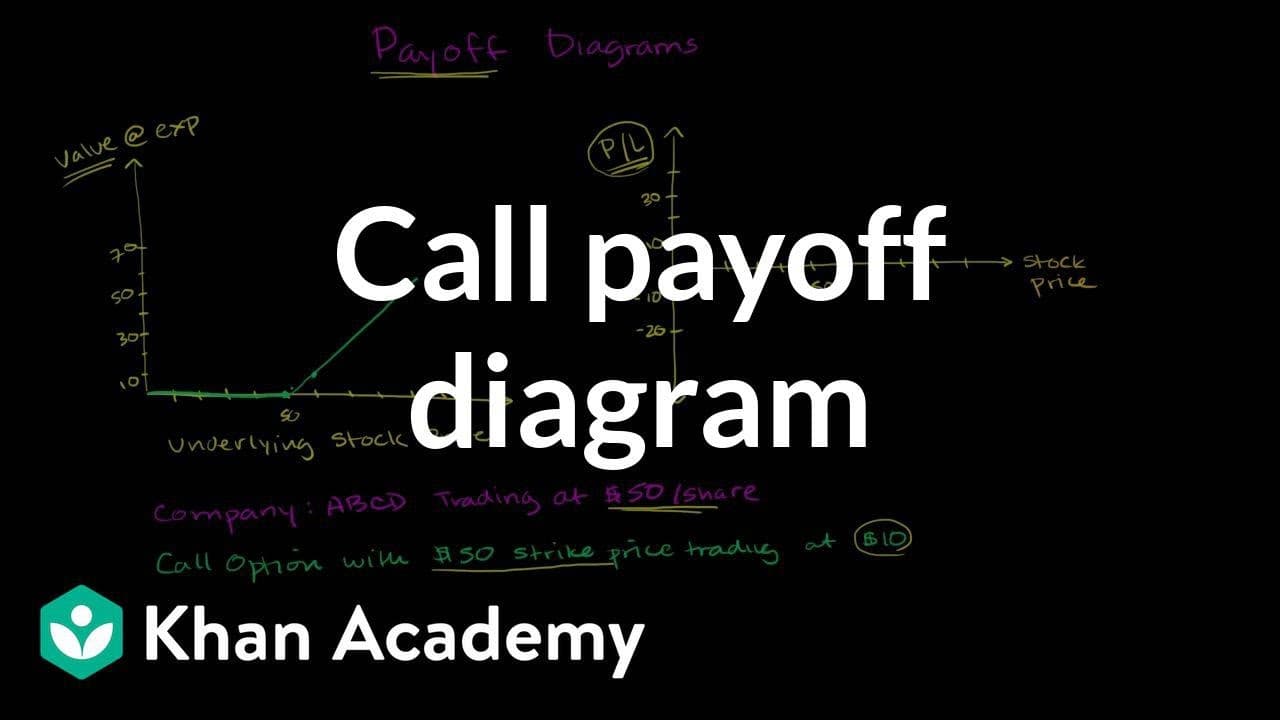
Payoff diagrams depict the value of options at expiration based on the underlying stock price, with one showing the option's value and the other incorporating profit and loss.
Transcript
Payoff diagrams are a way of depicting what an option or set of options or options combined with other securities are worth at option expiration. What you do is you plot it based on the value of the underlying stock price. And I have two different plots here, one that you might see more in an academic setting or a textbook, and one that you might s... Read More
Key Insights
- 🔨 Payoff diagrams are commonly used tools in options trading to understand the potential value and profitability of options at expiration.
- ❓ The value of an option at expiration depends on the relationship between the underlying stock price and the strike price.
- 🌸 Payoff diagrams provide visual representations of potential profits or losses associated with different stock prices.
- 🌸 The first payoff diagram focuses on the value of the option at expiration, while the second one considers the profit and loss by incorporating the option's cost.
- 🏃 Payoff diagrams help traders make informed decisions about whether to exercise options based on the stock's price.
- 👻 Options are most valuable when the stock price exceeds the strike price, allowing for potential profits.
- ❓ Below the strike price, options become worthless as it is more economical to buy the stock in the market.
Install to Summarize YouTube Videos and Get Transcripts
Explore YouTube Video Summarizer or Get YouTube Transcript Extractor
Questions & Answers
Q: How are payoff diagrams used to represent the value of options?
Payoff diagrams help visualize the worth of options at expiration by plotting them against the underlying stock price. They provide insight into whether or not the options would be profitable to exercise.
Q: What is the difference between the two types of payoff diagrams mentioned?
The first type focuses solely on the value of the options at expiration, while the second type incorporates the cost (profit and loss) of the options. The latter provides a more comprehensive view.
Q: Why would an option be worthless if the stock price is below the strike price?
If the stock price is below the strike price, it is not advantageous for the option owner to exercise it because they can buy the stock at a lower price in the market instead of paying the strike price.
Q: How does the option's value change as the stock price exceeds the strike price?
As the stock price surpasses the strike price, the value of the option increases. It represents the potential profit that can be made by exercising the option and selling the stock at a higher price.
Summary & Key Takeaways
-
Payoff diagrams illustrate the worth of options at expiration and can be viewed in academic settings or trading platforms.
-
They show the value of options without considering the cost (value at expiration) or with the inclusion of the cost (profit and loss).
-
The diagram for a call option for company ABCD with a $50 strike price shows that below $50, the option is worthless, and above $50, its value increases.
Read in Other Languages (beta)
Share This Summary 📚
Summarize YouTube Videos and Get Video Transcripts with 1-Click
Try YouTube Summary with ChatGPT & Claude or YouTube Transcript Generator
Explore More Summaries from Khan Academy 📚
Summarize YouTube Videos and Get Video Transcripts with 1-Click
Try YouTube Summary with ChatGPT & Claude or YouTube Transcript Generator