Understanding Logical Statements 2
TL;DR
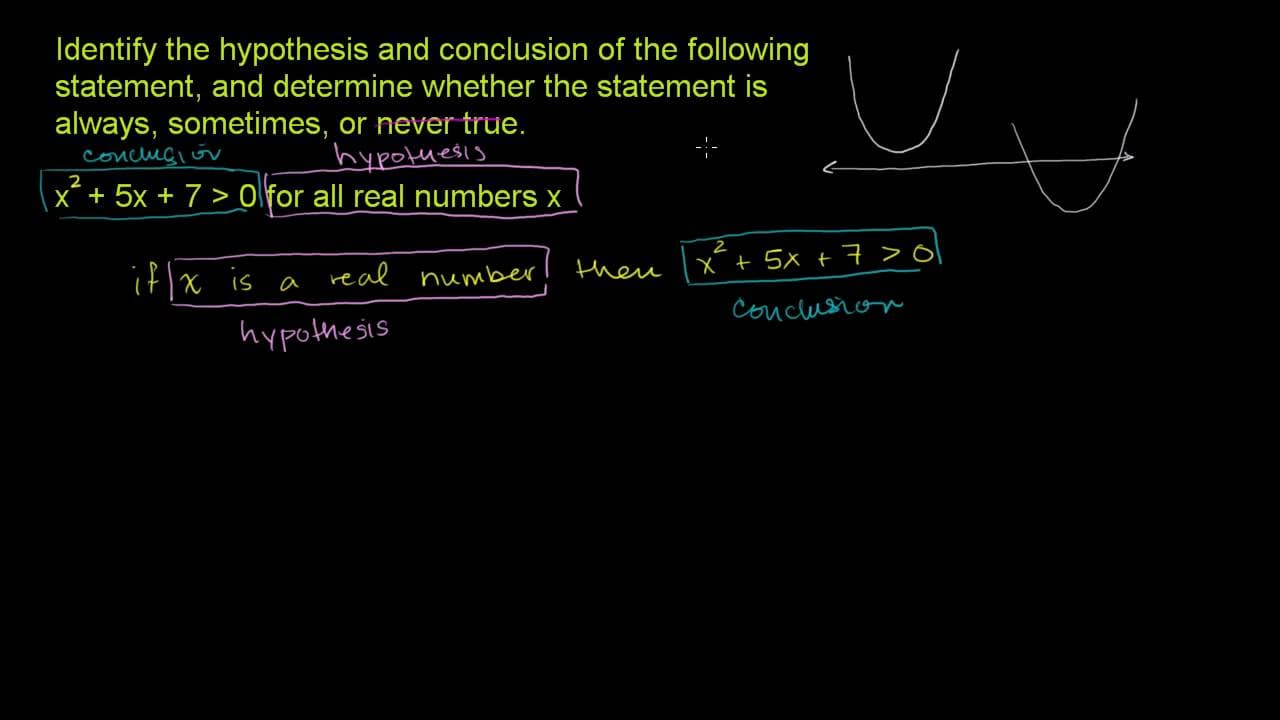
The hypothesis is that x is a real number, and the conclusion is that x squared plus 5x plus 7 is greater than 0, and this statement is always true.
Transcript
Identify the hypothesis and conclusion of the following statement, and determine whether the statement is always, sometimes, or never true. So let's see what the statement is. We have x-- well, this should be an x squared plus 5x plus 7 is greater than 0 for all real numbers x. So first let's rewrite this as a proposition, as an if/then statement. ... Read More
Key Insights
- 🚠 It is essential to be able to identify the hypothesis and conclusion of an if/then statement in mathematical inequalities.
- ✋ The coefficient of the highest degree term in the inequality affects the shape of the parabola and ultimately the truth of the statement.
- ❣️ The vertex of the parabola helps determine if the y-value is above or below the x-axis, indicating the validity of the inequality.
- 💄 Writing the statement as an if/then proposition makes it easier to understand and analyze.
Install to Summarize YouTube Videos and Get Transcripts
Explore YouTube Video Summarizer or Get YouTube Transcript Extractor
Questions & Answers
Q: What is the hypothesis and conclusion of the given statement?
The hypothesis is that x is a real number, and the conclusion is that x squared plus 5x plus 7 is greater than 0.
Q: Why is it easier to write the statement as an if/then proposition?
Writing the statement as an if/then proposition helps in identifying the hypothesis and conclusion clearly.
Q: How does the coefficient of the highest degree term affect the truth of the statement?
Since the coefficient is positive, the parabola representing the inequality opens upward, resulting in the statement being always true.
Q: How can the vertex of the parabola determine the truth of the inequality statement?
By calculating the vertex, it is possible to determine if the y-value (minimum point) is above or below the x-axis, indicating if the inequality is true for all real numbers or not.
Summary & Key Takeaways
-
The content explains how to identify the hypothesis and conclusion of an if/then statement in a mathematical inequality.
-
The hypothesis is the if part of the statement (x is a real number), and the conclusion is the then part (x squared plus 5x plus 7 is greater than 0).
-
By analyzing the coefficient of the highest degree term and finding the vertex of the parabola, it is possible to determine that the statement is always true.
Read in Other Languages (beta)
Share This Summary 📚
Summarize YouTube Videos and Get Video Transcripts with 1-Click
Try YouTube Summary with ChatGPT & Claude or YouTube Transcript Generator
Explore More Summaries from Khan Academy 📚



Summarize YouTube Videos and Get Video Transcripts with 1-Click
Try YouTube Summary with ChatGPT & Claude or YouTube Transcript Generator