GMAT: Math 49 | Problem solving | GMAT | Khan Academy
TL;DR
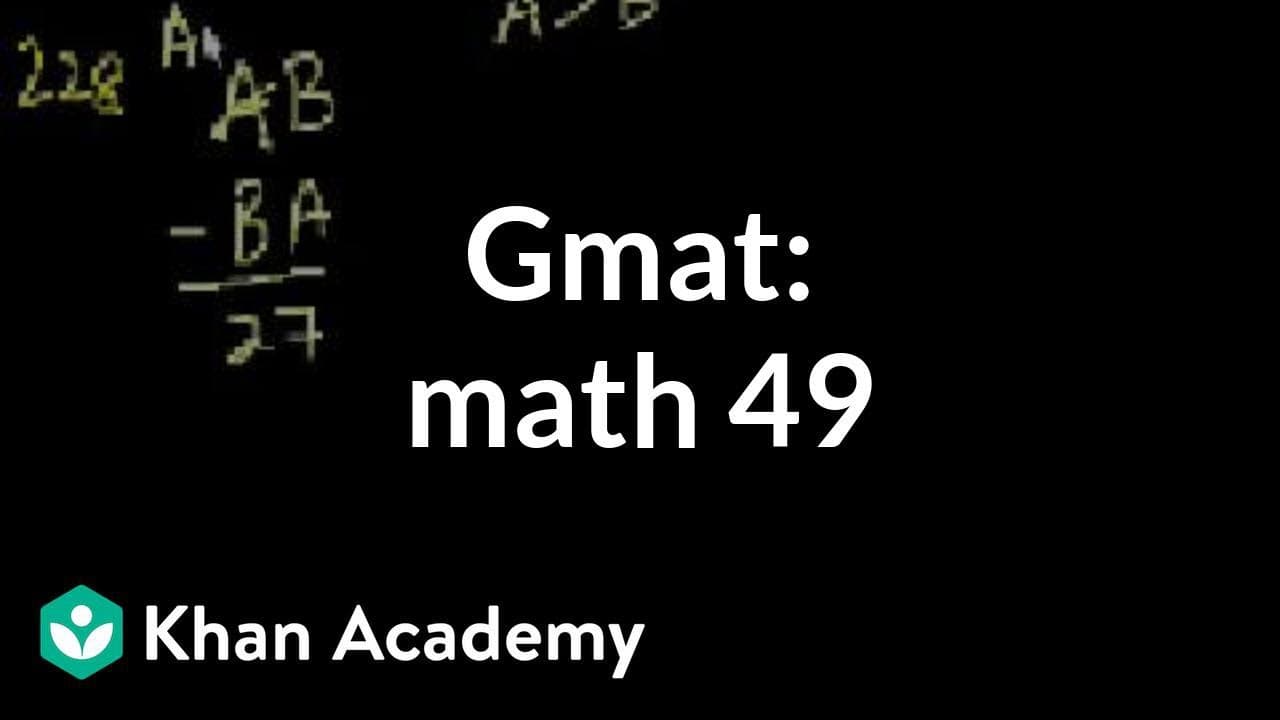
This video discusses solving GMAT math problems on topics such as coordinate geometry, reverse digits of a number, circle tangents, and parallel resistances, as well as probability calculations.
Transcript
We were on problem 227 when I got a phone call. It was actually from Jonathan who helps me with the Khan Academy, so I thought it was worth taking. He works at LinkedIn and he wanted let me know about all this news that was occurring there. Anyway, I'm getting distracted. Let's go back to the GMAT problems. So problem 227. In the coordinate system ... Read More
Key Insights
- 🫥 Understanding how to find the equation of a line is essential for solving coordinate geometry problems.
- #️⃣ Reversing the digits of a number can help find the difference between the original and reversed numbers.
- ⭕ The radius of a circle tangent to both axes can be found using the Pythagorean theorem.
- ☺️ Parallel resistances in an electric circuit can be combined using the formula 1/r = 1/x + 1/y.
Install to Summarize YouTube Videos and Get Transcripts
Explore YouTube Video Summarizer or Get YouTube Transcript Extractor
Questions & Answers
Q: How do you find the equation of a line in a coordinate system?
To find the equation of a line, you need to determine the slope using the change in y over the change in x, and the y-intercept using a point on the line. The equation is typically written in the form y = mx + b, where m is the slope and b is the y-intercept.
Q: How do you find the radius of a circle tangent to both axes?
Drawing a line from the center of the circle to the x-axis creates a right triangle. The distance from the center to the x-axis is equal to the radius. Using the Pythagorean theorem, you can find the radius in terms of the distance from the origin to the center of the circle.
Q: What is the formula for calculating combined resistance in parallel resistances?
The formula for calculating combined resistance in parallel resistances is 1/r = 1/x + 1/y, where r is the combined resistance and x and y are the individual resistances.
Q: How do you calculate the probability of a specific event occurring?
To calculate the probability of a specific event occurring, you multiply the probabilities of each independent event together. If there are events that should not occur, you subtract the probability of those events from 1 to find the probability of the desired event.
Summary & Key Takeaways
-
The video begins with a discussion of how to find the equation of a line in a coordinate system using slope and the y-intercept.
-
It then moves on to solving a problem involving reversing the digits of a two-digit number and finding the difference between the original and reversed numbers.
-
The next problem involves finding the radius of a circle tangent to both axes, using the Pythagorean theorem and the distance from the origin to the center of the circle.
-
The video then covers the concept of parallel resistances in an electric circuit and how to calculate the combined resistance.
-
Finally, it concludes by solving a probability problem involving three individuals attempting to solve a problem, and finding the probability that two individuals solve it while the third does not.
Read in Other Languages (beta)
Share This Summary 📚
Summarize YouTube Videos and Get Video Transcripts with 1-Click
Try YouTube Summary with ChatGPT & Claude or YouTube Transcript Generator
Explore More Summaries from Khan Academy 📚

Summarize YouTube Videos and Get Video Transcripts with 1-Click
Try YouTube Summary with ChatGPT & Claude or YouTube Transcript Generator