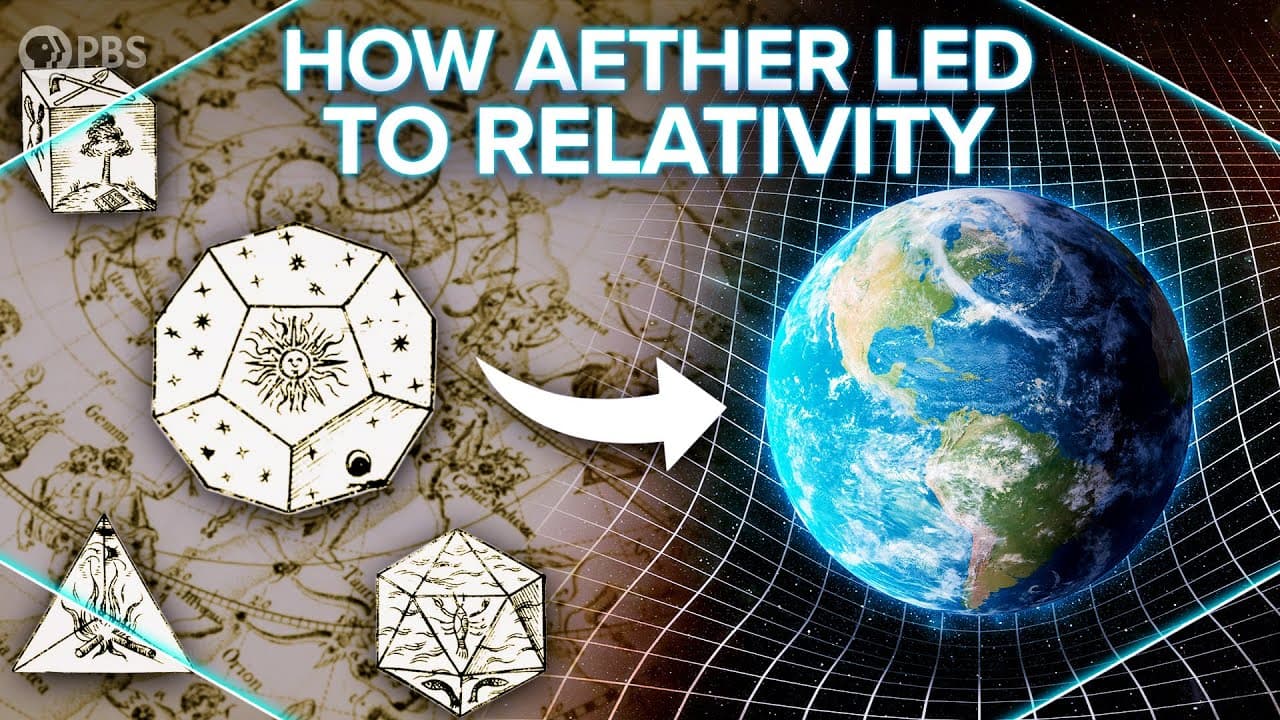
How Luminiferous Aether Led to Relativity
TL;DR
The failed search for aether led to Einstein's relativity.
Transcript
As the 19th century came to a close, physicists were feeling pretty satisfied with the state of their science. The great edifice of physical theory seemed complete. A few minor experiments remained to verify everything. But little did those physicists know that one of those experiments would bring the entire structure crashing down paving the way f... Read More
Key Insights
- The Michelson-Morley experiment aimed to detect the luminiferous aether, believed to be the medium for light propagation, but ultimately failed, sparking revolutionary changes in physics.
- The concept of aether originated with ancient Greeks and evolved through the Middle Ages, becoming central to theories of light and gravity.
- Huygens' wave theory of light required aether as a medium, but Newton's particle theory of light challenged this, leading to a historical debate.
- Thomas Young's double-slit experiment demonstrated light's wave-like properties, supporting the existence of aether as a medium.
- Maxwell's equations predicted light as an electromagnetic wave, further suggesting the need for an aether-like medium.
- The failure of the Michelson-Morley experiment to detect aether led to the development of the Lorentz transformation and Einstein's special theory of relativity.
- Einstein's relativity discarded the classical aether but introduced the concept of spacetime, a new 'medium' for gravitational fields.
- Despite the experiment's results, Michelson continued to believe in the aether until his death, highlighting the challenge of paradigm shifts in science.
Install to Summarize YouTube Videos and Get Transcripts
Explore YouTube Video Summarizer or Get YouTube Transcript Extractor
Questions & Answers
Q: What was the purpose of the Michelson-Morley experiment?
The Michelson-Morley experiment aimed to detect the luminiferous aether, which was thought to be the medium through which light waves propagated. By measuring changes in the speed of light depending on the Earth's motion through this medium, the experiment sought to confirm the existence of aether. However, the experiment famously failed to detect any such medium, challenging the prevailing theories of the time.
Q: How did the concept of aether evolve over time?
The concept of aether originated with ancient Greeks, who considered it the air breathed by gods. It evolved through the Middle Ages as a spiritual element in alchemy, known as quintessence. In the 17th century, Descartes and Huygens incorporated it into theories of gravity and light, respectively. By the 19th century, it was considered the medium for light propagation, until the Michelson-Morley experiment challenged its existence.
Q: What was the significance of Thomas Young's double-slit experiment?
Thomas Young's double-slit experiment demonstrated that light produces an interference pattern, similar to water waves, supporting the wave theory of light. This provided evidence for the existence of a medium like the luminiferous aether, as waves typically require a medium to propagate. The experiment was pivotal in the debate between wave and particle theories of light, which persisted until the development of quantum mechanics.
Q: How did Maxwell's equations contribute to the aether theory?
Maxwell's equations predicted that electromagnetic waves, including light, should travel at the speed of light, suggesting that light was a type of wave. This reinforced the idea that a medium, like the luminiferous aether, was necessary for wave propagation. However, the failure of the Michelson-Morley experiment to detect this medium led to a reevaluation of these assumptions and the development of new theories like relativity.
Q: What impact did the Michelson-Morley experiment have on physics?
The Michelson-Morley experiment's failure to detect the luminiferous aether led to significant changes in physics. It highlighted inconsistencies in Newtonian mechanics and Galilean relativity, inspiring Lorentz to develop his transformation equations. These equations, along with the constant speed of light, became foundational to Einstein's special theory of relativity, which revolutionized our understanding of space, time, and gravity.
Q: How did Einstein's theory of relativity address the concept of aether?
Einstein's theory of relativity discarded the classical concept of aether as a medium for light. Instead, it introduced the idea of spacetime as a new 'medium' for gravitational fields. This shift resolved inconsistencies in previous theories and provided a more accurate framework for understanding the behavior of light and gravity, ultimately leading to the development of general relativity and a deeper understanding of the universe.
Q: Why did Albert Michelson continue to believe in aether despite his experiment's results?
Albert Michelson continued to believe in the luminiferous aether despite the null results of his experiment because the concept was deeply entrenched in the scientific community at the time. The aether was considered essential for wave propagation, and the idea of discarding it required a significant paradigm shift. Michelson's continued belief highlights the challenges scientists face when confronting evidence that contradicts established theories.
Q: What is the modern view of the concept of aether?
The modern view rejects the classical concept of aether as a medium for light but acknowledges that space is not empty. Einstein's relativity introduced spacetime as the 'medium' for gravitational fields. Quantum physics suggests a 'particulate aether' in the form of quantum fields, where particle pairs are constantly created and destroyed. This view aligns more with Descartes' idea of a non-empty space, filled with dynamic fields and forces.
Summary & Key Takeaways
-
The Michelson-Morley experiment attempted to detect the luminiferous aether, a supposed medium for light, but its failure led to the development of Einstein's theory of relativity, revolutionizing physics.
-
The concept of aether has a long history, originating with ancient Greeks and evolving through the Middle Ages, becoming central to theories of light and gravity, before being challenged by Newton's particle theory.
-
The failure to detect aether led to the Lorentz transformation and Einstein's relativity, which discarded the classical aether but introduced spacetime as a new 'medium' for gravitational fields.
Read in Other Languages (beta)
Share This Summary 📚
Summarize YouTube Videos and Get Video Transcripts with 1-Click
Try YouTube Summary with ChatGPT & Claude or YouTube Transcript Generator
Explore More Summaries from PBS Space Time 📚




Summarize YouTube Videos and Get Video Transcripts with 1-Click
Try YouTube Summary with ChatGPT & Claude or YouTube Transcript Generator