Products
Features
YouTube Video Summarizer
Summarize YouTube videos
Web & PDF Highlighter
Highlight web pages & PDFs
Chat with PDF
Ask any PDF questions with AI
Ask AI Clone
Chat with your highlights & memories
Audio Transcriber
Transcribe audio files to text
Glasp Reader
Read and highlight articles
Kindle Highlight Export
Export your Kindle highlights
Idea Hatch
Hatch ideas from your highlights
Integrations
Obsidian Plugin
Notion Integration
Pocket Integration
Instapaper Integration
Medium Integration
Readwise Integration
Snipd Integration
Hypothesis Integration
Apps & Extensions
Chrome Extension
Safari Extension
Edge Add-ons
Firefox Add-ons
iOS App
Android App
Discover
Discover
Ideas
Discover new ideas and insights
Articles
Curated articles and insights
Books
Book recommendations by great minds
Posts
Essays and notes from readers
Quotes
Inspiring quotes collection
Videos
Curated videos and summaries
Explore Glasp
Glasp Newsletter
Weekly insights and updates
Glasp Talk
Interview series with great minds
Glasp Blog
Latest news and articles
Glasp Use Cases
Learn how others use Glasp
Build & Support
Glasp API
Access Glasp's API for developers
MCP Connector
Connect Glasp to Claude & ChatGPT
Community
Glasp Reddit Community
Students
Student discount and benefits
FAQs
Frequently Asked Questions
AboutPricing
DashboardLog inSign up

Can you find the next number in this sequence? - Alex Gendler
558.8K views
•
July 20, 2017
by
TED-Ed
YouTube video player
Can you find the next number in this sequence? - Alex Gendler

TL;DR

Discover the intriguing patterns in the Look and Say sequence, revealing unique properties beyond typical number sequences.

Transcript

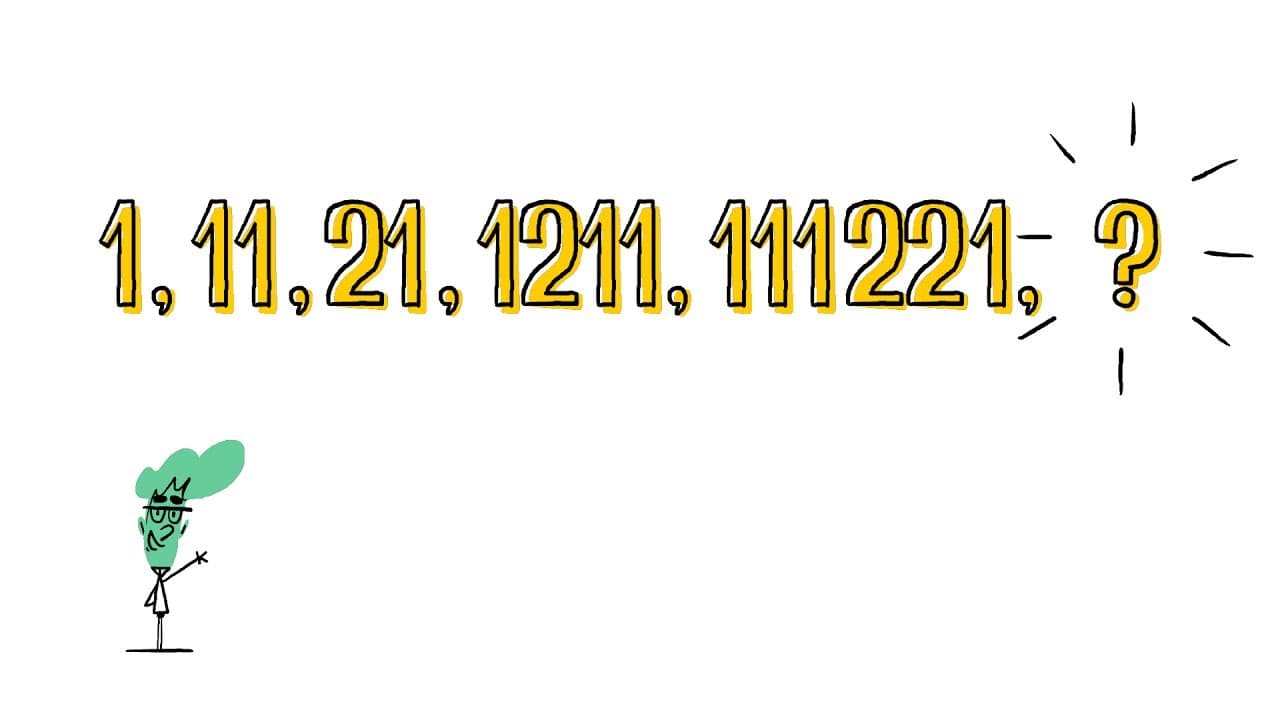
These are the first five elements of a number sequence. Can you figure out what comes next? Pause here if you want to figure it out for yourself. Answer in: 3 Answer in: 2 Answer in: 1 There is a pattern here, but it may not be the kind of pattern you think it is. Look at the sequence again and try reading it aloud. Now, look at the next number in... Read More

Key Insights

  • ❓ The Look and Say sequence focuses on the notation and repetition of digits rather than mathematical properties.
  • 🥺 Seeded with any number except 22, the sequence unfolds in specific ways, leading to interesting patterns.
  • 🥳 Conway's Constant in the sequence represents the growth ratio of digits between consecutive terms.
  • 🍳 The sequence eventually breaks down into distinct strings of digits, showcasing a repetitive pattern.
  • 🏃 Practical applications of the sequence include data compression techniques like run-length encoding.
  • 🤬 The sequence's structure offers insights into how numbers and symbols convey meaning at multiple levels.
  • ❓ Distinct elements in the Look and Say sequence composed of digits 1, 2, and 3 exhibit specific patterns.

Install to Summarize YouTube Videos and Get Transcripts

Explore YouTube Video Summarizer or Get YouTube Transcript Extractor

Questions & Answers

Q: What distinguishes the Look and Say sequence from traditional number sequences?

Unlike normal number patterns, the Look and Say sequence is based on the notation of how digits are read out and repeated in succession, revealing a unique linguistic structure.

Q: How does Conway's Constant relate to the Look and Say sequence?

Conway's Constant in the Look and Say sequence represents the ratio in the growth of digits between two consecutive terms, gradually converging to a value of about 1.3, showing a non-linear increase pattern.

Q: What practical applications does the Look and Say sequence have?

The Look and Say sequence is not just a mathematical curiosity but has practical significance, as seen in run-length encoding, a form of data compression used in television signals and digital graphics.

Summary & Key Takeaways

  • The Look and Say sequence involves reading out numbers based on how many times a digit appears in a row, not mathematical properties.

  • Seeded with any number except 22, the sequence grows in specific ways leading to Conway's Constant.

  • The sequence eventually breaks down into distinct strings of digits, showing a repetitive pattern with practical applications in data compression.


Read in Other Languages (beta)

English

Share This Summary 📚

Summarize YouTube Videos and Get Video Transcripts with 1-Click

Download browser extensions on:

Try YouTube Summary with ChatGPT & Claude or YouTube Transcript Generator

Explore More Summaries from TED-Ed 📚
What is bipolar disorder? - Helen M. Farrell thumbnail
What is bipolar disorder? - Helen M. Farrell
TED-Ed
Why the octopus brain is so extraordinary - Cláudio L. Guerra thumbnail
Why the octopus brain is so extraordinary - Cláudio L. Guerra
TED-Ed
The benefits of a bilingual brain - Mia Nacamulli thumbnail
The benefits of a bilingual brain - Mia Nacamulli
TED-Ed
Why do cats act so weird? - Tony Buffington thumbnail
Why do cats act so weird? - Tony Buffington
TED-Ed
Which is stronger: Glue or tape? - Elizabeth Cox thumbnail
Which is stronger: Glue or tape? - Elizabeth Cox
TED-Ed
What makes something "Kafkaesque"? - Noah Tavlin thumbnail
What makes something "Kafkaesque"? - Noah Tavlin
TED-Ed

Summarize YouTube Videos and Get Video Transcripts with 1-Click

Download browser extensions on:

Try YouTube Summary with ChatGPT & Claude or YouTube Transcript Generator

Apps & Extensions

  • Chrome Extension
  • Safari Extension
  • Edge Add-ons
  • Firefox Add-ons
  • iOS App
  • Android App

Key Features

  • YouTube Video Summarizer
  • Web & PDF Summarizer
  • Web & PDF Highlighter
  • Chat with PDF
  • Ask AI Clone
  • Audio Transcriber
  • Glasp Reader
  • Kindle Highlight Export
  • Idea Hatch

Integrations

  • Obsidian Plugin
  • Notion Integration
  • Pocket Integration
  • Instapaper Integration
  • Medium Integration
  • Readwise Integration
  • Snipd Integration
  • Hypothesis Integration

More Features

  • APIs
  • MCP Connector
  • Blog & Post
  • Embed Links
  • Image Highlight
  • Personality Test
  • Quote Shots

Company

  • About us
  • Blog
  • Community
  • FAQs
  • Job Board
  • Newsletter
  • Pricing
Terms

•

Privacy

•

Guidelines

© 2026 Glasp Inc. All rights reserved.