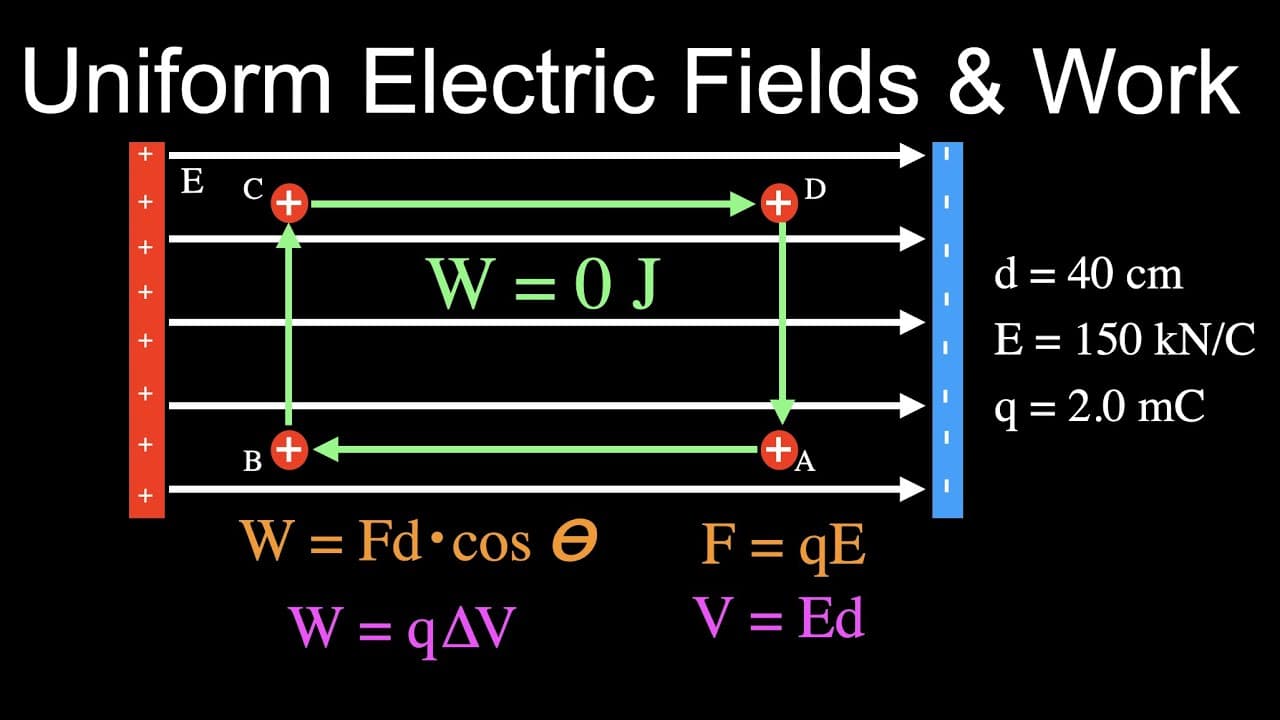
Uniform Electric Field: Work Done to Move a Charge Through the Field
TL;DR
Calculate work on charges in varying electric fields using simple formulas.
Transcript
in today's video i'm gonna go over six different example problems for calculating the work done on an electric charge when it's moving through a uniform electric field now before we get started please don't forget to subscribe to my channel especially if you're one of my students get all of our excellent videos from step by step science don't forge... Read More
Key Insights
- 💦 Electric field strength determines the force on a charge and influences the work calculation.
- 🈂️ Calculating work on charges involves understanding the relationships between charge, force, distance, and angle.
- 💦 Work done by external forces and electric fields can be positive or negative, reflecting the direction of force applied.
- 💦 Potential energy changes when moving charges in electric fields, impacting the work calculations.
- 💦 The concept of work in electric fields mirrors the principles of work in gravitational fields.
- 💦 External forces can apply work on charges in different directions, affecting the overall energy transfers.
- 😥 Path taken by a charge in an electric field may not affect the work done if the initial and final points are the same.
Install to Summarize YouTube Videos and Get Transcripts
Explore YouTube Video Summarizer or Get YouTube Transcript Extractor
Questions & Answers
Q: How is work done calculated on a charge moving through a uniform electric field?
Work done is calculated as the product of charge, electric field strength, distance, and the cosine of the angle between force and displacement vectors.
Q: Does the angle between the force and displacement vectors affect the work done on a charge in an electric field?
Yes, the angle determines the direction and magnitude of work, as the cosine of the angle plays a crucial role in the calculation.
Q: What relationship exists between potential energy and work done on a charge in an electric field?
The work done on a charge is equal to the change in potential energy, indicating how energy is transferred during the movement of a charge through an electric field.
Q: Why does moving a charge perpendicular to an electric field result in no work being done?
Perpendicular movement across electric field lines does not change the potential energy of the charge, leading to zero work being done according to the definition of work.
Summary & Key Takeaways
-
Work on electric charges in uniform electric fields involves calculating the work done by external forces and electric fields.
-
Moving charges in parallel or perpendicular fields generates different work values.
-
The concepts of potential energy and work done on charges are interrelated and can be calculated using straightforward equations.
Read in Other Languages (beta)
Share This Summary 📚
Summarize YouTube Videos and Get Video Transcripts with 1-Click
Try YouTube Summary with ChatGPT & Claude or YouTube Transcript Generator
Explore More Summaries from Step by Step Science 📚
Summarize YouTube Videos and Get Video Transcripts with 1-Click
Try YouTube Summary with ChatGPT & Claude or YouTube Transcript Generator