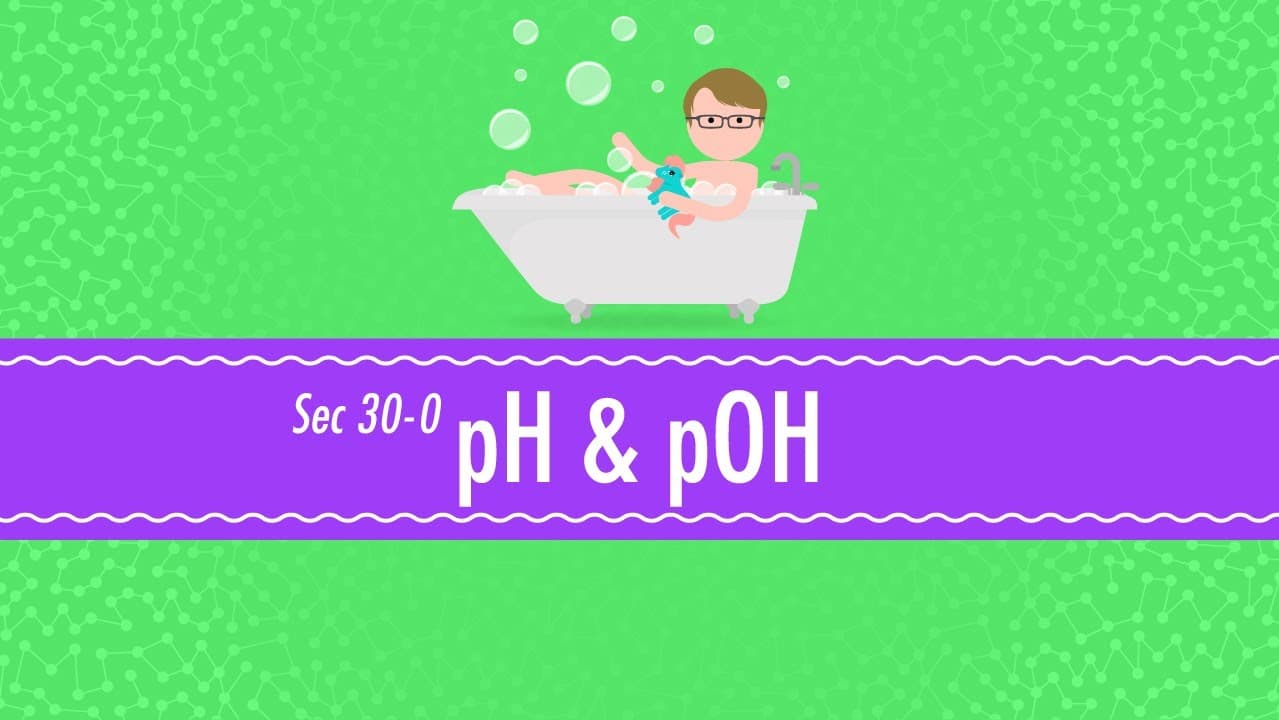
pH and pOH: Crash Course Chemistry #30
TL;DR
Explains pH, pOH, acids, bases, and logarithms.
Transcript
This may come as a bit of a shock to you, but I'm not super into personal grooming. Like I understand soap and shampoo. But there's all this other stuff now, and I keep seeing references to pH balance everywhere. pH balanced soaps, and shampoos, and deodorant, and makeup abound in supermarkets and drugstores. And I've even seen pH balanced water?! ... Read More
Key Insights
- pH represents the power of hydrogen in a solution, crucial for understanding acids and bases, with water being central to this concept.
- The origin of 'p' in pH is unclear, but it helps denote the power of hydrogen ions, with 'H' standing for hydrogen.
- Water can act as both an acid and a base, releasing or consuming hydrogen ions, which is key to its neutrality.
- pH is defined as the negative logarithm of hydrogen ion concentration, simplifying calculations involving very small numbers.
- The water dissociation constant (Kw) is crucial, showing that hydronium and hydroxide concentrations are equal in pure water.
- Litmus paper is a pH indicator, changing color based on pH, with acids turning it pink and bases turning it blue.
- Strong acids and bases have extreme pH values due to their ability to release or consume large amounts of hydrogen ions.
- pOH is similar to pH, calculated using hydroxide concentration, with pH and pOH always summing to 14 in aqueous solutions.
Install to Summarize YouTube Videos and Get Transcripts
Explore YouTube Video Summarizer or Get YouTube Transcript Extractor
Questions & Answers
Q: What does pH represent in chemistry?
pH represents the power of hydrogen in a solution, reflecting the concentration of hydrogen ions. It is crucial for understanding the acidic or basic nature of a substance. The term 'pH' is commonly used in chemistry to describe the strength of acids and bases, with water being a central component.
Q: Why is water considered neutral?
Water is considered neutral because it can act as both an acid and a base. It releases hydrogen ions (acting as an acid) and consumes them (acting as a base), maintaining a balance. This dual behavior is due to the reversible reaction where water molecules dissociate into hydronium and hydroxide ions.
Q: How is pH mathematically defined?
pH is mathematically defined as the negative logarithm of the hydrogen ion concentration in a solution. This definition simplifies the calculation of pH by converting very small numbers into manageable logarithmic values. It is a crucial concept in chemistry for understanding the acidity or basicity of substances.
Q: What is the water dissociation constant (Kw)?
The water dissociation constant (Kw) is a special equilibrium constant for the reversible reaction where water dissociates into hydronium and hydroxide ions. Kw is equal to 1.0 x 10^-14, indicating the product of the concentrations of these ions in pure water. It is a fundamental concept in understanding pH and pOH.
Q: How does litmus paper indicate pH?
Litmus paper is a pH indicator that changes color based on the pH of a solution. In acidic solutions, it turns pink, while in basic solutions, it turns blue. When the solution is neutral, litmus paper appears light purple. It is a simple yet effective tool for determining the pH of a substance.
Q: What distinguishes strong acids from weak acids?
Strong acids ionize completely in water, releasing a large number of hydrogen ions, resulting in very low pH values. Weak acids, on the other hand, dissociate incompletely, releasing fewer hydrogen ions and having higher pH values. This distinction is crucial for understanding the strength and behavior of acids.
Q: How is pOH related to pH?
pOH is related to pH as both are measures of ion concentration in a solution. pOH is the negative logarithm of hydroxide ion concentration. In any aqueous solution, the sum of pH and pOH always equals 14. This relationship helps in understanding the balance between acidic and basic properties of solutions.
Q: What is the significance of logarithms in pH calculations?
Logarithms simplify pH calculations by converting very small numbers, like hydrogen ion concentrations, into manageable values. The base 10 logarithm is used, reflecting the exponent needed to raise 10 to achieve the concentration value. This mathematical approach makes it easier to understand and calculate pH in chemistry.
Summary & Key Takeaways
-
This episode of Crash Course Chemistry explores the concepts of pH and pOH, explaining their significance in understanding acids, bases, and neutral substances. It delves into the mathematical definition of pH as the negative logarithm of hydrogen ion concentration, simplifying complex calculations.
-
The video highlights the unique properties of water, which can act as both an acid and a base, and introduces the water dissociation constant (Kw). It explains how pH indicators like litmus paper work, changing color to indicate whether a substance is acidic or basic.
-
Strong and weak acids and bases are discussed, with their pH values explained in terms of hydrogen ion concentration. The episode concludes with a look at the mathematical relationships between pH and pOH, emphasizing their importance in chemistry.
Read in Other Languages (beta)
Share This Summary 📚
Summarize YouTube Videos and Get Video Transcripts with 1-Click
Try YouTube Summary with ChatGPT & Claude or YouTube Transcript Generator
Explore More Summaries from CrashCourse 📚





Summarize YouTube Videos and Get Video Transcripts with 1-Click
Try YouTube Summary with ChatGPT & Claude or YouTube Transcript Generator