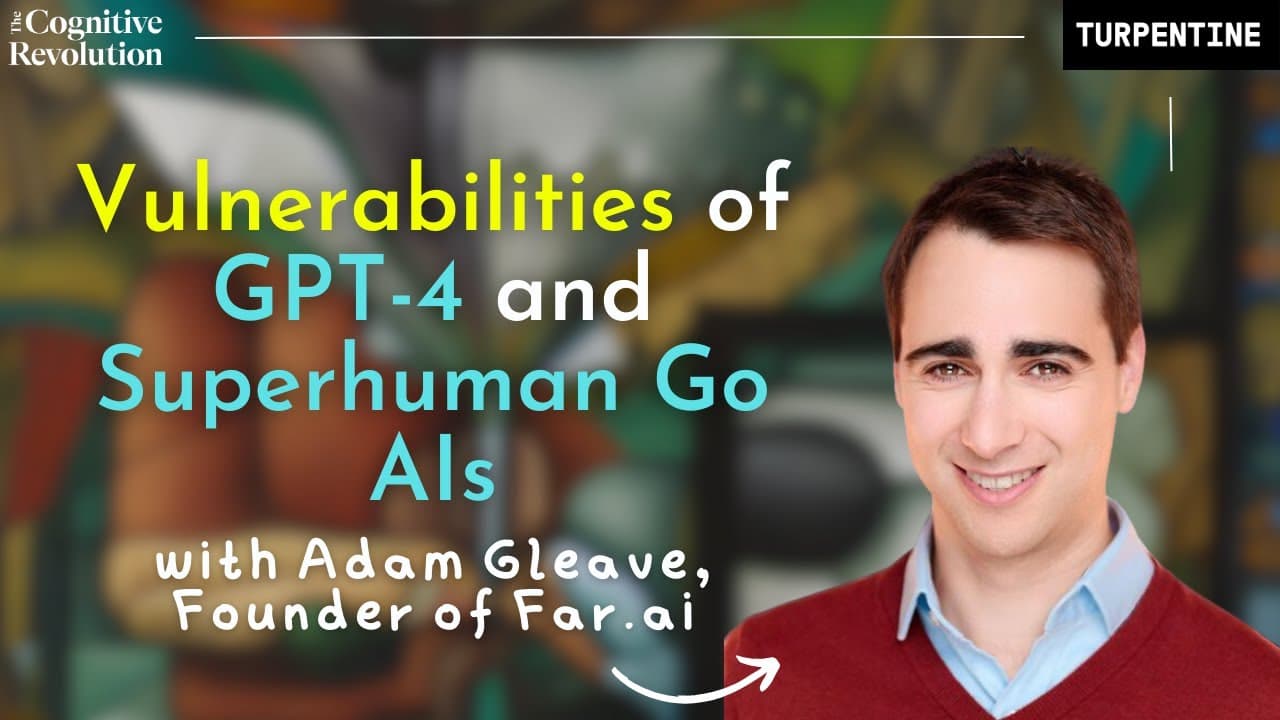
Exploitable by Default: Vulnerabilities in GPT-4 APIs & Superhuman Go AIs with Adam Gleave of Far.ai
TL;DR
AI systems, including GPT-4, have significant vulnerabilities that need addressing.
Transcript
this sort of experiment of like what could Einstein's brain in a that do it's like look you can't take over the world and no matter how smart you are if all you can do is just sort of think and now well we're not just letting models think we're giving them access to to run code to spin up virtual machines to execute you know external apis so I thin... Read More
Key Insights
- Vulnerabilities in AI systems like GPT-4 are easily exploitable, emphasizing the need for robust security measures.
- Fine-tuning AI models can accidentally remove safety filters, leading to potential misuse without malicious intent.
- The accessibility of AI models can shift the economics of cyber-attacks, making them more feasible for non-state actors.
- AI systems are inherently exploitable by default, and achieving robustness requires significant computational and developmental resources.
- Adversarial strategies can exploit superhuman AI systems, highlighting deep-seated vulnerabilities even in advanced models.
- Empirical evidence suggests a divergence between the growth of AI capabilities and the improvement of control measures.
- Open-source AI projects face unique challenges in maintaining safety standards due to their accessibility and potential for misuse.
- There is a need for industry standards and best practices for AI application developers to ensure safety and mitigate risks.
Install to Summarize YouTube Videos and Get Transcripts
Explore YouTube Video Summarizer or Get YouTube Transcript Extractor
Questions & Answers
Q: What are the key vulnerabilities found in GPT-4's fine-tuning process?
The fine-tuning process can accidentally remove safety filters, leading to vulnerabilities such as accidental jailbreaking, targeted misinformation, and malicious code generation. These vulnerabilities can arise even when fine-tuning on benign data, indicating that the safety fine-tuning is fragile and easily reversible.
Q: How does the accessibility of AI models affect the economics of cyber-attacks?
The accessibility of AI models like GPT-4 can lower the barrier for cyber-attacks by automating processes that previously required skilled human hackers. This shift in economics makes it easier for non-state actors and smaller groups to perform large-scale attacks, increasing the potential for misuse.
Q: What challenges do open-source AI projects face in maintaining safety standards?
Open-source AI projects face challenges in maintaining safety standards due to their accessibility and potential for misuse. Developers must balance the benefits of open access with the risks of exploitation and ensure that safety measures are in place to prevent harmful applications.
Q: What is the robustness tax in AI systems?
The robustness tax refers to the additional computational and developmental resources required to make AI systems robust against adversarial attacks. Achieving robustness often results in a trade-off with performance, where systems may become less capable in non-adversarial settings.
Q: How can adversarial strategies exploit superhuman AI systems?
Adversarial strategies can exploit superhuman AI systems by systematically optimizing against them. Even with gray box access, where the adversary can query the AI for its moves, it is possible to find vulnerabilities that allow for successful exploitation, revealing deep-seated flaws in the AI's decision-making process.
Q: What role do industry standards and best practices play in AI safety?
Industry standards and best practices are crucial for ensuring AI safety, particularly for application developers. They provide guidelines for mitigating risks and implementing necessary safety measures, helping to prevent exploitation and misuse of AI systems.
Q: Why is there a divergence between AI capabilities and control measures?
There is a divergence between AI capabilities and control measures because the growth of AI capabilities is outpacing the development of effective control mechanisms. This gap increases the risk of unpredictable and potentially harmful behavior in AI systems, emphasizing the need for focused efforts on improving control measures.
Q: What are the implications of AI systems being exploitable by default?
AI systems being exploitable by default implies that without deliberate efforts to enhance robustness, these systems are vulnerable to adversarial attacks and misuse. This highlights the importance of integrating security measures into the development process and prioritizing safety in AI research and deployment.
Summary & Key Takeaways
-
AI systems, including GPT-4, have significant vulnerabilities that are easily exploitable. These vulnerabilities arise from both intentional and accidental modifications during fine-tuning, which can remove safety filters and lead to misuse.
-
The accessibility of AI models like GPT-4 can change the economics of cyber-attacks, making them more feasible for non-state actors. This highlights the need for robust security measures to prevent exploitation.
-
Adversarial strategies can exploit even superhuman AI systems, revealing deep-seated vulnerabilities. Achieving robustness in AI systems requires significant computational and developmental resources, and there is a need for industry standards and best practices.
Read in Other Languages (beta)
Share This Summary 📚
Summarize YouTube Videos and Get Video Transcripts with 1-Click
Try YouTube Summary with ChatGPT & Claude or YouTube Transcript Generator
Explore More Summaries from Cognitive Revolution "How AI Changes Everything" 📚





Summarize YouTube Videos and Get Video Transcripts with 1-Click
Try YouTube Summary with ChatGPT & Claude or YouTube Transcript Generator