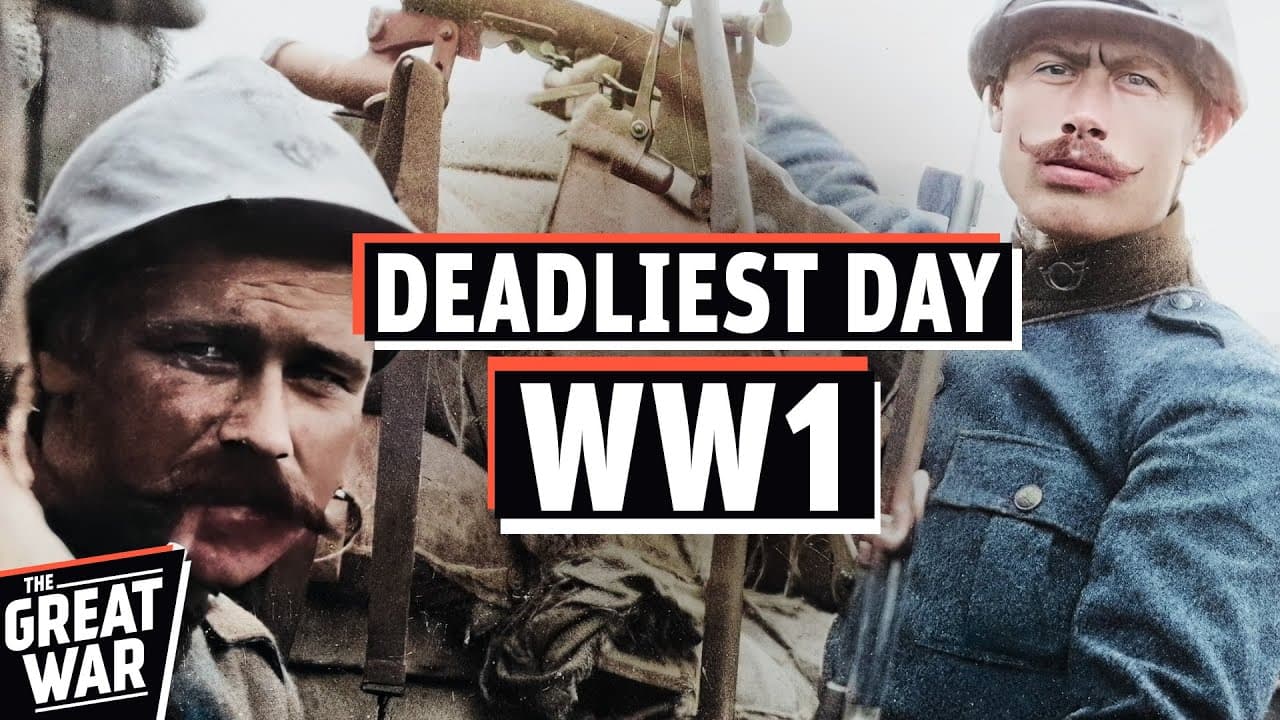
The Deadliest Day of WW1
TL;DR
Explores the deadliest single day for each nation in WW1.
Transcript
The First World War lasted four years and claimed the lives of some 10 million soldiers. But what was the deadliest single day of the Great War? The answer might come as a surprise – and a useful reminder. From 1914 to 1918, in Europe, Africa, Asia and on the high seas, the Great War claimed the lives of around 10 million soldiers from dozens o... Read More
Key Insights
- The First World War saw approximately 10 million military deaths, averaging 6700 deaths per day across its duration.
- July 1, 1916, marked the deadliest day for Britain, with 19,240 killed during the Battle of the Somme.
- France's deadliest day was September 25, 1915, with an estimated 23,000 deaths during the 2nd Battle of Champagne.
- Germany's worst day was March 21, 1918, with around 11,000 deaths during the Spring Offensive's first day.
- Italy faced significant losses on October 24, 1917, during the Battle of Caporetto, though exact figures are elusive.
- The Austro-Hungarian army's most devastating day might have been August 1914 in Galicia or February 27, 1915, in the Carpathians.
- Russia's deadliest day is uncertain due to poor records but likely occurred during the Gorlice-Tarnow Offensive or the Brusilov Offensive.
- The bloodiest day of WW1 does not always align with the most famous battles, challenging popular memory of the war.
Install to Summarize YouTube Videos and Get Transcripts
Explore YouTube Video Summarizer or Get YouTube Transcript Extractor
Questions & Answers
Q: What was the deadliest day for Britain during WW1?
The deadliest day for Britain during World War I was July 1, 1916, the first day of the Battle of the Somme. On this day, the British army suffered approximately 19,240 deaths. The attack was part of a larger Allied offensive, but the British forces faced heavily fortified German defenses, leading to significant casualties.
Q: Why is the deadliest day of WW1 difficult to determine?
Determining the deadliest day of WW1 is challenging due to incomplete, inaccurate, or lost records from various armies. Each nation maintained its own casualty records, and discrepancies exist in how data was recorded. Additionally, some archives were destroyed or lost, such as the German records in 1945 and Russian records post-revolution.
Q: What was the deadliest day for France in WW1?
France's deadliest day in World War I was September 25, 1915, during the 2nd Battle of Champagne. On this day, approximately 23,000 French soldiers were killed. The battle was part of a major French offensive aimed at breaking through German lines, but despite initial successes, the offensive ultimately failed to achieve its strategic objectives.
Q: How did the Battle of the Somme impact British memory of WW1?
The Battle of the Somme, particularly its first day on July 1, 1916, had a profound impact on British memory of WW1 due to the immense loss of life. The battle has been extensively documented in books, films, and television, and its legacy continues to be commemorated, with many Britons visiting the battlefield annually to honor the fallen.
Q: What tactics did Germany use during their Spring Offensive in 1918?
During the Spring Offensive in 1918, Germany employed 'Stormtrooper' tactics, which involved using well-trained infantry units to penetrate deep into enemy lines, bypassing strongpoints for regular infantry to mop up. This approach aimed to create a breakthrough and destabilize Allied positions, but despite initial gains, the offensive ultimately failed.
Q: Why are some of the deadliest days of WW1 not widely remembered?
Some of the deadliest days of WW1 are not widely remembered because they occurred during battles that did not achieve significant strategic outcomes or are overshadowed by more famous battles like the Somme or Verdun. This discrepancy in memory highlights how popular narratives often focus on symbolic events rather than the full scope of wartime losses.
Q: What challenges did the French face during their 1915 offensives?
During the 1915 offensives, the French army faced several challenges, including a shortage of artillery and ammunition, difficulties in command and control, and underdeveloped infantry tactics. These issues hindered their ability to break through German lines, resulting in high casualties and limited territorial gains, contributing to 1915 being the deadliest year for France in WW1.
Q: How did the First World War casualty numbers compare to later conflicts?
The First World War's casualty numbers were unprecedented at the time, with around 10 million military deaths. However, these figures were later surpassed by the Second World War, which saw even higher casualties and introduced new forms of warfare, such as nuclear weapons, further altering the landscape of global conflict and memory.
Summary & Key Takeaways
-
The First World War, lasting from 1914 to 1918, resulted in massive casualties, with some days being particularly deadly for specific nations. The deadliest day for Britain was July 1, 1916, during the Battle of the Somme, while France's was September 25, 1915, during the 2nd Battle of Champagne.
-
Germany's most lethal day occurred on March 21, 1918, at the start of the Spring Offensive. Other nations, like Italy and Austria-Hungary, also faced severe losses on different days, though exact figures are often difficult to determine due to incomplete records.
-
The analysis of these days highlights the complexity of war memory, as the deadliest days are not always the most famous. The casualties of WW1 were unprecedented, influencing how societies remember and commemorate the war.
Read in Other Languages (beta)
Share This Summary 📚
Summarize YouTube Videos and Get Video Transcripts with 1-Click
Try YouTube Summary with ChatGPT & Claude or YouTube Transcript Generator
Explore More Summaries from The Great War 📚



Summarize YouTube Videos and Get Video Transcripts with 1-Click
Try YouTube Summary with ChatGPT & Claude or YouTube Transcript Generator