What Is the Gravitational Wave Background and Its Significance?
TL;DR
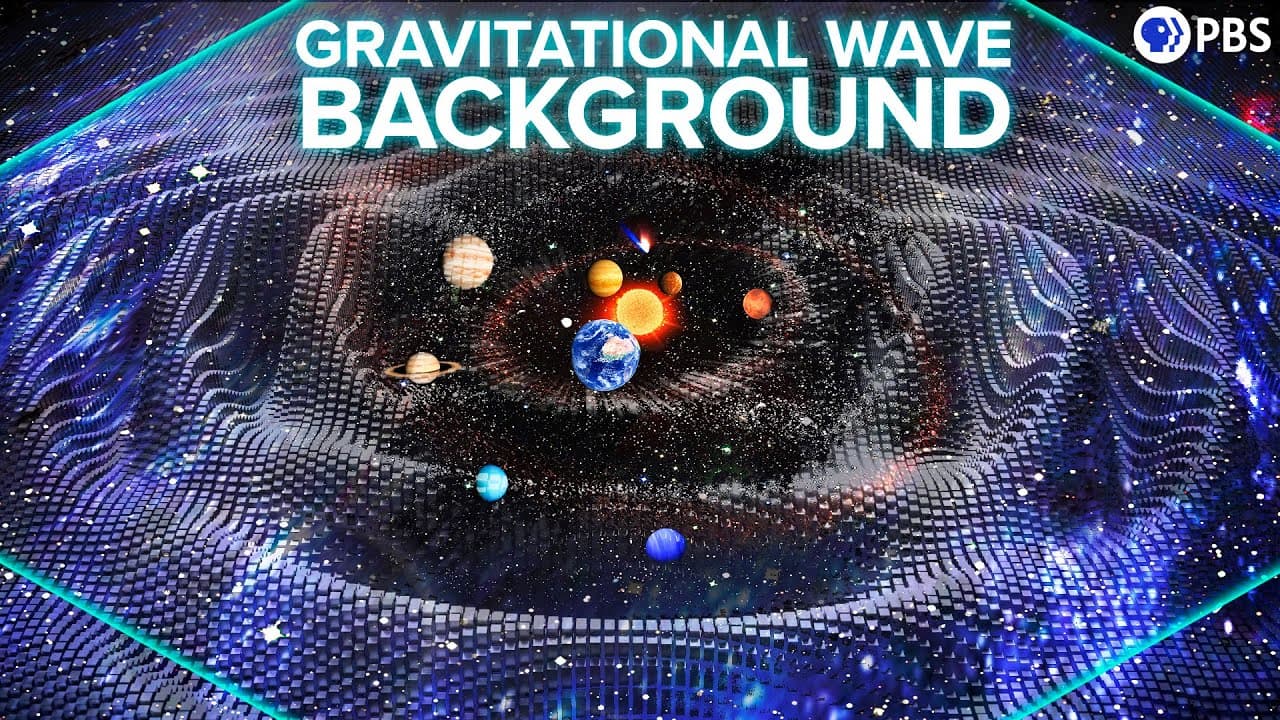
The gravitational wave background refers to a constant hum of weak gravitational waves from various cosmic events, detected by pulsar timing arrays like NANOGrav. This background could help us understand supermassive black hole mergers, cosmic strings, and the early universe's inflation, offering insights into the fundamental structure of space-time.
Transcript
it was pretty impressive when we built this giant machine that spotted gravitational waves from colliding black holes well we've just taken it to the next level with a galaxy spanning gravitational wave detector that may have detected a foundational element of space itself the gravitational wave background when the laser interferometer gravitationa... Read More
Key Insights
- LIGO's initial success in detecting gravitational waves from black hole collisions has been expanded with a galaxy-wide detector potentially identifying a gravitational wave background.
- Gravitational waves are ripples in space-time fabric, caused by cosmic events like black hole mergers and supernovae, and can reveal the universe's history.
- LIGO detects gravitational waves with specific frequencies, but larger or smaller waves remain undetected, necessitating new detection methods like the pulsar timing array.
- Pulsar timing arrays use the regular pulses from neutron stars to detect gravitational waves by observing variations in pulse arrival times.
- The North American Nanohertz Observatory for Gravitational Waves (NANOGrav) has tentatively detected the gravitational wave background using pulsar timing arrays.
- The gravitational wave background consists of weak gravitational waves from numerous cosmic events, creating a constant universe-wide hum.
- Understanding the gravitational wave background could provide insights into phenomena like supermassive black hole mergers, cosmic strings, and the early universe's inflationary epoch.
- Future advancements in pulsar timing arrays and radio telescopes could enhance the detection and understanding of the gravitational wave background.
Install to Summarize YouTube Videos and Get Transcripts
Explore YouTube Video Summarizer or Get YouTube Transcript Extractor
Questions & Answers
Q: What are gravitational waves and how are they detected?
Gravitational waves are ripples in the fabric of space-time, caused by massive cosmic events like black hole mergers and supernovae. They are detected using instruments like LIGO, which measures the tiny oscillations in space-time caused by these waves. LIGO detects waves with specific frequencies, but larger or smaller waves require different detection methods, such as pulsar timing arrays.
Q: What is the gravitational wave background?
The gravitational wave background is a constant hum of weak gravitational waves produced by numerous cosmic events throughout the universe's history. These waves are too weak to be detected individually but collectively form a background noise that permeates the universe. Detecting this background can provide insights into the universe's structure and history, including events like supermassive black hole mergers and cosmic strings.
Q: How do pulsar timing arrays detect gravitational waves?
Pulsar timing arrays detect gravitational waves by using the regular pulses emitted by neutron stars, known as pulsars. These pulses serve as precise cosmic clocks. Gravitational waves passing through space can alter the distance between Earth and the pulsars, leading to variations in the arrival times of the pulses. By analyzing these timing variations across multiple pulsars, scientists can detect the presence of gravitational waves.
Q: What is NANOGrav and what has it discovered?
NANOGrav, the North American Nanohertz Observatory for Gravitational Waves, is a collaboration of researchers using pulsar timing arrays to detect gravitational waves. It has tentatively discovered the gravitational wave background by observing correlations in the timing residuals of pulsar signals. This discovery suggests the presence of a universe-wide hum of gravitational waves, potentially offering insights into cosmic phenomena and the early universe.
Q: What role do supermassive black holes play in gravitational wave detection?
Supermassive black holes, often found in the cores of galaxies, can produce enormous gravitational waves when they orbit each other, particularly during galaxy collisions. These waves are significant contributors to the gravitational wave background. Detecting and analyzing these waves can provide valuable information about the behavior and history of supermassive black holes, as well as the dynamics of galaxy mergers.
Q: What are cosmic strings and how are they related to gravitational waves?
Cosmic strings are hypothetical topological defects in the fabric of space-time, theorized to have formed in the early universe. They could produce gravitational waves when their kinks become unkinked. Detecting these waves could confirm the existence of cosmic strings, offering insights into the universe's early conditions and the fundamental nature of space-time. The gravitational wave background may contain contributions from cosmic strings.
Q: What advancements are needed to better understand the gravitational wave background?
To better understand the gravitational wave background, advancements in pulsar timing arrays and radio telescopes are needed. Increasing the number of monitored pulsars, extending observation durations, and using more sensitive and larger telescopes can enhance detection capabilities. These improvements will help resolve the background's wave frequency spectrum, revealing the sources and characteristics of the gravitational waves, and offering insights into cosmic phenomena and early universe physics.
Q: How does the gravitational wave background contribute to our understanding of the universe?
The gravitational wave background contributes to our understanding of the universe by providing a comprehensive view of cosmic events throughout history. Analyzing this background can reveal the behavior and interactions of massive cosmic objects like black holes, the nature of cosmic strings, and conditions during the universe's inflationary epoch. It offers a unique perspective on the universe's structure, evolution, and the fundamental nature of space-time, potentially uncovering new physics beyond current theories.
Summary & Key Takeaways
-
LIGO's detection of gravitational waves has been built upon with a galaxy-spanning detector that may have identified the gravitational wave background. This discovery could reveal cosmic history and the universe's structure.
-
Gravitational waves are space-time ripples from cosmic events like black hole mergers. LIGO detects specific frequencies, but larger or smaller waves require new methods like pulsar timing arrays.
-
NANOGrav's pulsar timing array has tentatively detected the gravitational wave background, a universe-wide hum from weak waves. Future enhancements could provide insights into cosmic phenomena and the early universe.
Read in Other Languages (beta)
Share This Summary 📚
Summarize YouTube Videos and Get Video Transcripts with 1-Click
Try YouTube Summary with ChatGPT & Claude or YouTube Transcript Generator
Explore More Summaries from PBS Space Time 📚

Summarize YouTube Videos and Get Video Transcripts with 1-Click
Try YouTube Summary with ChatGPT & Claude or YouTube Transcript Generator