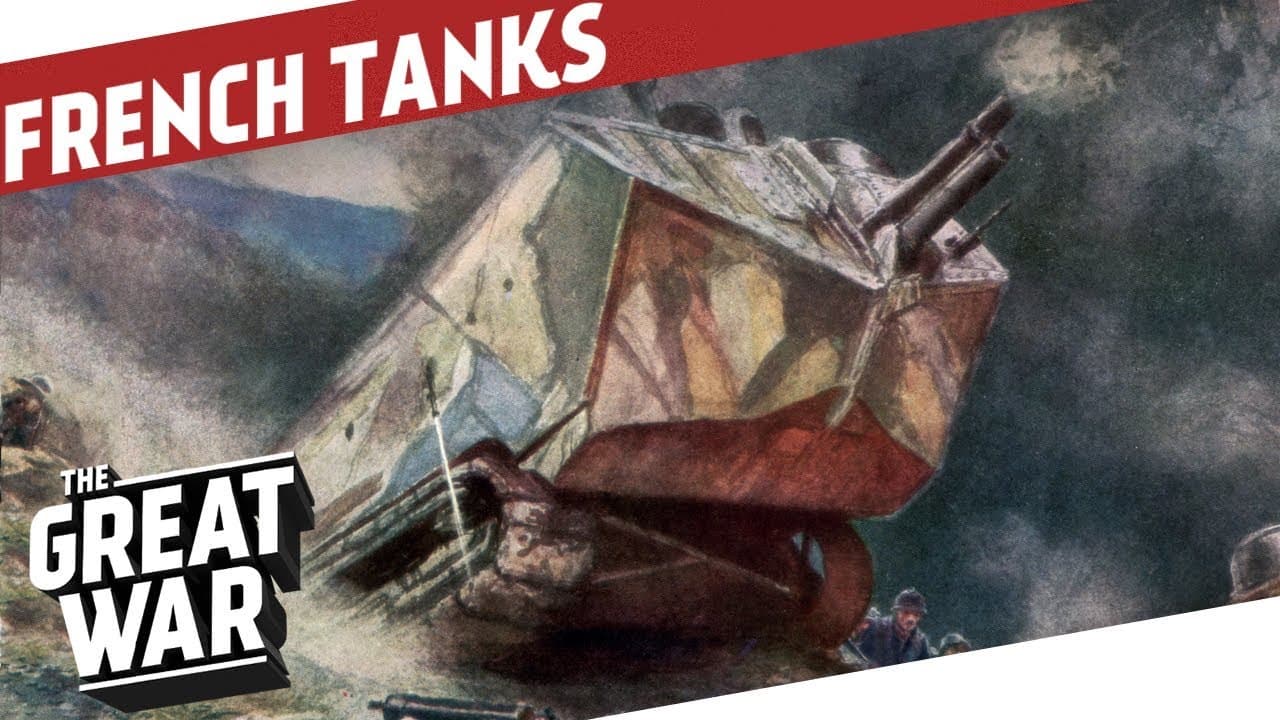
French Tanks of World War 1 I THE GREAT WAR Special
TL;DR
French tanks played a crucial role in WWI despite initial setbacks.
Transcript
It is impossible to think of 20th century warfare without it. Tanks made their first appearance in the First World War and for all of their initial drawbacks, by the war’s end they were acknowledged to be an important part of the modern battlefield. We’ve talked a bit already about British and German tank designs, and today I’m going to look at the... Read More
Key Insights
- French tank development during WWI was spearheaded by Jean Estienne, who proposed using armored vehicles to break trench warfare stalemates.
- The Schneider tank, France's first prototype, faced issues such as limited speed, ventilation problems, and a vulnerable fuel tank position.
- The St. Chamond tank was heavier with more firepower but suffered from design flaws like inadequate track length and mechanical failures.
- French tanks were designed with a different philosophy than British tanks, focusing on firepower rather than breakthrough capabilities.
- The Nivelle Offensive showcased the French tanks, but mechanical issues and artillery fire highlighted their limitations, leading to strategic reassessments.
- The Renault FT, introduced in 1918, was a lighter, more agile tank with a rotating turret, influencing future tank designs.
- The Battle of La Malmaison demonstrated the effectiveness of combined arms tactics, with tanks supporting infantry advances.
- By the war's end, the Renault FT was considered a pivotal tank, with over 2,500 units produced, marking a significant evolution in tank warfare.
Install to Summarize YouTube Videos and Get Transcripts
Explore YouTube Video Summarizer or Get YouTube Transcript Extractor
Questions & Answers
Q: What was Jean Estienne's initial proposal for French tanks in WWI?
Jean Estienne proposed using a fleet of armored vehicles to break the stalemate of trench warfare. His idea was to have these vehicles carry artillery and machine guns across no man's land ahead of the infantry, seizing new ground and serving as mobile artillery batteries. This proposal intrigued the French High Command and marked the beginning of French tank development.
Q: What were some of the design flaws of the Schneider tank?
The Schneider tank had several design flaws, including an underpowered engine for its weight, poor ventilation, and a vulnerable fuel tank placement at the front. Its speed was limited, especially on uneven terrain, and it was susceptible to becoming a death trap if hit, due to its combustible oil and difficult-to-use escape door.
Q: How did the St. Chamond tank differ from the Schneider tank?
The St. Chamond tank was envisioned as a heavier tank with more firepower, including four machine guns and a 120mm gun or flamethrower. However, it faced design issues like high ground pressure due to inadequate track length and mechanical failures from its electric transmission system. It was longer than the Schneider but not necessarily more effective.
Q: What was the significance of the Renault FT tank introduced in 1918?
The Renault FT tank, introduced in 1918, was significant for its lightweight design, agility, and innovative rotating turret. It featured a standard car engine and was easy to produce and transport. Its design influenced future tank models and played a crucial role in the French army's advances during the latter part of WWI, marking a turning point in tank warfare.
Q: How did the Battle of La Malmaison demonstrate the effectiveness of combined arms tactics?
The Battle of La Malmaison showcased the effectiveness of combined arms tactics by integrating tanks, artillery, and infantry. Reconnaissance flights and artillery barrages helped tanks enter the battlefield and engage the enemy effectively. Tanks absorbed enemy fire and neutralized machine gun posts, allowing infantry to advance. This strategy proved successful and increased confidence in tank warfare.
Q: What challenges did French tanks face during the Nivelle Offensive?
During the Nivelle Offensive, French tanks faced challenges such as mechanical failures, breakdowns in shell holes, and vulnerability to artillery fire. The offensive was a failure, but it provided valuable lessons that led to strategic adjustments, including improved communication, reconnaissance, and coordination with infantry, which were essential for future tank operations.
Q: How did the French tank design philosophy differ from the British during WWI?
French tanks were designed with a focus on firepower rather than breakthrough capabilities, differing from the British approach. French tanks like the Schneider and St. Chamond carried more firepower, such as the 75mm gun, and were intended as shock weapons to neutralize enemy machine guns and support infantry advances, rather than pushing through enemy lines.
Q: What impact did the Renault FT tank have on future tank designs?
The Renault FT tank had a profound impact on future tank designs due to its innovative features, such as a lightweight build, rotating turret, and ease of production. Its successful deployment in 1918 demonstrated the effectiveness of such designs, influencing tank development for decades. It is often regarded as the first modern tank, setting a standard for future innovations in armored warfare.
Summary & Key Takeaways
-
French tanks in WWI were initially designed by Jean Estienne to break the trench warfare stalemate. The Schneider and St. Chamond tanks faced mechanical and design challenges but laid the groundwork for future developments.
-
The Renault FT tank, introduced in 1918, revolutionized tank design with its lightweight build and rotating turret, influencing future tank models. Its effectiveness in battle contributed to the French army's strategic advances.
-
Despite initial setbacks, French tanks played a crucial role in WWI. The evolution of tank strategy and design, particularly with the Renault FT, showcased the importance of tanks in modern warfare.
Read in Other Languages (beta)
Share This Summary 📚
Summarize YouTube Videos and Get Video Transcripts with 1-Click
Try YouTube Summary with ChatGPT & Claude or YouTube Transcript Generator
Explore More Summaries from The Great War 📚
Summarize YouTube Videos and Get Video Transcripts with 1-Click
Try YouTube Summary with ChatGPT & Claude or YouTube Transcript Generator