What Distance to a Supernova Could Cause Mass Extinction?
TL;DR
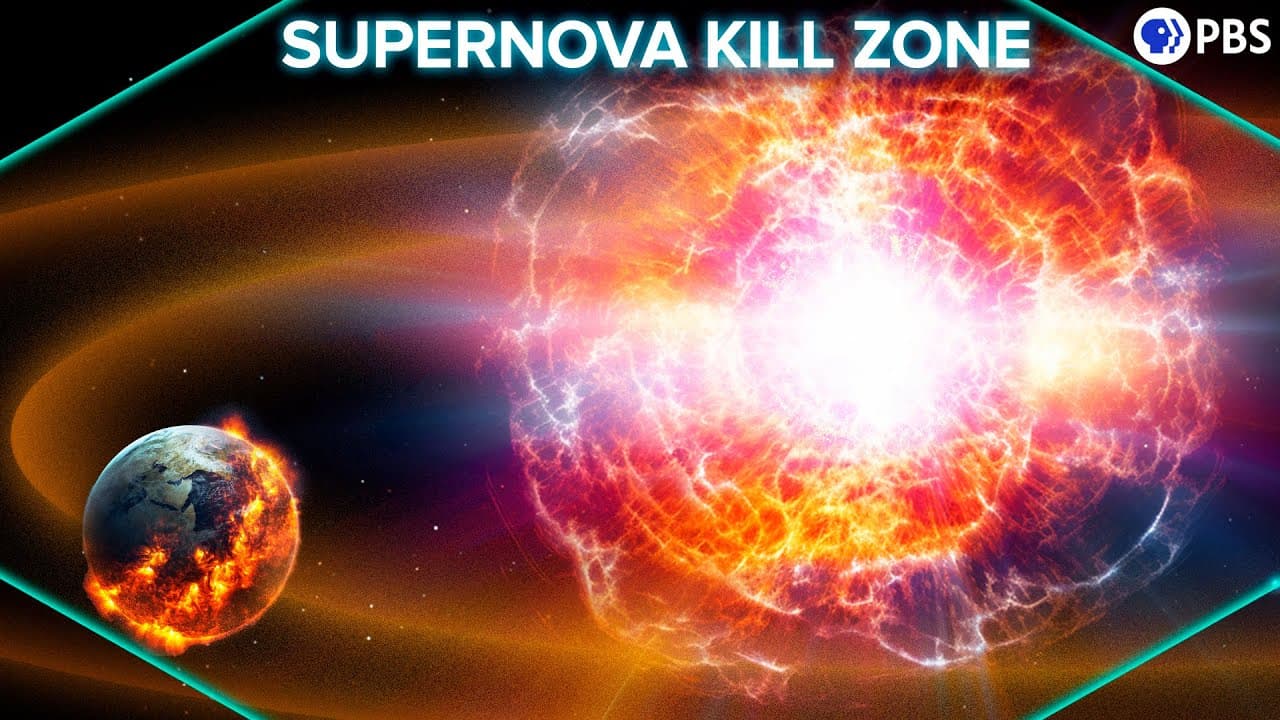
A supernova could trigger mass extinction if it's within 15-20 light years, as this proximity would significantly damage Earth's ozone layer. Supernovae within 30-50 light years can also create dangerous cosmic rays. Current threats include stars like IK Pegasi, but they are not close enough to pose a danger for billions of years.
Transcript
Thank you to Brilliant for supporting PBS Around two and a half million years ago, a human-ish creature looked up at the sky confused at a constellation familiar to her. She was confused because its brightest star was getting brighter, and quickly. Over around a day, it blazed to become brighter than the full moon, easily visible during daytime. Fo... Read More
Key Insights
- Supernovae are powerful stellar explosions that can be visible from Earth, but their radiation can be deadly if too close.
- Betelgeuse, a red supergiant star, is 640 light years away and not a threat to Earth despite its recent brightness fluctuations.
- Supernovae within 15-20 light years can destroy Earth's ozone layer, leading to mass extinctions due to increased UV radiation.
- Cosmic rays from supernovae within 30-50 light years can penetrate the atmosphere, posing significant risks to life on Earth.
- The Pleistocene supernova, around 2.7 million years ago, may have influenced Earth's climate and triggered the Ice Age.
- Type II supernovae result from massive stars collapsing under gravity, releasing neutrinos and heavy elements like iron-60.
- Hypernovae and gamma-ray bursts, though rare, can deplete the ozone layer if within several thousand light years.
- Current estimates suggest a supernova occurs every 50 years in the Milky Way, but most are too distant to affect Earth.
Install to Summarize YouTube Videos and Get Transcripts
Explore YouTube Video Summarizer or Get YouTube Transcript Extractor
Questions & Answers
Q: What is the significance of Betelgeuse in the context of supernova threats?
Betelgeuse is a red supergiant star located 640 light years away. Its recent fluctuations in brightness have sparked interest, but it remains too distant to pose a threat to Earth. A potential supernova from Betelgeuse would be a spectacular astronomical event but not dangerous to our planet.
Q: How do supernovae affect Earth's ozone layer?
Supernovae emit high-energy radiation, including gamma rays and cosmic rays, which can destroy ozone molecules in Earth's atmosphere. If a supernova occurs within 15-20 light years, it can significantly deplete the ozone layer, increasing UV radiation from the Sun and potentially leading to mass extinctions.
Q: What evidence suggests a supernova occurred 2.7 million years ago?
The presence of iron-60 isotopes in ocean sediments, Antarctic ice, and lunar samples indicates a supernova occurred around 2.7 million years ago. This event, known as the Pleistocene supernova, may have influenced Earth's climate and contributed to the onset of the Ice Age.
Q: What are cosmic rays, and why are they dangerous?
Cosmic rays are high-energy particles accelerated by supernova shockwaves. They can penetrate Earth's atmosphere more easily than gamma rays, posing a threat to life by causing radiation damage. A supernova within 30-50 light years can increase cosmic ray exposure, potentially leading to mass extinctions.
Q: How does the local interstellar medium affect supernova danger?
The local interstellar medium, consisting of gas and dust, can influence the propagation of supernova radiation. A denser medium can enhance the effects of a supernova, extending the kill zone for dangerous radiation like X-rays, potentially affecting Earth from greater distances than usual.
Q: What role do hypernovae and gamma-ray bursts play in supernova threats?
Hypernovae and gamma-ray bursts are rare, powerful explosions that emit focused beams of gamma rays. If directed towards Earth from within several thousand light years, they can significantly deplete the ozone layer, posing a severe threat to life. However, such events are infrequent.
Q: What is the likelihood of a supernova affecting Earth in the near future?
The likelihood of a supernova affecting Earth soon is low. While supernovae occur frequently in the Milky Way, most are thousands of light years away. Current nearby candidates like Spica and IK Pegasi are at safe distances, with any potential threats millions to billions of years away.
Q: How does stellar evolution influence supernova frequency?
Stellar evolution determines when a massive star will explode as a supernova. In the Milky Way, supernovae occur approximately every 50 years. The frequency is influenced by the number of massive stars and their life cycles, as well as the star formation rate in different regions of the galaxy.
Summary & Key Takeaways
-
Supernovae are explosive events that can illuminate the sky but pose a threat if occurring within a close range. Betelgeuse, a red supergiant, is one such star that has shown fluctuations but remains too distant to endanger Earth.
-
The Pleistocene supernova, occurring 2.7 million years ago, left traces of iron-60 and possibly influenced Earth's climate, marking the beginning of the Ice Age. Supernovae closer than 50 light years can cause mass extinctions by damaging the ozone layer.
-
Future supernova threats include nearby stars like Spica and IK Pegasi, though both are currently at safe distances. Supernova frequency in the Milky Way is high, but most occur far from Earth, reducing immediate risk.
Read in Other Languages (beta)
Share This Summary 📚
Summarize YouTube Videos and Get Video Transcripts with 1-Click
Try YouTube Summary with ChatGPT & Claude or YouTube Transcript Generator
Explore More Summaries from PBS Space Time 📚



Summarize YouTube Videos and Get Video Transcripts with 1-Click
Try YouTube Summary with ChatGPT & Claude or YouTube Transcript Generator