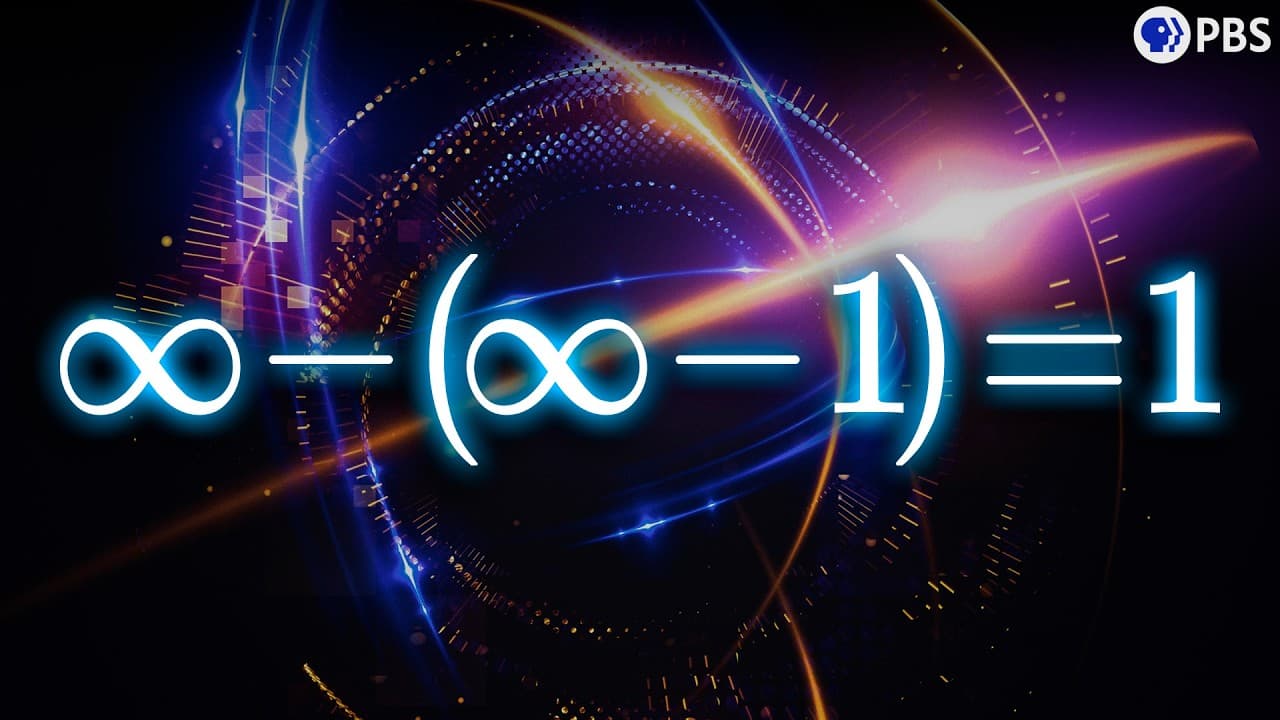
Does Infinity - Infinity = an Electron?
TL;DR
Exploring the hierarchy problem and quantum mechanics' role in electron mass.
Transcript
Thank You To Radiacode for supporting PBS. What do you get if you take something that’s infinitely massive and combining with something else that’s negative infinitely massive? You get a single electron, at least that’s what it looks like in our most precise way of describing the quantum world. Today’s episode is an introduction to one of the m... Read More
Key Insights
- The hierarchy problem is a major issue in physics, questioning why the Higgs boson's mass is smaller than expected.
- Quantum field theory and quantum electrodynamics help describe the electron's interaction with electromagnetic fields.
- Renormalization is a process used to adjust internal contributions to eliminate infinities in quantum field theory.
- The bare mass of an electron is theorized to be negative and infinite, counteracting the infinite self-energy mass.
- Quantum mechanics introduces virtual particles that contribute to the electron's self-energy, affecting its mass.
- Feynman diagrams represent virtual processes and interactions, crucial for calculating quantum field interactions.
- Regularization involves setting an energy cutoff to avoid infinities, acknowledging quantum mechanics' limitations.
- Chiral symmetry and matter-antimatter symmetry protect the electron's mass from scaling to unnatural levels.
Install to Summarize YouTube Videos and Get Transcripts
Explore YouTube Video Summarizer or Get YouTube Transcript Extractor
Questions & Answers
Q: What is the hierarchy problem in physics?
The hierarchy problem in physics is the question of why the Higgs boson's mass is much smaller than expected based on quantum field theory and the standard model of particle physics. This discrepancy suggests that there may be unknown mechanisms or theories that protect the Higgs boson's mass from becoming extremely large, which would have catastrophic consequences for the universe.
Q: How does quantum field theory describe the electron's interaction with electromagnetic fields?
Quantum field theory (QFT), specifically quantum electrodynamics (QED), describes the electron's interaction with electromagnetic fields using the concept of virtual particles. These virtual particles, such as photons and electron-positron pairs, contribute to the electron's self-energy and influence its mass. Feynman diagrams are used to represent these virtual processes and interactions, which are crucial for calculating the probabilities and energies involved in these interactions.
Q: What is renormalization in quantum field theory?
Renormalization in quantum field theory is a process used to adjust internal contributions towards a measured quantity to eliminate infinities. It involves the concept of a bare mass, which is adjusted to counteract the infinite self-energy mass. Although renormalization may seem counterintuitive, it has been a successful tool in making precise predictions in quantum mechanics, particularly in quantum electrodynamics.
Q: Why is the concept of negative bare mass introduced for the electron?
The concept of negative bare mass for the electron is introduced to counteract the infinite self-energy mass that arises in calculations. By assuming a negative infinite bare mass, the infinities can be canceled out, resulting in the observed finite mass of the electron. This approach, while seemingly unconventional, allows for the reconciliation of theoretical predictions with experimental observations.
Q: What role do Feynman diagrams play in quantum field theory?
Feynman diagrams are a key tool in quantum field theory, used to visually represent the possible virtual processes and interactions that can occur in particle interactions. These diagrams help in calculating the probabilities and energies involved in interactions by considering all possible scenarios and contributions. They are essential for understanding the complex interactions at the quantum level and are used extensively in quantum electrodynamics.
Q: What is regularization, and why is it necessary in quantum mechanics?
Regularization is a process in quantum mechanics where an energy cutoff is set to prevent the inclusion of infinite energies in calculations. It acknowledges the limitations of quantum mechanics, particularly its inability to include gravity, and ensures that calculations remain within the valid range of the theory. By setting a cutoff, regularization helps avoid infinities and ensures that the results are physically meaningful.
Q: How does chiral symmetry protect the electron's mass?
Chiral symmetry, along with matter-antimatter symmetry, protects the electron's mass from scaling to unnatural levels. This symmetry ensures that contributions to the electron's self-energy are balanced, preventing the mass from becoming excessively large. The presence of an antiparticle, such as the positron, contributes to this symmetry and helps maintain the observed small mass of the electron, solving the hierarchy problem at the electron scale.
Q: What limitations does quantum mechanics have in describing the universe?
Quantum mechanics has limitations, particularly in its inability to include gravity in its framework. This indicates that quantum mechanics is an effective theory that emerges from a deeper, yet-to-be-discovered theory. Additionally, quantum mechanics fails at the Planck scale, where lengths and energies reach extreme values. These limitations suggest that new physics or theories are needed to fully describe the universe at these scales.
Summary & Key Takeaways
-
The video explores the hierarchy problem in physics, focusing on why the Higgs boson's mass is surprisingly small. Quantum field theory and quantum electrodynamics are used to describe the electron's interaction with electromagnetic fields, highlighting the role of virtual particles and renormalization in addressing infinite self-energy mass.
-
Renormalization is explained as a method to adjust internal contributions and eliminate infinities in quantum field theory. The concept of negative bare mass is introduced, where the electron's infinite self-energy mass is counteracted by a negative infinite bare mass. This approach, while controversial, has proven effective in quantum mechanics.
-
The video discusses the limitations of quantum mechanics, particularly its inability to include gravity, and the need for an energy cutoff in calculations. Chiral symmetry and matter-antimatter symmetry are highlighted as protective factors for the electron's mass, preventing it from scaling to unnatural levels and solving the electron's hierarchy problem.
Read in Other Languages (beta)
Share This Summary 📚
Summarize YouTube Videos and Get Video Transcripts with 1-Click
Try YouTube Summary with ChatGPT & Claude or YouTube Transcript Generator
Explore More Summaries from PBS Space Time 📚




Summarize YouTube Videos and Get Video Transcripts with 1-Click
Try YouTube Summary with ChatGPT & Claude or YouTube Transcript Generator