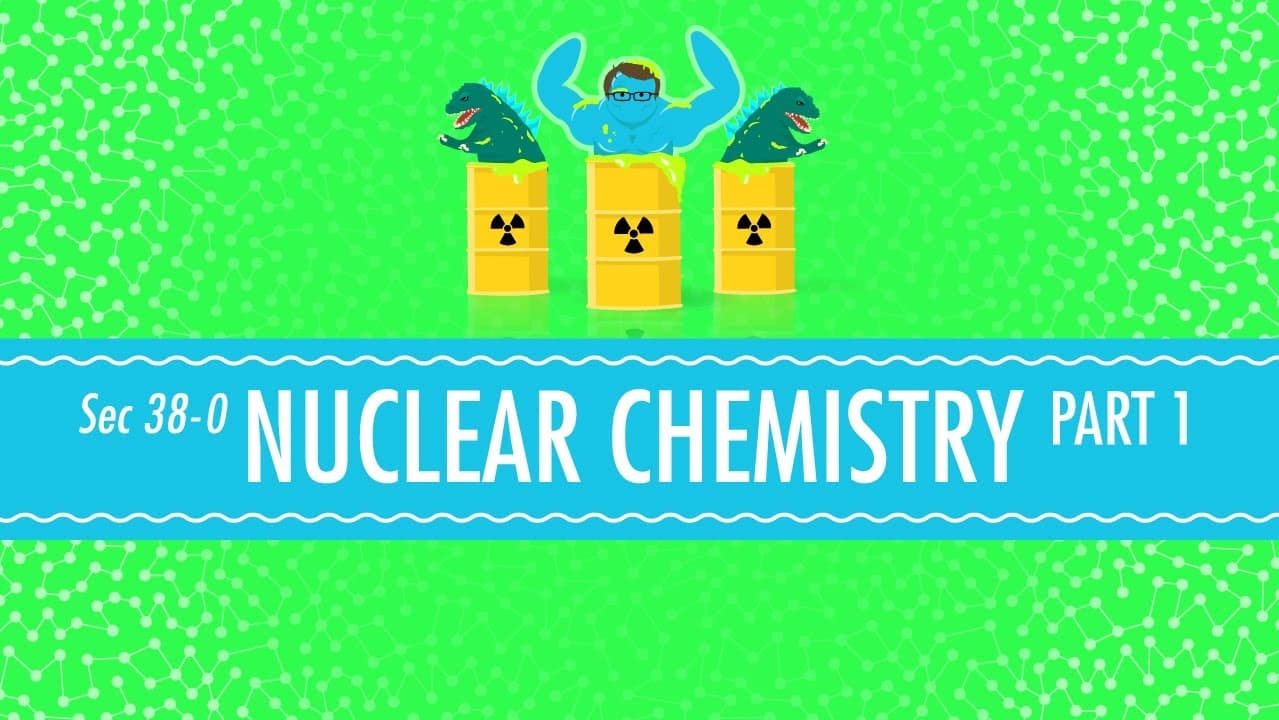
Nuclear Chemistry: Crash Course Chemistry #38
TL;DR
Explores radioactivity, nuclear chemistry, and different types of decay.
Transcript
Apparently, it can turn you into a superhero or into a mutant zombie. It's the plot device for probably half of the sci-fi movies made in the last 60 years and it's even the name of the song that welcomes you to the new age, to the new age, welcome to the new age. Presumably this new age occurring after some kind of apocalypse. As principles of che... Read More
Key Insights
- Radioactivity is often misunderstood and is a key concept in nuclear chemistry, distinct from typical chemical reactions which involve electron interactions.
- Nuclear chemistry involves changes in the nucleus, affecting protons and neutrons, and can result in transmutation, changing one element into another.
- Radioactive decay involves the release of ionizing radiation as unstable nuclei seek stability, with common types being alpha, beta, and gamma decay.
- Alpha decay releases a helium nucleus, beta decay emits electrons, and gamma decay emits energy, with varying levels of penetration and potential harm.
- Half-life is a crucial concept in understanding radioactive decay, indicating the time it takes for half of a radioactive sample to decay.
- Some radioactive isotopes like carbon-14 are constantly renewed, while others persist due to long decay chains originating from supernovae.
- Gamma radiation is particularly dangerous due to its ability to penetrate cells and alter DNA, potentially causing mutations and cancer.
- Spontaneous fission is a rare type of radioactivity where atoms split into smaller atoms without external influence, useful in specific nuclear reactions.
Install to Summarize YouTube Videos and Get Transcripts
Explore YouTube Video Summarizer or Get YouTube Transcript Extractor
Questions & Answers
Q: What is the main difference between nuclear chemistry and traditional chemistry?
Nuclear chemistry differs from traditional chemistry in that it focuses on changes within the nucleus of an atom, involving protons and neutrons, rather than interactions involving the atom's outermost electrons. This can lead to significant energy release and transmutation of elements, whereas traditional chemistry involves electron transfer and bonding.
Q: What is transmutation in the context of nuclear chemistry?
Transmutation in nuclear chemistry refers to the process where one element is transformed into another by changing the number of protons in the nucleus. This can occur naturally through radioactive decay or artificially in nuclear reactions. Changes in neutron numbers result in different isotopes of the same element.
Q: How does radioactive decay work and what are its types?
Radioactive decay occurs when an unstable nucleus releases energy to become more stable. There are three main types: alpha decay (emits a helium nucleus), beta decay (emits electrons), and gamma decay (emits energy as electromagnetic radiation). Each type has different penetration capabilities and potential health impacts.
Q: What is the significance of half-life in radioactive decay?
Half-life is a measure of the time it takes for half of a radioactive sample to decay into a more stable form. It is crucial for predicting the longevity and decay rate of radioactive materials, allowing scientists to calculate how much of a substance remains after a given period.
Q: Why are some radioactive elements still present on Earth?
Some radioactive elements persist on Earth due to their long decay chains, originating from supernovae billions of years ago. Elements with short half-lives are continually replenished by decay from other elements or cosmic ray interactions, ensuring their presence despite ongoing decay into stable forms.
Q: What makes gamma radiation particularly dangerous?
Gamma radiation is dangerous due to its high energy and penetrating power, allowing it to pass through skin and cell membranes, potentially causing internal damage. It can alter DNA, leading to mutations and cancer. Unlike alpha and beta particles, gamma rays require dense materials like lead for effective shielding.
Q: What is spontaneous fission and its significance?
Spontaneous fission is a type of radioactivity where an atom splits into two smaller atoms without external influence. It occurs at a slow rate in most elements, except Californium-254, which is used to produce neutrons for other nuclear reactions. It's significant for understanding nuclear processes and energy production.
Q: How does the episode relate to popular culture's portrayal of radioactivity?
The episode addresses misconceptions in popular culture, where radioactivity is often depicted as a source of superpowers or apocalyptic scenarios. It emphasizes the scientific understanding of radioactivity as a natural process with practical applications, contrasting with its sensationalized portrayal in movies and media.
Summary & Key Takeaways
-
This episode of Crash Course Chemistry delves into the complex world of radioactivity and nuclear chemistry, explaining how it differs from traditional chemistry by focusing on changes within the atom's nucleus. The episode covers the concept of transmutation, where elements can transform into different ones, and introduces the idea of isotopes.
-
Key topics include the different types of radioactive decay—alpha, beta, and gamma—and their implications, such as the potential for gamma rays to cause significant harm due to their penetrating power. The episode also explains the concept of half-life, which helps predict the rate of decay in radioactive materials.
-
The episode concludes by touching on spontaneous fission, a rare but important process in nuclear reactions, and emphasizes the importance of understanding radioactivity beyond its portrayal in popular culture. The content is supported by additional resources like flashcards available on the Crash Course App.
Read in Other Languages (beta)
Share This Summary 📚
Summarize YouTube Videos and Get Video Transcripts with 1-Click
Try YouTube Summary with ChatGPT & Claude or YouTube Transcript Generator
Explore More Summaries from CrashCourse 📚
Summarize YouTube Videos and Get Video Transcripts with 1-Click
Try YouTube Summary with ChatGPT & Claude or YouTube Transcript Generator