What Led to the Unification of Italy and Germany?
TL;DR
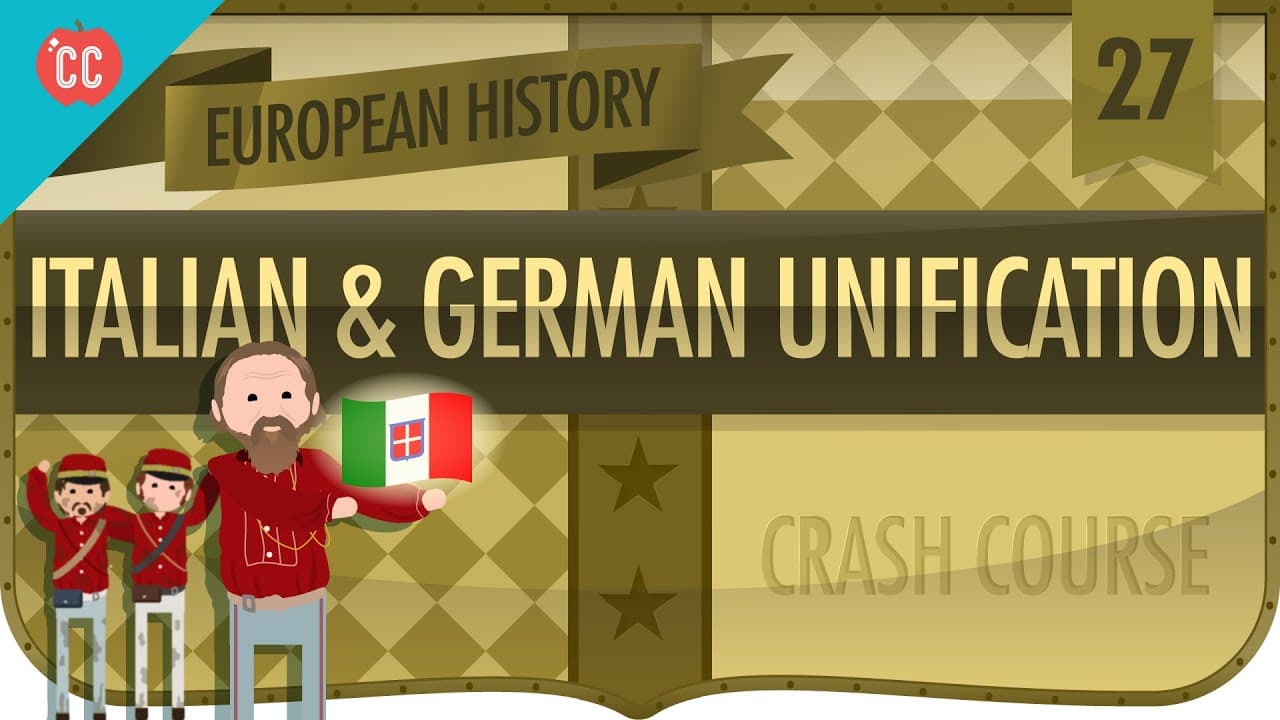
Italy and Germany were unified through a series of strategic political maneuvers by key figures like Napoleon III and Otto von Bismarck. Napoleon III modernized France and engaged in wars that shifted regional power, while Bismarck used realpolitik and media manipulation to unite the German states, ultimately establishing the German Empire in 1871.
Transcript
Hi I’m John Green and this is Crash Course European History. So if you look at Europe today, you’ll note that two of the European Union’s largest economies--Italy and Germany--have not existed as unified kingdoms or sovereign states during our first 26 episodes. We tend to think of Europe’s nation states as static and longstanding, but one of my gr... Read More
Key Insights
- 🌍 Europe's nation-states, including Italy and Germany, were not historically unified kingdoms or sovereign states.
- 🌍 Napoleon III's nation-building efforts, through modernization and war, reshaped power dynamics in Europe.
- 🖐️ Otto von Bismarck's realpolitik approach and manipulation of media played essential roles in unifying Germany.
Install to Summarize YouTube Videos and Get Transcripts
Explore YouTube Video Summarizer or Get YouTube Transcript Extractor
Questions & Answers
Q: How did the national identities of Italians and Germans develop in the 19th century?
Prior to the 19th century, Italians identified themselves based on their regional affiliations, such as Genoese or Sicilian. Similarly, Germans were fragmented into various states. The development of national identities took place through the process of nation-building, fueled by figures like Napoleon III and Otto von Bismarck.
Q: How did Napoleon III contribute to nation-building in Europe?
Napoleon III modernized France, built railways, and created a lavish court. He actively engaged in war, which disrupted the existing power dynamics in Europe and led to the dissolution of the Holy Alliance. His role in the Crimean War weakened Russia and paved the way for revolution.
Q: What was Otto von Bismarck's strategy for unifying Germany?
Bismarck employed a realpolitik approach, prioritizing power politics and realism. He aligned with Prussian King William I and pursued military and diplomatic strategies to consolidate Prussia's dominance. Bismarck's manipulation of media and negative integration tactics, such as targeting Catholics and Social Democrats, furthered his goal of unifying Germany.
Q: How did negative integration impact nation-building in Germany?
Negative integration refers to the process of uniting a country by creating enemies or outcasts. In Germany, Bismarck employed negative integration strategies against Catholics and Social Democrats. While he faced resistance and criticism, negative integration played a role in solidifying a unified Germany.
Summary & Key Takeaways
-
Europe's nation-states, such as Italy and Germany, were not always unified kingdoms or sovereign states, and their national identities are relatively new compared to their long-standing stereotypes.
-
Napoleon III played a significant role in the nation-building process by modernizing France and sparking the Crimean War, which led to the breakup of the Holy Alliance and revolution in Russia.
-
Otto von Bismarck's realpolitik approach, characterized by the use of power politics and diplomacy, resulted in the unification of Germany under the leadership of Prussia and the consolidation of a German empire.
Read in Other Languages (beta)
Share This Summary 📚
Summarize YouTube Videos and Get Video Transcripts with 1-Click
Try YouTube Summary with ChatGPT & Claude or YouTube Transcript Generator
Explore More Summaries from CrashCourse 📚

Summarize YouTube Videos and Get Video Transcripts with 1-Click
Try YouTube Summary with ChatGPT & Claude or YouTube Transcript Generator