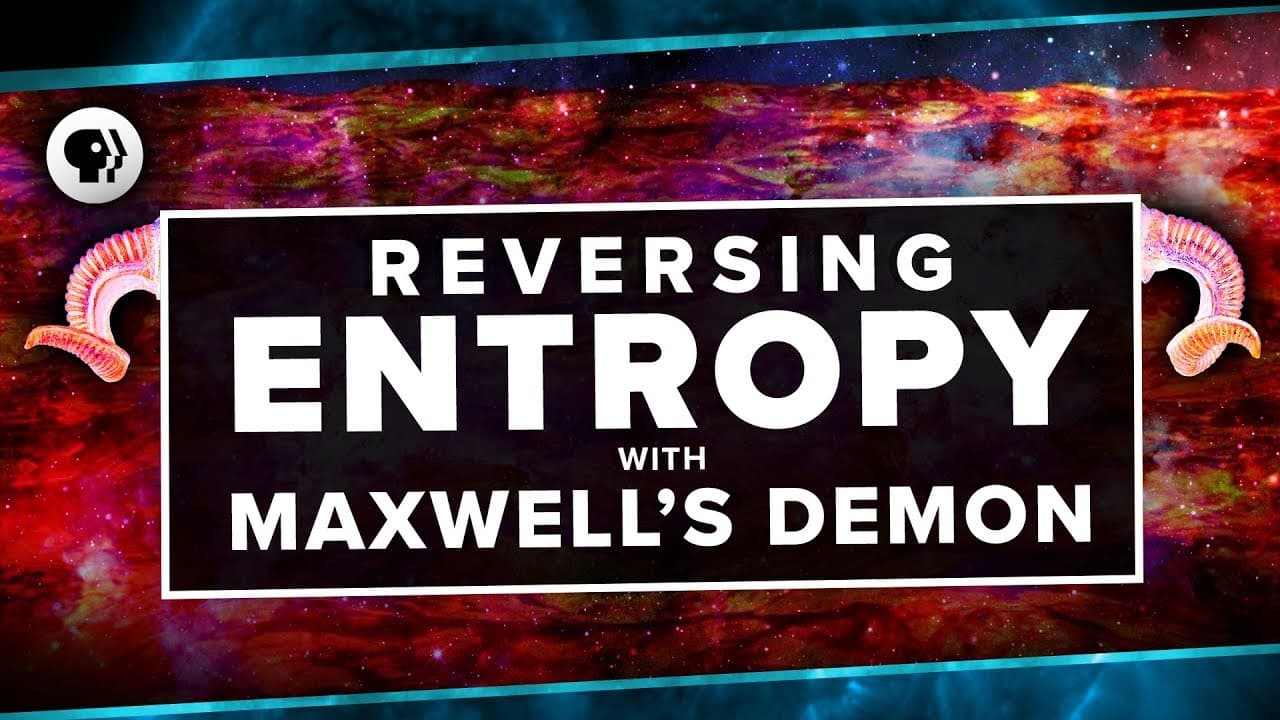
Reversing Entropy with Maxwell's Demon
TL;DR
Maxwell's demon challenges the second law of thermodynamics using information.
Transcript
MATT O'DOWD: Can a demon defeat the second law of thermodynamics? This is actually a very serious scientific question. Entropy is sometimes described as a measure of disorder or randomness. The second law of thermodynamics, the law that entropy must on average increase, has been interpreted as the inevitability of the decay of structure. This is mi... Read More
Key Insights
- The second law of thermodynamics suggests that entropy, or disorder, always increases, but structure can still form locally.
- Entropy is linked to the amount of hidden information about a system, affecting the availability of free energy.
- Maxwell's demon is a thought experiment that challenges the second law by sorting particles based on their speed, creating a temperature differential.
- The demon's actions seem to decrease entropy without external energy exchange, but information storage and erasure ultimately increase entropy.
- Landauer's principle resolves the paradox by stating that erasing information increases entropy, preserving the second law.
- Shannon entropy, inspired by thermodynamic entropy, measures the hidden information revealed by observing random events.
- Quantum entropy, or Von Neumann entropy, measures entanglement in quantum systems and may explain the arrow of time.
- Understanding entropy and information highlights the deep connection between physical laws and the nature of computation.
Install to Summarize YouTube Videos and Get Transcripts
Explore YouTube Video Summarizer or Get YouTube Transcript Extractor
Questions & Answers
Q: What is the second law of thermodynamics?
The second law of thermodynamics states that the entropy of an isolated system will tend to increase over time, leading to a state of maximum entropy or thermal equilibrium. It implies that processes involving energy transfer or transformation are irreversible and that disorder or randomness in a system will generally increase.
Q: How does Maxwell's demon challenge the second law?
Maxwell's demon challenges the second law by hypothetically sorting particles based on their speed, creating a temperature differential between two halves of a box. This process appears to decrease entropy without any external energy exchange, seemingly violating the law that entropy must always increase or remain constant in an isolated system.
Q: What role does information play in Maxwell's demon thought experiment?
In Maxwell's demon thought experiment, information plays a crucial role as the demon must learn about the particles' speeds to sort them. The demon's memory stores this information, and eventually, the process of resetting or erasing this information leads to an increase in entropy, thus preserving the second law of thermodynamics.
Q: What is Landauer's principle?
Landauer's principle states that any logically irreversible manipulation of information, such as erasing a bit or merging computation paths, must be accompanied by a corresponding increase in entropy. This principle resolves the paradox of Maxwell's demon by highlighting that erasing the demon's memory increases entropy, thus maintaining the second law of thermodynamics.
Q: How does Shannon entropy relate to thermodynamics?
Shannon entropy, inspired by thermodynamic entropy, measures the amount of hidden information revealed by observing a random event. It quantifies the uncertainty of an event, similar to how thermodynamic entropy measures disorder in a system. Shannon's formula parallels the Boltzmann equation, illustrating the connection between entropy and information theory.
Q: What is quantum entropy?
Quantum entropy, also known as Von Neumann entropy, measures the hidden information or entanglement within quantum systems. It provides insights into the fundamental nature of quantum mechanics and may explain phenomena such as the arrow of time and the limits of information processing, tying into broader concepts of entropy and thermodynamics.
Q: Why is the connection between entropy and information significant?
The connection between entropy and information is significant because it reveals how physical laws govern both thermodynamic processes and information theory. This relationship highlights the fundamental limits of computation, the efficiency of energy use, and the nature of disorder and structure in the universe, bridging physics and information science.
Q: What is the role of computation in the context of entropy?
Computation plays a critical role in the context of entropy as processing and storing information inherently involves physical processes that affect entropy. According to Landauer's principle, erasing information increases entropy, illustrating the link between computation, thermodynamics, and the fundamental laws governing energy and information in the universe.
Summary & Key Takeaways
-
Maxwell's demon is a theoretical construct that challenges the second law of thermodynamics by sorting particles based on their speed to create a temperature differential. This process seems to decrease entropy without external energy exchange, but the demon's memory and information processing ultimately ensure entropy increases.
-
Landauer's principle resolves the paradox by stating that erasing information leads to an increase in entropy, thus preserving the second law of thermodynamics. This principle highlights the fundamental link between entropy and information, showing that information processing is inherently tied to physical laws.
-
Shannon entropy measures the hidden information revealed by observing random events, while quantum entropy, or Von Neumann entropy, measures entanglement in quantum systems. These concepts illustrate the deep connection between entropy, information theory, and the fundamental nature of computation and the universe.
Read in Other Languages (beta)
Share This Summary 📚
Summarize YouTube Videos and Get Video Transcripts with 1-Click
Try YouTube Summary with ChatGPT & Claude or YouTube Transcript Generator
Explore More Summaries from PBS Space Time 📚



Summarize YouTube Videos and Get Video Transcripts with 1-Click
Try YouTube Summary with ChatGPT & Claude or YouTube Transcript Generator