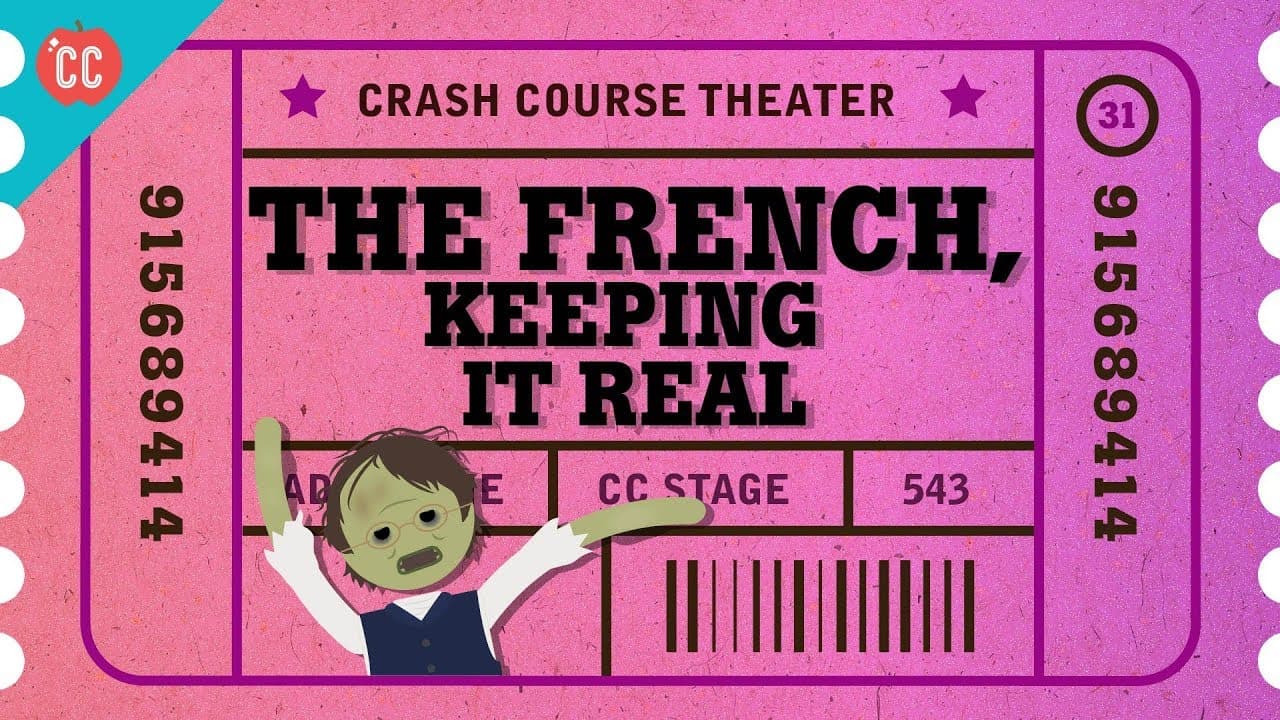
Zola, France, Realism, and Naturalism: Crash Course Theater #31
TL;DR
Exploration of Realism and Naturalism in 19th-century French theater.
Transcript
Hey there! I’m Mike Rugnetta. This is Crash Course Theater, and today we’re headed back to France. Hang onto your culturally appropriate headwear because today there’s gonna be murder. There’s gonna be sexy times. There’s gonna be tuberculosis. Rebels are gonna pee in the aisles. Au revoir, neoclassicism. Don’t let the minimal scene changes hit you... Read More
Key Insights
- Victor Hugo challenged neoclassical norms in theater, advocating for more natural representations of life, which led to a small riot at the premiere of his play 'Hernani'.
- Eugene Scribe popularized the 'well-made play' formula, focusing on entertainment over realism, which was criticized by contemporaries for lacking authenticity.
- Realism in theater emerged in the 1850s, calling for realistic situations, characters, and dialogue, moving away from melodrama's sensationalism.
- Alexandre Dumas fils contributed to realism by emphasizing the importance of reflecting real-life experiences and societal issues in plays.
- Emile Zola introduced Naturalism, suggesting theater should be like a scientific experiment, focusing on characters' hereditary traits and environmental influences.
- Zola's 'Therese Raquin' exemplifies Naturalism, exploring guilt and psychological torment after a murder, though it retains melodramatic elements.
- The transition to Realism and Naturalism coincided with scientific discoveries, such as Darwin's theories, influencing how playwrights depicted human behavior.
- Despite aiming for realism, theatrical conventions still shape narratives, requiring structured scenes and resolutions to engage audiences.
Install to Summarize YouTube Videos and Get Transcripts
Explore YouTube Video Summarizer or Get YouTube Transcript Extractor
Questions & Answers
Q: What was Victor Hugo's contribution to French theater?
Victor Hugo challenged the neoclassical norms in French theater, advocating for a more natural and truthful representation of life. His play 'Hernani' mixed comedy and tragedy, defying traditional rules and sparking a riot at its premiere. Hugo's work paved the way for Realism by emphasizing the grotesque and sublime aspects of life.
Q: How did Eugene Scribe influence French theater?
Eugene Scribe popularized the 'well-made play' formula, which focused on structured, five-act prose dramas that entertained audiences with discoveries, reversals, and recognitions. While his plays were immensely popular, they were criticized for prioritizing entertainment over realism, often reaffirming conservative bourgeois values.
Q: What defines Realism in theater?
Realism in theater, emerging in the 1850s, called for realistic situations, characters, and dialogue, moving away from the sensationalism of melodrama. It aimed to reflect real-life experiences and societal issues, though achieving a perfect balance between authenticity and audience engagement remained challenging.
Q: Who was Alexandre Dumas fils and what was his impact?
Alexandre Dumas fils, son of the famous novelist, was a key figure in the shift towards Realism in theater. He emphasized the importance of reflecting real-life experiences and societal issues in plays, arguing that artists should reveal truths not immediately apparent in everyday life, though his works still retained some melodramatic elements.
Q: What is Naturalism and how did Emile Zola contribute to it?
Naturalism, introduced by Emile Zola, treated theater as a scientific experiment, focusing on characters' hereditary traits and environmental influences. Zola believed plays should test hypotheses about human behavior, though his works, like 'Therese Raquin', often retained melodramatic elements despite aiming for a more realistic portrayal.
Q: What themes are explored in 'Therese Raquin'?
'Therese Raquin' explores themes of guilt, psychological torment, and the consequences of murder. The play follows an adulterous couple haunted by their crime, highlighting how their hereditary traits and environment lead to their downfall. Despite its naturalistic approach, the play retains melodramatic elements, questioning its realism.
Q: How did scientific discoveries influence theater in the 19th century?
Scientific discoveries, notably Darwin's theories, influenced 19th-century theater by informing the Realism and Naturalism movements. Playwrights became fascinated with heredity and environment's roles in shaping character, leading to more realistic portrayals of human behavior and societal issues, though achieving pure realism on stage remained complex.
Q: What challenges did Realism and Naturalism face in theater?
Realism and Naturalism faced challenges in achieving authenticity while maintaining audience engagement. Theatrical conventions, such as structured scenes and resolutions, often shaped narratives, making it difficult to present life exactly as it is. These genres had to balance realistic portrayals with the demands of storytelling and entertainment.
Summary & Key Takeaways
-
This episode of Crash Course Theater explores the evolution of French theater in the 19th century, focusing on the transition from Romanticism to Realism and Naturalism. Key figures like Victor Hugo, Eugene Scribe, and Emile Zola played pivotal roles in challenging traditional theatrical norms.
-
Victor Hugo's rebellion against neoclassical rules set the stage for Realism, while Eugene Scribe's 'well-made play' format, though popular, was criticized for its lack of authenticity. Realism sought to portray life more accurately, though achieving this balance proved challenging.
-
Emile Zola's Naturalism took Realism further by treating theater as a scientific experiment, focusing on characters' hereditary traits and environmental influences. However, even Zola's works, like 'Therese Raquin', retained elements of melodrama, highlighting the difficulty of achieving pure realism on stage.
Read in Other Languages (beta)
Share This Summary 📚
Summarize YouTube Videos and Get Video Transcripts with 1-Click
Try YouTube Summary with ChatGPT & Claude or YouTube Transcript Generator
Explore More Summaries from CrashCourse 📚

Summarize YouTube Videos and Get Video Transcripts with 1-Click
Try YouTube Summary with ChatGPT & Claude or YouTube Transcript Generator