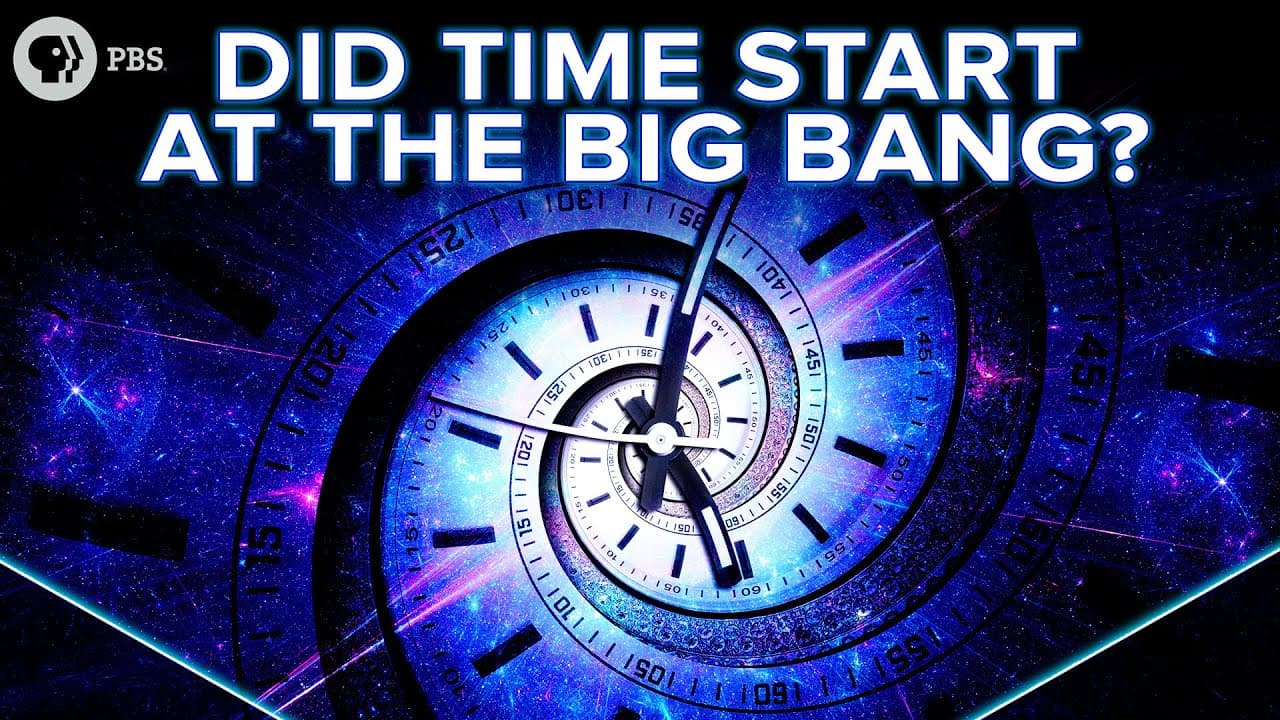
Did Time Start at the Big Bang?
TL;DR
The Big Bang singularity concept is outdated and needs reevaluation.
Transcript
Thank you to LastPass for sponsoring PBS Digital Studios Our universe started with the Big Bang. But only for the right definition of our universe and "started" for that matter. In fact, the Big Bang is probably nothing like what you were taught. A hundred years ago, we discovered the beginning of the Universe. Observations of the retreating galaxi... Read More
Key Insights
- The traditional view of the Big Bang as a singularity followed by explosive expansion is outdated according to modern physicists.
- Einstein's general relativity suggests a universe compacted into a singularity, but this view is limited and incomplete.
- Observational evidence, like the Cosmic Microwave Background, supports a hot dense early universe, not necessarily a singularity.
- Cosmic inflation theory suggests a rapid expansion period before the Big Bang, potentially avoiding the singularity issue.
- Alternative theories like eternal inflation, cyclic universes, and quantum fluctuations propose different origins for our universe.
- The singularity concept is challenged by the conflict between general relativity and quantum mechanics at extreme densities.
- The analogy of geodesics converging at the Big Bang is similar to lines of longitude meeting at the North Pole.
- Current physics theories are insufficient to fully describe conditions at the universe's beginning, indicating a need for new physics.
Install to Summarize YouTube Videos and Get Transcripts
Explore YouTube Video Summarizer or Get YouTube Transcript Extractor
Questions & Answers
Q: What is the traditional view of the Big Bang?
The traditional view of the Big Bang is that it started as a singularity, an infinitesimally small point where all space, mass, and energy were compacted. This singularity supposedly exploded, leading to the expansion of the universe. However, this view is now considered outdated by many physicists.
Q: What evidence supports the idea of a hot dense early universe?
Evidence for a hot dense early universe includes the Cosmic Microwave Background (CMB), which shows the universe as it was a few hundred thousand years after its hypothetical beginning. Additionally, the relative abundance of simple elements like hydrogen and helium supports the idea of an early universe that was a dense, high-temperature nuclear furnace.
Q: How does cosmic inflation challenge the singularity concept?
Cosmic inflation suggests a period of extremely rapid expansion before the Big Bang, which can avoid the singularity problem. This theory proposes that our universe emerged as a bubble in a larger inflating space-time, challenging the idea that everything was once compacted into a singularity.
Q: What are some alternative theories to the Big Bang singularity?
Alternative theories to the Big Bang singularity include eternal inflation, cyclic universe models like the Big Bounce, and Roger Penrose's conformal cyclic cosmology. These theories suggest different mechanisms for the universe's origin, such as continuous expansion, cycles of expansion and contraction, or new universes emerging from black holes.
Q: Why is the singularity concept considered limited?
The singularity concept is limited because it arises from general relativity, which conflicts with quantum mechanics at extreme densities and temperatures. This conflict suggests that current physics theories are incomplete and that new theoretical frameworks are needed to accurately describe the universe's beginnings.
Q: What is the significance of geodesics in understanding the Big Bang?
Geodesics are paths through space-time that converge at the Big Bang, similar to lines of longitude meeting at the North Pole. This convergence illustrates the limitations of current theories, as all timelines end at the singularity, highlighting the need for new physics to understand what happens at the universe's beginning.
Q: How do cyclic universe models propose a different origin for the universe?
Cyclic universe models, like the Big Bounce, propose that the universe undergoes cycles of expansion and contraction. In these models, the gravitational attraction of matter could cause the universe to collapse and then bounce back, leading to a new cycle of expansion. These models offer an alternative to the singularity concept by suggesting a regenerating universe.
Q: What role does quantum mechanics play in challenging the Big Bang singularity?
Quantum mechanics challenges the Big Bang singularity by introducing the possibility of quantum fluctuations and other phenomena that could lead to a universe without a singular starting point. The conflict between quantum mechanics and general relativity at extreme conditions suggests that our understanding of the universe's origin is incomplete, necessitating new physics.
Summary & Key Takeaways
-
The Big Bang is traditionally viewed as a singularity, but modern physics challenges this notion. Observations and theories like inflation suggest a more complex origin. The singularity concept is limited by conflicts between general relativity and quantum mechanics, indicating the need for new theoretical frameworks.
-
Cosmic inflation offers an alternative to the singularity, proposing a rapid expansion phase before the Big Bang. This theory, along with others like cyclic universes and quantum fluctuations, suggests different origins and challenges the idea of a singular starting point for the universe.
-
The convergence of geodesics at the Big Bang is analogous to lines meeting at the North Pole, illustrating the limitations of current theories. The singularity's extreme conditions highlight the need for new physics to understand the universe's true beginnings.
Read in Other Languages (beta)
Share This Summary 📚
Summarize YouTube Videos and Get Video Transcripts with 1-Click
Try YouTube Summary with ChatGPT & Claude or YouTube Transcript Generator
Explore More Summaries from PBS Space Time 📚
Summarize YouTube Videos and Get Video Transcripts with 1-Click
Try YouTube Summary with ChatGPT & Claude or YouTube Transcript Generator