Ortho Para Ratio - Aromatic Nitration of Toluene
TL;DR
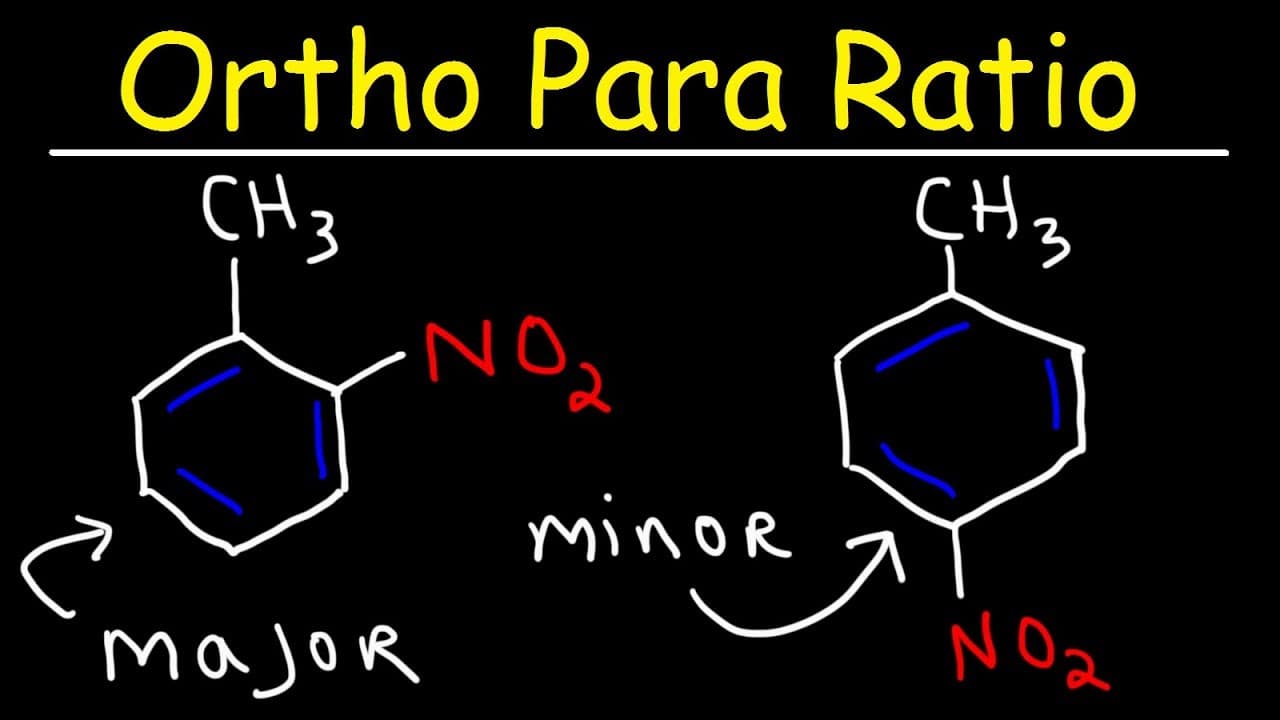
The ortho/para ratio in aromatic nitration depends on how strongly steric effects restrict access to the ortho position. Toluene gives about 60% ortho and 40% para product, ethylbenzene gives roughly 50/50, and a bulky tert-butyl substituent gives about 20% ortho and 80% para product. Read on to see how accessibility predicts major, minor, and negligible products.
Transcript
now what products will we get if we mix toluene with nitric acid and sulfuric acid so here's toluene is basically a benzene ring with a methyl group and so in this reaction this is going to be the nitration of toluene so what products can we get in this reaction now the methyl group is a weakly activating group it's also an ortho para director so i... Read More
Key Insights
- 😋 The ortho/para ratio in nitration reactions is influenced by the presence and size of substituent groups on the benzene ring.
- 👥 A methyl group, as a weakly activating group, favors the ortho product over the para product in nitration reactions.
- 🪂 Bulkier substituent groups, like tert-butyl, favor the para product and result in a higher yield of the para product compared to the ortho product.
- 👥 The ortho/para ratio can be equalized when substituent groups are small or less bulky, such as ethyl groups.
Install to Summarize YouTube Videos and Get Transcripts
Explore YouTube Video Summarizer or Get YouTube Transcript Extractor
Questions & Answers
Q: What is the ortho/para ratio in the nitration of toluene?
Nitration of toluene with nitric acid and sulfuric acid produces about 60% ortho product and 40% para product. The ortho product is therefore slightly favored, although both products form in good amounts.
Q: Why does nitration of toluene produce both ortho and para products?
The methyl group is a weakly activating ortho/para director, so it directs the incoming NO2 group to either the ortho or para position. Because the methyl group is not bulky, access to the ortho position remains favorable.
Q: What is the ortho/para ratio for nitration of ethylbenzene?
The ortho and para products form in approximately equal yields, giving a ratio of about 50/50. Replacing methyl with the bulkier ethyl group lowers the ortho yield and raises the para yield.
Q: How does substituent size affect the ortho/para ratio in aromatic nitration?
Increasing substituent bulk makes the ortho position more sterically hindered and favors nitration at the more accessible para position. A less bulky methyl group slightly favors ortho product, while a bulky tert-butyl group strongly favors para product.
Q: What product ratio results from nitration next to a tert-butyl group?
According to the textbook ratio cited in the transcript, the reaction gives roughly 20% ortho product and 80% para product. The para product is major because its reaction site is more accessible, while the ortho site is sterically hindered.
Q: How do you identify the major nitration product when methyl and tert-butyl groups compete?
Compare how accessible the positions directed by the two alkyl groups are. The major product places NO2 near the less sterically hindered methyl group rather than close to the bulky tert-butyl group, although both competing products can form.
Q: What happens when methyl and tert-butyl groups direct nitration to the same positions?
Steric accessibility determines the product ranking. The position farthest from tert-butyl gives the major product, the position closer to tert-butyl gives the minor product, and the position between tert-butyl and methyl is so hindered that its product is negligible.
Summary & Key Takeaways
-
In the nitration of toluene, a mixture of ortho and para products is obtained, with the ortho product being slightly favored due to the presence of a methyl group.
-
When the methyl group is replaced with an ethyl group, both the ortho and para products are obtained in equal yields.
-
The use of a bulky tert-butyl group in nitration reactions results in the para product being the major product, with the ortho product being the minor product.
Read in Other Languages (beta)
Share This Summary 📚
Summarize YouTube Videos and Get Video Transcripts with 1-Click
Try YouTube Summary with ChatGPT & Claude or YouTube Transcript Generator
Explore More Summaries from The Organic Chemistry Tutor 📚



Summarize YouTube Videos and Get Video Transcripts with 1-Click
Try YouTube Summary with ChatGPT & Claude or YouTube Transcript Generator