12. Utilitarianism and its Critiques
TL;DR
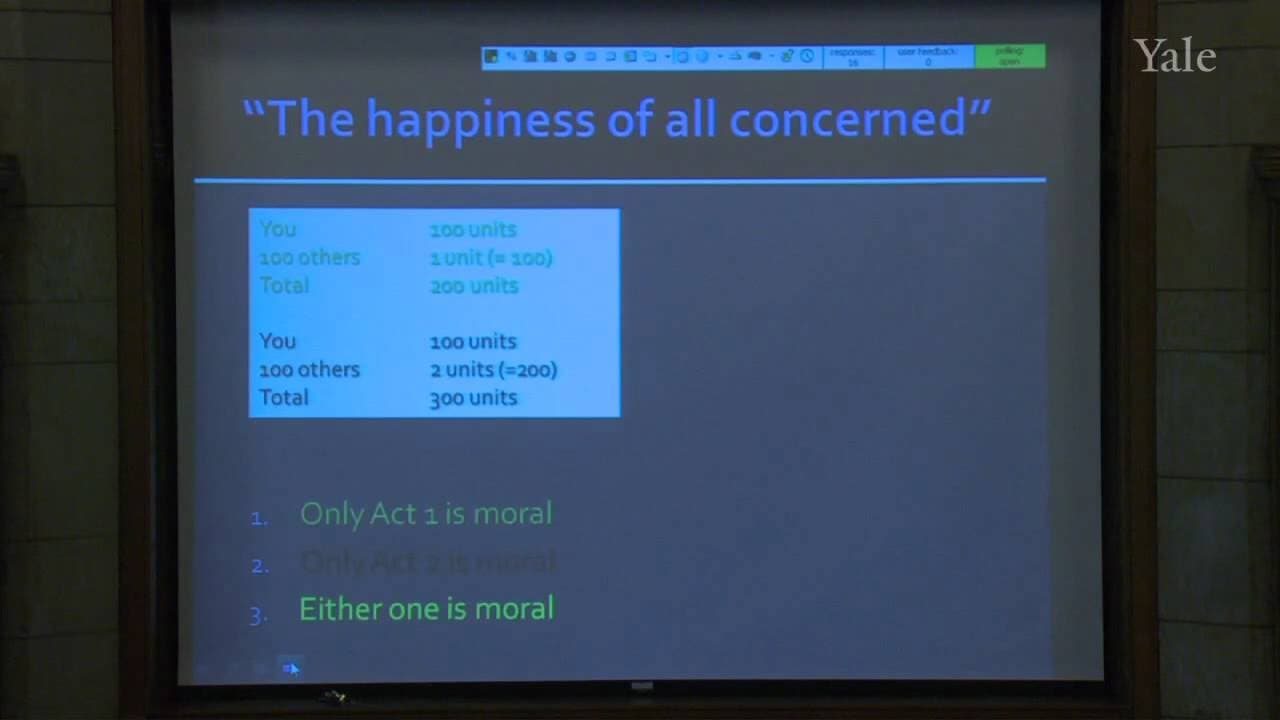
Moral philosophy aims to understand moral concepts and justify moral principles. Utilitarianism, a consequentialist moral theory, states that actions are right if they result in the greatest amount of overall happiness.
Transcript
PROFESSOR: So what I want to do in today's lecture is to shift gears somewhat from what we've been talking about in the first unit of the course. As you know, the first unit of the course was focused on a set of texts that we're concerned with what is involved in human flourishing. And though our opening text, Glaucon's challenge from Plato's Repub... Read More
Key Insights
- 🛄 Moral philosophy aims to provide philosophical accounts of morality by understanding moral concepts and justifying moral principles.
- 🗯️ Utilitarianism is a consequentialist theory that states actions are morally right if they produce the greatest amount of overall happiness.
- 🧑🏭 Moral theories seek to answer questions about moral motivation, moral acceptability, and the distinction between moral and immoral acts.
- 🚂 The motive behind an action does not determine its moral value, according to Mill.
Install to Summarize YouTube Videos and Get Transcripts
Explore YouTube Video Summarizer or Get YouTube Transcript Extractor
Questions & Answers
Q: What is the goal of moral philosophy?
The goal of moral philosophy is to understand moral concepts, justify moral principles, and provide a systematic understanding of morality.
Q: What is the difference between descriptive and normative approaches in moral philosophy?
Descriptive approaches aim to explain how people actually behave, while normative approaches focus on how people ought to behave in order to conform to moral constraints.
Q: What are some justifications for behaving morally based on self-interest?
Self-interest theories suggest that behaving morally can lead to personal benefits such as harmony in the soul, stability in society, enhanced reputation, avoidance of punishment, or internalized notions of conscience.
Q: How do utilitarianism and deontology differ in their approach to moral actions?
Utilitarianism focuses on the consequences of actions, seeking to maximize overall happiness. Deontology, on the other hand, emphasizes the motives behind actions and adhering to moral duties and obligations.
Summary & Key Takeaways
-
The lecture aims to introduce two prominent moral theories in the Western tradition: utilitarianism and deontology.
-
Utilitarianism, a consequentialist theory, states that actions are morally right if they produce the greatest amount of happiness for the greatest number of people.
-
Moral philosophy seeks to answer questions about moral motivation, what actions are morally acceptable or not, and the distinction between moral and immoral acts.
Read in Other Languages (beta)
Share This Summary 📚
Summarize YouTube Videos and Get Video Transcripts with 1-Click
Try YouTube Summary with ChatGPT & Claude or YouTube Transcript Generator
Explore More Summaries from YaleCourses 📚




Summarize YouTube Videos and Get Video Transcripts with 1-Click
Try YouTube Summary with ChatGPT & Claude or YouTube Transcript Generator