How Does Bromination of Benzene Work?
TL;DR
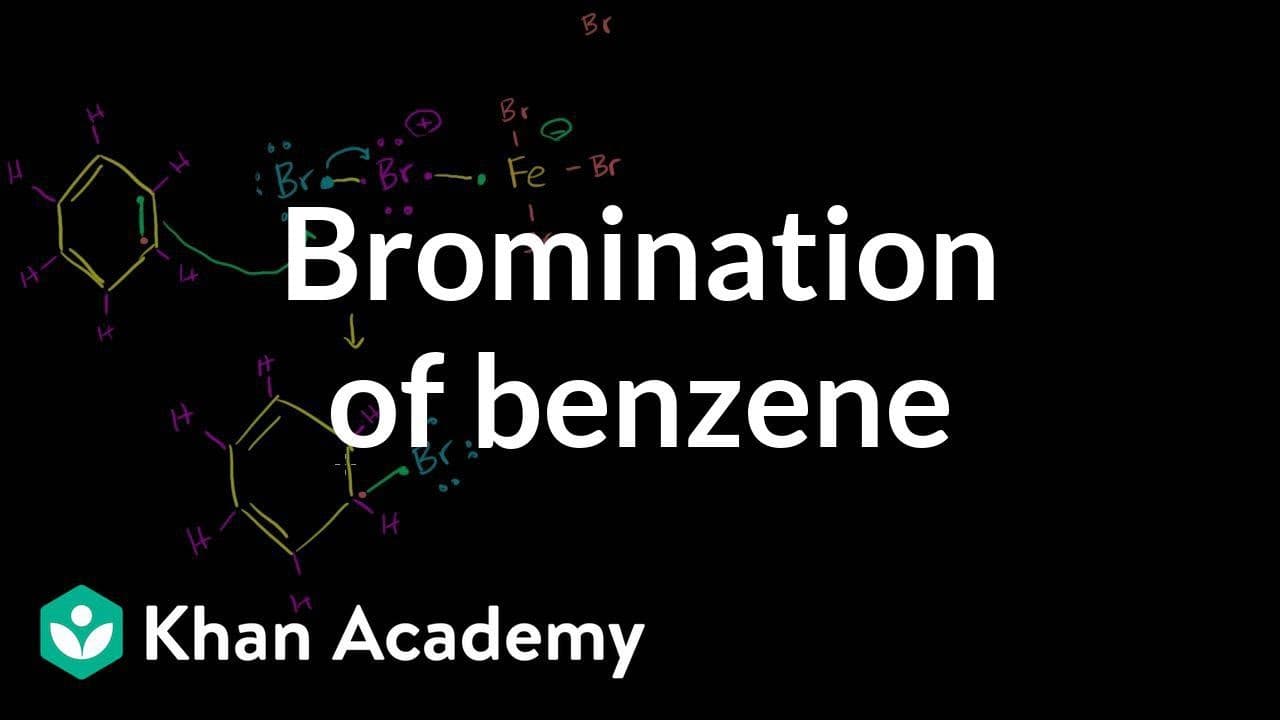
Bromination of benzene involves using iron bromide as a catalyst to facilitate electrophilic aromatic substitution. The process results in a bromine atom replacing a hydrogen atom in the benzene ring, maintaining aromaticity through resonance stabilization of the resulting positive charge on the carbon atom.
Transcript
In the last video I promised you that I would show a concrete example of electrophilic aromatic substitution. So let's do that right here. So let's say we have some benzene. And it's a solution with some molecular bromine. So I'll draw the molecular bromine like this. So it's one bromine right there. It has one, two, three, four, five, six, seven, ... Read More
Key Insights
- 😋 Electrophilic aromatic substitution involves the reaction of an electrophile with the electron-rich benzene ring.
- ♻️ The presence of a catalyst, such as iron bromide, can enhance the reactivity of the electrophile.
- 🫀 The bromination of benzene proceeds through the formation of a positive charge on a carbon atom in the benzene ring, followed by the bonding of a bromine atom.
- 😋 The aromaticity of the benzene ring is maintained through resonance stabilization of the positive charge.
- 🧑🏭 Iron bromide acts as both a Lewis acid and a catalyst in the reaction.
- 🫀 The reaction results in the replacement of a hydrogen atom in benzene with a bromine atom.
- 👊 The reaction occurs under specific conditions and requires the appropriate energy for the electrophilic attack to take place.
Install to Summarize YouTube Videos and Get Transcripts
Explore YouTube Video Summarizer or Get YouTube Transcript Extractor
Questions & Answers
Q: What is the role of iron bromide in the bromination reaction of benzene?
Iron bromide acts as a catalyst, accepting an electron from the bromine molecule to become a Lewis acid. By forming a positive charge on the iron atom, it creates an electrophilic center that can react with benzene.
Q: Why does the bromine atom act as a strong electrophile in this reaction?
The bromine atom gains an electron from the iron bromide, leading to a positive charge on the bromine. Bromine is highly electronegative and readily accepts electrons, making it a strong electrophile that can react with the electron-rich benzene ring.
Q: How is the aromaticity of the benzene ring maintained during the reaction?
The electron that originally bonded with bromine is transferred to one of the carbon atoms in the benzene ring, creating a positive charge. However, due to the delocalized electrons in the benzene ring, the positive charge is stabilized through resonance, maintaining the aromaticity.
Q: Is the iron bromide consumed in the reaction?
No, iron bromide acts as a catalyst and is not consumed during the reaction. It facilitates the reaction by accepting and donating electrons but remains unchanged throughout the process.
Summary & Key Takeaways
-
The video demonstrates how molecular bromine reacts with benzene in the presence of iron bromide as a catalyst.
-
Iron bromide acts as a Lewis acid, accepting an electron from the bromine molecule and forming a positive charge on the iron atom.
-
The bromine molecule then acts as a strong electrophile, breaking the aromaticity of the benzene ring and bonding with one of the carbon atoms.
-
The resulting positive charge on the carbon atom is stabilized through resonance, and the reaction continues until a bromine atom is bonded to the benzene ring.
Read in Other Languages (beta)
Share This Summary 📚
Summarize YouTube Videos and Get Video Transcripts with 1-Click
Try YouTube Summary with ChatGPT & Claude or YouTube Transcript Generator
Explore More Summaries from Khan Academy 📚






Summarize YouTube Videos and Get Video Transcripts with 1-Click
Try YouTube Summary with ChatGPT & Claude or YouTube Transcript Generator