Products
Features
YouTube Video Summarizer
Summarize YouTube videos
Web & PDF Highlighter
Highlight web pages & PDFs
Chat with PDF
Ask any PDF questions with AI
Ask AI Clone
Chat with your highlights & memories
Audio Transcriber
Transcribe audio files to text
Glasp Reader
Read and highlight articles
Kindle Highlight Export
Export your Kindle highlights
Idea Hatch
Hatch ideas from your highlights
Integrations
Obsidian Plugin
Notion Integration
Pocket Integration
Instapaper Integration
Medium Integration
Readwise Integration
Snipd Integration
Hypothesis Integration
Apps & Extensions
Chrome Extension
Safari Extension
Edge Add-ons
Firefox Add-ons
iOS App
Android App
Discover
Discover
Ideas
Discover new ideas and insights
Articles
Curated articles and insights
Books
Book recommendations by great minds
Posts
Essays and notes from readers
Quotes
Inspiring quotes collection
Videos
Curated videos and summaries
Explore Glasp
Glasp Newsletter
Weekly insights and updates
Glasp Talk
Interview series with great minds
Glasp Blog
Latest news and articles
Glasp Use Cases
Learn how others use Glasp
Build & Support
Glasp API
Access Glasp's API for developers
MCP Connector
Connect Glasp to Claude & ChatGPT
Community
Glasp Reddit Community
Students
Student discount and benefits
FAQs
Frequently Asked Questions
AboutPricing
DashboardLog inSign up

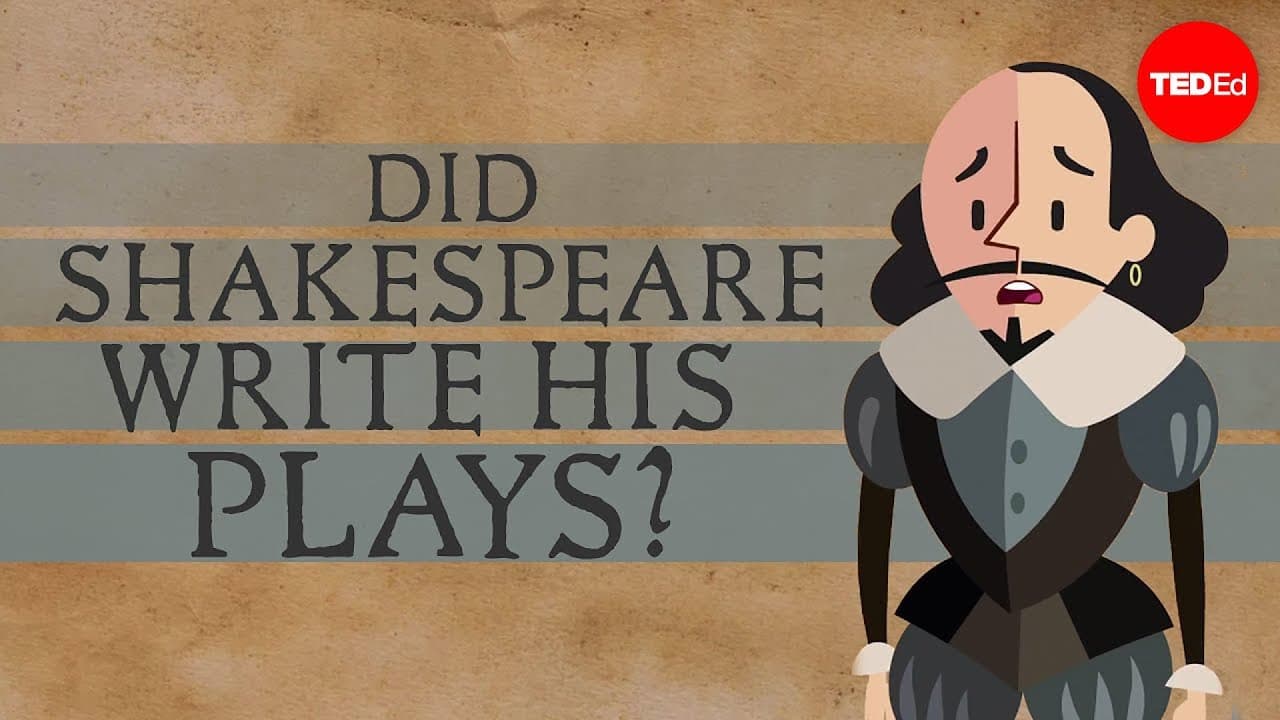
Did Shakespeare write his plays? - Natalya St. Clair and Aaron Williams
998.2K views
•
February 24, 2015
by
TED-Ed
YouTube video player
Did Shakespeare write his plays? - Natalya St. Clair and Aaron Williams

TL;DR

Linguistics and stylometry debunk theories of Shakespeare being a pseudonym, utilizing statistical analysis.

Transcript

"Some are born great, some achieve greatness, and others have greatness thrust upon them", quoth William Shakespeare. Or did he? Some people question whether Shakespeare really wrote the works that bear his name, or whether he even existed at all. They speculate that Shakespeare was a pseudonym for another writer, or a group of writers. Proposed ca... Read More

Key Insights

  • ❓ Shakespeare's identity controversy persists, with various theories suggesting alternate authors.
  • 🔨 Stylometry, a statistical tool, provides evidence confirming Shakespeare as the true author.
  • ❓ Collaborations with other playwrights, like Marlowe, are suggested by stylometry analyses.
  • 💌 Stylometry's broader applications include dating texts, detecting plagiarism, and filtering spam emails.
  • 💦 While stylometry reveals structural aspects of writing, it cannot capture the artistic and emotional essence of Shakespeare's works.
  • 🖐️ Linguistic patterns like syntax and vocabulary play a crucial role in authorship attribution through stylometry.
  • 🔨 The variance in writing styles can be analyzed and compared using statistical tools like Principal Component Analysis.

Install to Summarize YouTube Videos and Get Transcripts

Explore YouTube Video Summarizer or Get YouTube Transcript Extractor

Questions & Answers

Q: Who are some proposed candidates for the real Shakespeare?

Some proposed candidates include other playwrights, politicians, and even prominent women who might have written under the Shakespeare pseudonym.

Q: How does stylometry work?

Stylometry analyzes linguistic patterns such as syntax, grammar, and vocabulary to determine the authorship of a text based on statistical analysis.

Q: What did the results of the stylometry analysis conclude?

The analysis confirmed that Shakespeare is the true author of his works and that his signature style is unique and distinct from other potential candidates.

Q: What are some other applications of stylometry aside from authorship attribution?

Stylometry can help determine the date of a text's creation, identify plagiarism in student papers, unveil forgery in ancient texts, and differentiate between emails of importance or spam.

Summary & Key Takeaways

  • Scholars debate Shakespeare's true identity, proposing various candidates.

  • Stylometry, a statistical analysis based on linguistic patterns, confirms Shakespeare as the author.

  • While stylometry can analyze writing styles, it cannot capture the emotional depth of Shakespeare's works.


Read in Other Languages (beta)

English

Share This Summary 📚

Summarize YouTube Videos and Get Video Transcripts with 1-Click

Download browser extensions on:

Try YouTube Summary with ChatGPT & Claude or YouTube Transcript Generator

Explore More Summaries from TED-Ed 📚
Exponential growth: How folding paper can get you to the Moon thumbnail
Exponential growth: How folding paper can get you to the Moon
TED-Ed
Does time exist? - Andrew Zimmerman Jones thumbnail
Does time exist? - Andrew Zimmerman Jones
TED-Ed
The great conspiracy against Julius Caesar - Kathryn Tempest thumbnail
The great conspiracy against Julius Caesar - Kathryn Tempest
TED-Ed
How does laser eye surgery work? - Dan Reinstein thumbnail
How does laser eye surgery work? - Dan Reinstein
TED-Ed
What makes muscles grow? - Jeffrey Siegel thumbnail
What makes muscles grow? - Jeffrey Siegel
TED-Ed
Can you solve the locker riddle? - Lisa Winer thumbnail
Can you solve the locker riddle? - Lisa Winer
TED-Ed

Summarize YouTube Videos and Get Video Transcripts with 1-Click

Download browser extensions on:

Try YouTube Summary with ChatGPT & Claude or YouTube Transcript Generator

Apps & Extensions

  • Chrome Extension
  • Safari Extension
  • Edge Add-ons
  • Firefox Add-ons
  • iOS App
  • Android App

Key Features

  • YouTube Video Summarizer
  • Web & PDF Summarizer
  • Web & PDF Highlighter
  • Chat with PDF
  • Ask AI Clone
  • Audio Transcriber
  • Glasp Reader
  • Kindle Highlight Export
  • Idea Hatch

Integrations

  • Obsidian Plugin
  • Notion Integration
  • Pocket Integration
  • Instapaper Integration
  • Medium Integration
  • Readwise Integration
  • Snipd Integration
  • Hypothesis Integration

More Features

  • APIs
  • MCP Connector
  • Blog & Post
  • Embed Links
  • Image Highlight
  • Personality Test
  • Quote Shots

Company

  • About us
  • Blog
  • Community
  • FAQs
  • Job Board
  • Newsletter
  • Pricing
Terms

•

Privacy

•

Guidelines

© 2026 Glasp Inc. All rights reserved.