How AI Chips Transform Computing: Andrew Feldman Interview
TL;DR
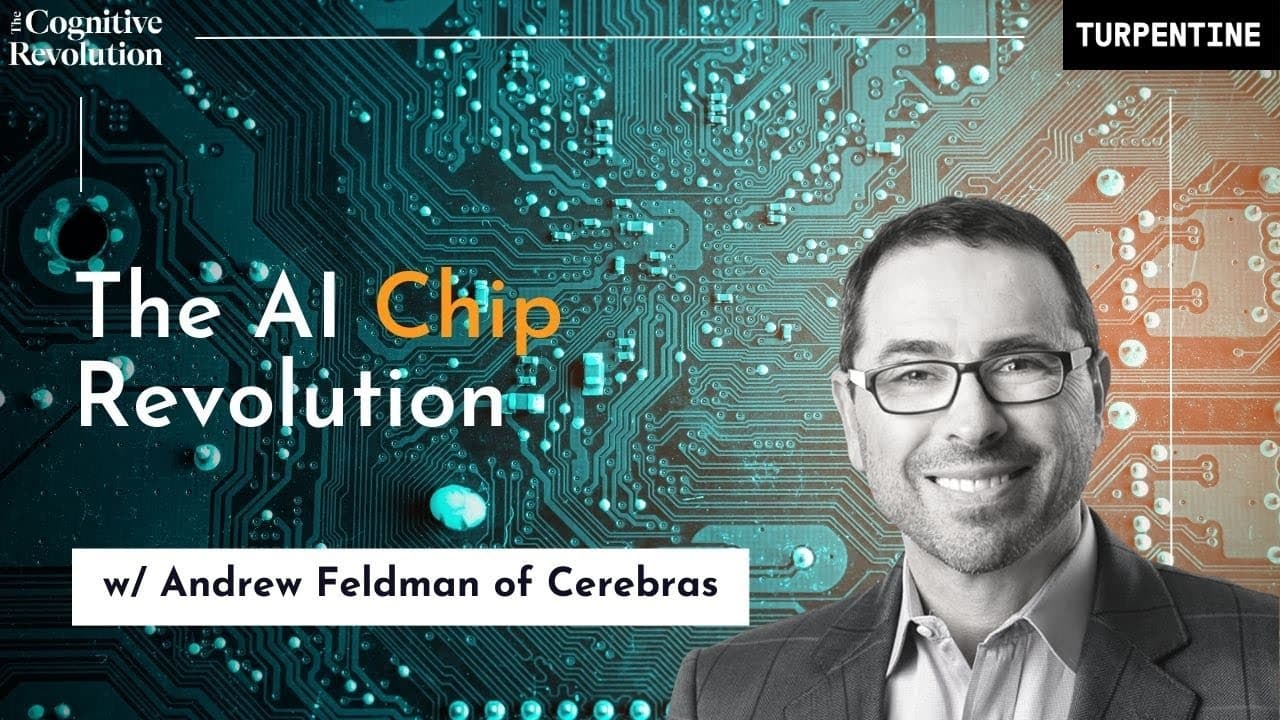
Cerebras Systems, led by Andrew Feldman, has developed the world's largest chip, revolutionizing AI computing by simplifying the process and enhancing efficiency. The chip, designed specifically for AI workloads, offers a significant improvement over traditional GPUs by reducing complexity and increasing speed, which is crucial for advancing AI technology.
Transcript
this wasn't about making money this wasn't about moving the ball forward a little bit we wanted to move an industry forward and we wanted to put our shoulders to it and see if we could transform an industry we tried to see if we could come up with a solution that was creative and that would be substantially better not a little bit not 10 times bett... Read More
Key Insights
- Cerebras Systems created the world's largest chip with 2.5 trillion transistors to optimize AI workloads.
- Traditional GPUs are not specifically designed for AI, leading to complexity in large-scale AI training.
- Cerebras' chip reduces the need for complex software stacks by handling AI tasks more efficiently on a single chip.
- AI workloads require significant compute power due to large models and data, which Cerebras addresses with its chip.
- The chip's design focuses on AI-specific tasks, removing unnecessary elements found in general-purpose GPUs.
- Sparse linear algebra is central to AI computations, and Cerebras' chip is optimized for these tasks.
- Cerebras Systems has built clusters of their chips, forming supercomputers for advanced AI research and applications.
- The AI field continues to grow, with new opportunities and challenges in leveraging large-scale computing for AI advancements.
Install to Summarize YouTube Videos and Get Transcripts
Explore YouTube Video Summarizer or Get YouTube Transcript Extractor
Questions & Answers
Q: How does the Cerebras chip differ from traditional GPUs?
The Cerebras chip is specifically designed for AI workloads, offering a significant improvement over traditional GPUs by reducing complexity and increasing efficiency. Unlike GPUs, which require complex software stacks to manage AI tasks, the Cerebras chip handles these tasks more efficiently on a single chip, streamlining the process and enhancing performance.
Q: What challenges do traditional GPUs face in AI computing?
Traditional GPUs face challenges in AI computing as they are not specifically designed for AI workloads. They require complex software stacks to manage large-scale AI training, leading to inefficiencies. This complexity arises from the need to parallelize computations across multiple GPUs, which can be a significant part of the overall effort in AI projects.
Q: Why is the Cerebras chip considered a breakthrough in AI hardware?
The Cerebras chip is considered a breakthrough in AI hardware because it simplifies the process of AI computing by integrating tasks into a single chip, reducing the need for complex software management. This innovation allows for faster, more efficient AI computations, which is crucial for advancing AI technology and handling the growing demands of large-scale AI models.
Q: What role does sparse linear algebra play in AI computations?
Sparse linear algebra is central to AI computations as it involves operations with matrices that contain many zeros. The Cerebras chip is optimized for these tasks, allowing it to skip unnecessary calculations and focus on meaningful computations, thus enhancing efficiency and performance in AI workloads.
Q: How does the Cerebras chip handle memory differently from GPUs?
The Cerebras chip handles memory differently by keeping activations on-chip and minimizing data movement, which is a significant departure from traditional GPUs. This approach reduces memory bandwidth contention and allows for faster data access, improving the overall efficiency and speed of AI computations.
Q: What is the significance of Cerebras building supercomputers with their chips?
Cerebras building supercomputers with their chips signifies a major advancement in AI research and applications. These supercomputers leverage the efficiency and power of the Cerebras chip to handle complex AI tasks, enabling researchers to train larger models and process more data than previously possible, thus pushing the boundaries of AI technology.
Q: How does the Cerebras chip impact the future of AI development?
The Cerebras chip impacts the future of AI development by providing a powerful, efficient solution for handling the increasing demands of AI workloads. Its ability to simplify and accelerate AI computations enables researchers and developers to explore new possibilities in AI applications, potentially leading to breakthroughs in various fields.
Q: What are the potential applications of the Cerebras chip in industry?
The potential applications of the Cerebras chip in industry include enhancing AI capabilities in sectors like pharmaceuticals, energy, and technology. Its efficiency in handling large-scale AI tasks can lead to advancements in drug discovery, predictive modeling, and other AI-driven innovations, offering significant benefits across various industries.
Summary & Key Takeaways
-
Cerebras Systems, founded by Andrew Feldman, developed the world's largest chip to revolutionize AI computing. The chip is designed specifically for AI workloads, reducing complexity and enhancing efficiency compared to traditional GPUs. This innovation is crucial for advancing AI technology, as it simplifies the process and increases speed.
-
The Cerebras chip addresses the challenges of AI workloads, which require significant compute power due to large models and data. By focusing on AI-specific tasks and removing unnecessary elements found in general-purpose GPUs, the chip offers a significant improvement over traditional methods.
-
Cerebras Systems has built clusters of their chips, creating supercomputers for advanced AI research and applications. This development highlights the growing importance of AI hardware in transforming how AI technology is implemented and utilized across various industries.
Read in Other Languages (beta)
Share This Summary 📚
Summarize YouTube Videos and Get Video Transcripts with 1-Click
Try YouTube Summary with ChatGPT & Claude or YouTube Transcript Generator
Explore More Summaries from Cognitive Revolution "How AI Changes Everything" 📚






Summarize YouTube Videos and Get Video Transcripts with 1-Click
Try YouTube Summary with ChatGPT & Claude or YouTube Transcript Generator