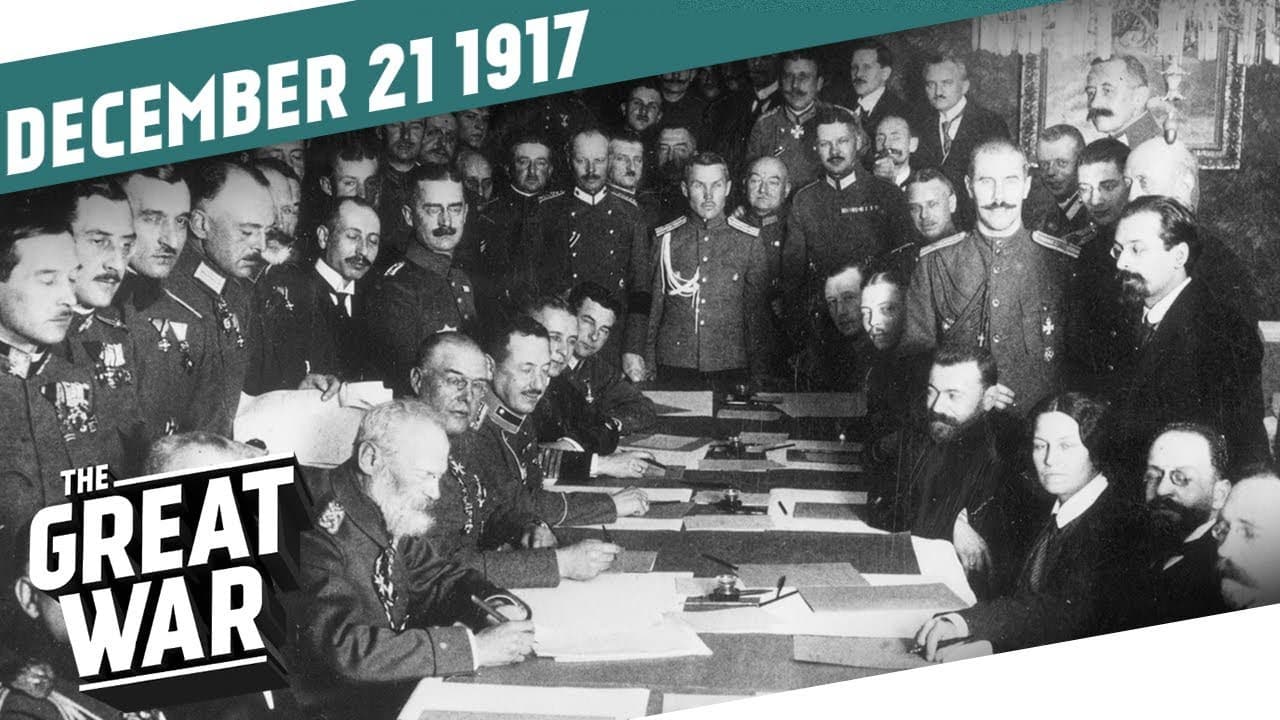
What Happened at the Brest-Litovsk Armistice?
TL;DR
The armistice at Brest-Litovsk marked Russia's attempt to exit World War I, leading to complex negotiations with Germany and Austria-Hungary. Germany aimed for territorial gains and resource acquisition, while Russia, amidst internal turmoil, sought peace to focus on its civil war. Despite differing agendas, an armistice was signed, setting the stage for further peace talks.
Transcript
Russia and the Central Powers were soon going to try to negotiate a peace treaty, officially ending the war for Russia. But the German and Austro-Hungarian delegates may want different things from such a peace, and what happens when they disagree? The German army puts its foot down. I’m Indy Neidell; welcome to the Great War. Last week Jerusalem su... Read More
Key Insights
- The armistice at Brest-Litovsk aimed to end Russia's involvement in World War I.
- Germany sought territorial gains and resources through the treaty.
- Austro-Hungarian and German delegates had differing objectives in the negotiations.
- Lenin and Trotsky prioritized ending the war to focus on Russia's civil war.
- Count Czernin of Austria-Hungary considered a separate peace with Russia.
- British leaders contemplated separate peace deals with Austria-Hungary or the Ottomans.
- The armistice included a clause preventing reinforcement of the Russian front, which Germany violated.
- The armistice was a precursor to the Treaty of Brest-Litovsk, reshaping Eastern Europe.
Install to Summarize YouTube Videos and Get Transcripts
Explore YouTube Video Summarizer or Get YouTube Transcript Extractor
Questions & Answers
Q: How did the Brest-Litovsk armistice affect Russia's role in World War I?
The Brest-Litovsk armistice effectively marked Russia's withdrawal from World War I, allowing the country to redirect its focus towards internal issues, notably the civil war. The agreement temporarily halted hostilities on the Eastern Front, providing the Bolshevik government the opportunity to consolidate power without the burden of foreign conflict.
Q: What were Germany's objectives in the Brest-Litovsk negotiations?
Germany's primary objectives in the Brest-Litovsk negotiations were to secure territorial gains and acquire natural resources to alleviate domestic shortages caused by the British blockade. German military leaders also sought strategic advantages by creating a buffer zone against future conflicts with Russia, emphasizing a 'winners' peace' approach.
Q: Why did Lenin and Trotsky support a peace treaty despite unfavorable terms?
Lenin and Trotsky supported a peace treaty at Brest-Litovsk despite unfavorable terms because they prioritized ending Russia's involvement in World War I to focus on the internal civil war. They recognized that continuing the war would jeopardize their efforts to consolidate Bolshevik power and stabilize the new government amidst domestic upheaval.
Q: What role did Austria-Hungary play in the Brest-Litovsk negotiations?
Austria-Hungary played a complex role in the Brest-Litovsk negotiations, with Count Czernin considering a separate peace with Russia due to perceived German military arrogance. However, internal and external pressures, including the potential threat of German troop withdrawals, ultimately kept Austria-Hungary aligned with Germany during the armistice talks.
Q: How did the Brest-Litovsk armistice impact the Central Powers' strategy?
The Brest-Litovsk armistice allowed the Central Powers, particularly Germany, to redirect military resources from the Eastern Front to the Western Front. This strategic shift aimed to strengthen their position against the Allies, although it also highlighted internal divisions as Austria-Hungary and Germany pursued different diplomatic and military objectives.
Q: What were the consequences of Germany violating the armistice terms?
Germany's violation of the Brest-Litovsk armistice terms, such as reinforcing the Western Front with troops from the Eastern Front, undermined the agreement's integrity and exacerbated tensions with Russia. These actions foreshadowed the contentious nature of subsequent peace negotiations and highlighted the fragility of wartime agreements among the Central Powers.
Q: How did the Brest-Litovsk armistice influence the Russian Civil War?
The Brest-Litovsk armistice significantly influenced the Russian Civil War by allowing the Bolshevik government to concentrate its efforts on internal conflicts without the distraction of World War I. This strategic withdrawal enabled Lenin and Trotsky to allocate resources and military focus towards defeating anti-Bolshevik forces and consolidating their control over Russia.
Q: What were the broader implications of the Brest-Litovsk armistice for World War I?
The broader implications of the Brest-Litovsk armistice for World War I included a shift in the balance of power as the Central Powers could refocus efforts on the Western Front. It also marked the beginning of significant territorial and political changes in Eastern Europe, setting the stage for the Treaty of Brest-Litovsk and reshaping post-war geopolitics.
Summary & Key Takeaways
-
The Brest-Litovsk armistice was a pivotal moment in World War I, as Russia sought to exit the conflict. Germany aimed to secure territorial and resource advantages, while Austria-Hungary considered separate peace options. Despite these tensions, an armistice was signed, allowing Russia to focus on its burgeoning civil war.
-
Negotiations at Brest-Litovsk revealed deep divisions among the Central Powers, with Germany pushing for a 'winners' peace' and Austria-Hungary exploring independent peace treaties. The armistice, effective from December 12th to January 14th, was a temporary measure leading to significant political realignments.
-
The armistice's terms, such as troop withdrawals and non-reinforcement clauses, were breached by Germany, highlighting the fragile nature of the agreement. This period marked a critical transition for Russia, shifting from international conflict to internal strife, as the Bolsheviks prioritized consolidating power.
Read in Other Languages (beta)
Share This Summary 📚
Summarize YouTube Videos and Get Video Transcripts with 1-Click
Try YouTube Summary with ChatGPT & Claude or YouTube Transcript Generator
Explore More Summaries from The Great War 📚
Summarize YouTube Videos and Get Video Transcripts with 1-Click
Try YouTube Summary with ChatGPT & Claude or YouTube Transcript Generator