What Are the Limitations of the Big Bang Theory?
TL;DR
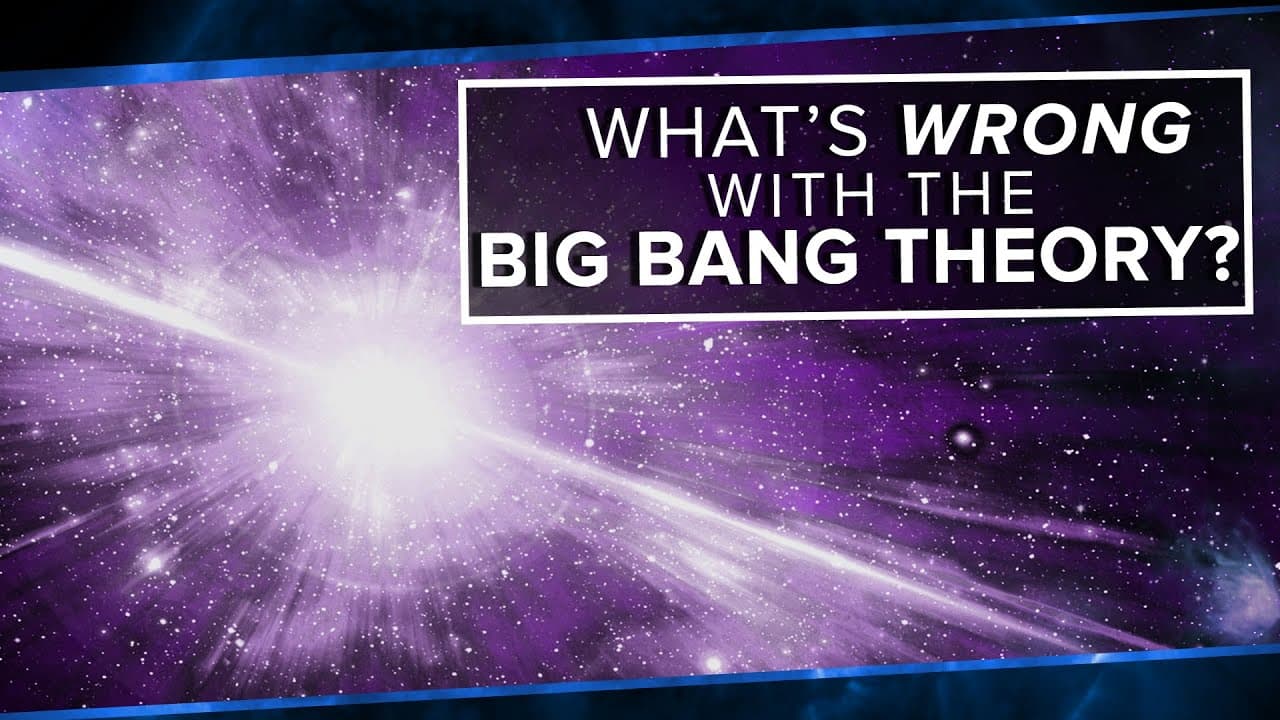
The Big Bang Theory successfully describes the universe's expansion from a hot, dense state but has limitations regarding its origin and early conditions. Key challenges include the horizon problem, which questions why distant parts of the universe have the same temperature, and the need for theories of quantum gravity to reconcile discrepancies between general relativity and quantum mechanics.
Transcript
[MUSIC PLAYING] When we look out at distant galaxies, we see that they are all racing away from us. We see that the universe is expanding. The Big Bang Theory suggests that once the entire universe was compacted into an infinitely small speck at the beginning of time. But was this really the case? What parts of this theory are still under serious q... Read More
Key Insights
- The Big Bang Theory suggests the universe was once compacted into an infinitely small speck, but this is still debated.
- Direct evidence supports the universe was smaller, hotter, and denser in the past, up to 10^-32 seconds after the Big Bang.
- At high temperatures, fundamental forces like the weak and electromagnetic forces merge, as seen in the electroweak era.
- Theories beyond the electroweak era, like grand unified theories, are speculative due to current technological limitations.
- The horizon problem questions why distant parts of the universe have similar temperatures, solved by the inflation theory.
- Inflation suggests the universe expanded exponentially fast, solving multiple Big Bang Theory issues despite lacking direct evidence.
- The Big Bang Theory doesn't describe the universe's origin but its expansion from a subatomic to cosmic size.
- Theories like quantum gravity are needed to reconcile general relativity with quantum mechanics at the universe's smallest scales.
Install to Summarize YouTube Videos and Get Transcripts
Explore YouTube Video Summarizer or Get YouTube Transcript Extractor
Questions & Answers
Q: Why doesn't matter stretch with the universe's expansion?
Matter doesn't stretch with the universe's expansion because the forces binding atoms are vastly stronger than the expansion's effect. The expansion is described by the Friedmann-Lemaître-Robertson-Walker metric, which applies on large scales, unlike regions like galaxies where local gravitational forces dominate.
Q: Can all particles in the universe fit into a grain of sand?
All particles in the observable universe once fit into a space smaller than a grain of sand. However, this applies only to the observable universe, not the entire universe, which could be infinite. The observable universe's size was once compacted into this tiny volume during the Big Bang.
Q: Did the universe start from nothing?
The statement that the universe started from nothing, which exploded, is a misconception. The Big Bang Theory describes events following the universe's existence in a hot, dense state. It doesn't claim to explain the universe's origin, focusing instead on describing its subsequent expansion.
Q: What is the horizon problem in cosmology?
The horizon problem arises from the uniform temperature of the cosmic microwave background (CMB) despite insufficient time for distant regions to exchange energy. Inflation theory resolves this by proposing rapid early universe expansion, allowing previously connected regions to become causally disconnected yet uniform in temperature.
Q: What is the electroweak era?
The electroweak era is a period shortly after the Big Bang when the electromagnetic and weak nuclear forces were unified due to high temperatures. This state, predicted by particle physics, can be recreated in particle accelerators like the Large Hadron Collider, supporting the theory's validity up to that point.
Q: What are grand unified theories?
Grand unified theories attempt to merge the electroweak force with the strong nuclear force into a single force. These theories remain speculative as they require energies beyond current technological capabilities to test. They aim to extend our understanding of fundamental forces beyond the electroweak era.
Q: Why is inflation theory important?
Inflation theory is crucial because it resolves several Big Bang Theory issues, such as the horizon problem. It proposes a rapid early universe expansion, explaining the uniformity of the cosmic microwave background. Despite lacking direct evidence, inflation is widely accepted due to its explanatory power.
Q: What challenges exist in unifying general relativity and quantum mechanics?
General relativity and quantum mechanics conflict at the universe's smallest scales, like the Planck length. A theory of quantum gravity is needed to reconcile them, potentially leading to a 'theory of everything.' This unification is crucial for understanding the universe's earliest moments and its fundamental nature.
Summary & Key Takeaways
-
The Big Bang Theory posits the universe was once an infinitely small speck, but this is still debated. Key evidence supports a smaller, hotter, denser universe up to 10^-32 seconds post-Big Bang. Beyond this, theories like grand unified theories remain speculative due to technological constraints.
-
The horizon problem questions why distant universe parts have similar temperatures. Inflation theory suggests rapid early expansion, solving this and other Big Bang Theory issues despite lacking direct evidence. The Big Bang Theory describes universe expansion, not origin, requiring further theories like quantum gravity.
-
Fundamental forces like weak and electromagnetic merge at high temperatures, as seen in the electroweak era. Beyond this, theories like grand unified theories remain speculative. Theories like quantum gravity are needed to reconcile general relativity with quantum mechanics at the universe's smallest scales.
Read in Other Languages (beta)
Share This Summary 📚
Summarize YouTube Videos and Get Video Transcripts with 1-Click
Try YouTube Summary with ChatGPT & Claude or YouTube Transcript Generator
Explore More Summaries from PBS Space Time 📚
Summarize YouTube Videos and Get Video Transcripts with 1-Click
Try YouTube Summary with ChatGPT & Claude or YouTube Transcript Generator