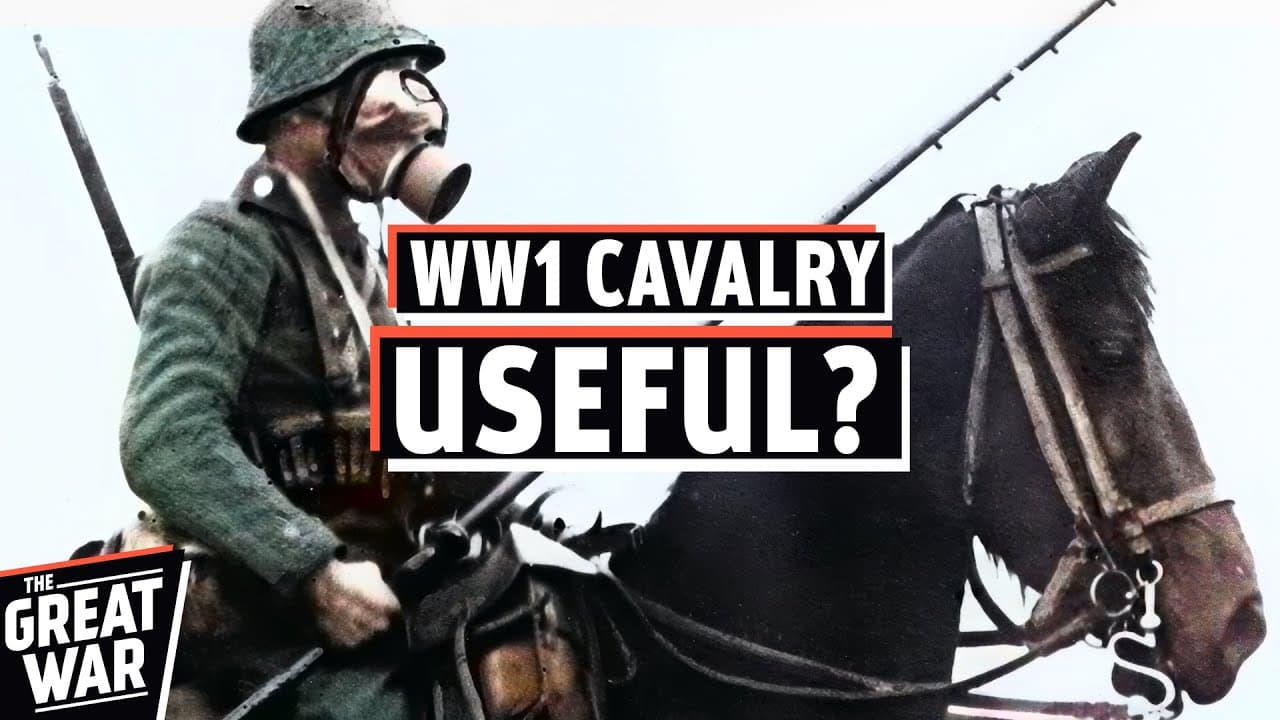
Was Cavalry Useless in the First World War?
TL;DR
Cavalry remained effective and strategic in World War I.
Transcript
By the end of the First World War, warfare had been changed forever by tanks, modern artillery, rifles, machine guns, airplanes, poison gas, and all the other novel methods of killing. Common wisdom says cavalry was useless in this new modern war. But was that really the case? Let’s find out. The cavalry is one of the oldest arms in history and... Read More
Key Insights
- Cavalry adapted to modern warfare by incorporating new technologies like machine guns and artillery, maintaining its relevance in WWI.
- French cavalry faced initial challenges due to poor horsemastership but improved significantly by learning from British practices.
- Successful cavalry charges, such as the French at Soissons, demonstrated that speed and surprise could overcome modern defenses.
- In the Middle East, British Empire cavalry was strategically decisive, particularly in the campaign against the Ottomans.
- Australian Light Horse's charge at Beersheba exemplified effective cavalry tactics against entrenched positions, leading to significant victories.
- German cavalry played a crucial role in Eastern Europe, utilizing mobility to disrupt enemy logistics and pursue retreating forces.
- Russian cavalry, despite vulnerabilities to modern firepower, effectively combined mounted and dismounted tactics for reconnaissance and rear-guard actions.
- Cavalry's strategic and tactical roles were complementary to mechanized units, highlighting its continued importance despite evolving warfare technologies.
Install to Summarize YouTube Videos and Get Transcripts
Explore YouTube Video Summarizer or Get YouTube Transcript Extractor
Questions & Answers
Q: How did cavalry adapt to the technological advancements of WWI?
Cavalry adapted by incorporating modern weaponry such as machine guns and artillery. They altered tactics to include skirmishing in spread-out formations to minimize exposure to enemy fire. The integration of these new technologies allowed cavalry to maintain a significant role on the battlefield despite the advent of more advanced warfare methods.
Q: What challenges did the French cavalry face at the start of WWI?
The French cavalry struggled with horsemastership, leading to poor care of their horses, which resulted in many animal casualties. Their doctrine emphasized prolonged mounted operations without sufficient rest or watering for horses, causing exhaustion and death. These issues were addressed by adopting British practices, improving their effectiveness as the war progressed.
Q: What was the significance of the cavalry charge at the Battle of Soissons?
The cavalry charge at Soissons was significant because it demonstrated that, under the right conditions, cavalry could still achieve success against modern defenses. The French cavalry used speed and surprise to overcome German positions, capturing them without losing a single man. This charge showed that cavalry tactics could still be effective on the Western Front.
Q: How did British Empire cavalry impact the Middle East campaign?
British Empire cavalry was strategically decisive in the Middle East, particularly against the Ottomans. They played a crucial role in the campaign from Egypt through Palestine into Syria. Their mobility and tactical flexibility enabled them to exploit breakthroughs, conduct successful charges, and contribute significantly to the Allied victory in the region.
Q: What was the outcome of the Australian Light Horse charge at Beersheba?
The Australian Light Horse charge at Beersheba was overwhelmingly successful. It demonstrated the effectiveness of cavalry tactics against entrenched Ottoman positions. The charge resulted in the capture of Beersheba, a crucial victory that opened the way for further advances in the Middle East campaign. This success led to calls for the Light Horse to be equipped with swords and converted to regular cavalry.
Q: How did German cavalry contribute to the campaign in Eastern Europe?
German cavalry played a vital role in Eastern Europe by utilizing their mobility to pursue retreating enemy forces and disrupt logistics. They conducted harassing attacks, such as destroying railways, which hindered Romanian movements and contributed to the Central Powers' advances. Their actions maintained the operational tempo and kept the enemy off balance, aiding in the overall success of the campaign.
Q: What tactics did Russian cavalry use during WWI?
Russian cavalry employed both mounted and dismounted tactics, often working in tandem with artillery. They conducted reconnaissance, charges, rear-guard actions, and ambushes. Despite being vulnerable to modern firepower, Russian cavalry adapted by using supporting arms and strategic positioning, demonstrating their versatility and importance on the fluid Eastern Front.
Q: Why was cavalry still important in WWI despite the rise of mechanized units?
Cavalry remained important due to its speed and flexibility, which were crucial for exploiting breakthroughs and conducting reconnaissance. While mechanized units like tanks could break through defenses, they lacked the speed for rapid exploitation. Cavalry complemented these units by providing mobility and strategic depth, maintaining their relevance until mechanization became more widespread post-war.
Summary & Key Takeaways
-
Cavalry in WWI adapted to new technologies and tactics, maintaining its relevance and effectiveness on various fronts. The French improved their cavalry's performance by learning from British horsemastership, while successful charges demonstrated its continued tactical value.
-
In the Middle East, British Empire cavalry played a decisive role against the Ottomans, with the Australian Light Horse's charge at Beersheba exemplifying effective cavalry tactics. German cavalry also contributed significantly in Eastern Europe through mobility and disruption.
-
Russian cavalry combined mounted and dismounted tactics for reconnaissance and rear-guard actions, proving effective despite vulnerabilities. Overall, cavalry complemented mechanized units and remained strategically important in WWI, challenging the misconception of its obsolescence.
Read in Other Languages (beta)
Share This Summary 📚
Summarize YouTube Videos and Get Video Transcripts with 1-Click
Try YouTube Summary with ChatGPT & Claude or YouTube Transcript Generator
Explore More Summaries from The Great War 📚
Summarize YouTube Videos and Get Video Transcripts with 1-Click
Try YouTube Summary with ChatGPT & Claude or YouTube Transcript Generator